


 Francais
 Deutsch
 Italiano

Refine Your Search
Binh Thuy Vietnam 1969 stock footage and images
- Showing 73 to 78 of 4374 results more
 Hide
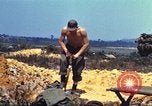
U.S. 3rd Brigade, 82nd Airborne Division soldier digs in during base operations in Phu Bai, Vietnam.
U.S. 3rd Brigade, 82nd Airborne Division base camp operations in Phu Bai near Hue, Vietnam, during the Vietnam War. Soldier digs with a shovel. Soldier uses pickaxe. He drinks from canteen cup and douses his head with water. (This camp was later named Camp Eagle in March 1969).
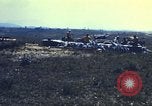
U.S. 3rd Brigade, 82nd Airborne Division soldiers clean 106 mm Recoiless Rifle during base operations in Phu Bai, Vietnam.
U.S. 3rd Brigade, 82nd Airborne Division base camp operations during Vietnam War in Phu Bai near Hue, Vietnam. View of camp area. Soldiers clean 106 mm RR (Recoiless Rifle) in sandbagged position. (This camp was later named Camp Eagle in March 1969).
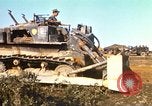
Soldier operates bulldozer at camp during base operations of U.S. 3rd Brigade, 82nd Airborne Division in Phu Bai, Vietnam.
U.S. 3rd Brigade, 82nd Airborne Division base camp operations in Phu Bai near Hue, Vietnam. Bulldozer levels ground at the base camp. Soldier operates bulldozer. Earth being pushed by bulldozer. Soldier wearing spectacles looks on. (Vietnam War period. This camp was later named Camp Eagle in March 1969).

U.S. President Richard Nixon addresses people in the United States on withdrawal of remaining U.S. troops from Vietnam.
Television broadcast of U.S. President Richard Nixon's speech from the White House in Washington DC, United States on the withdrawal of remaining U.S. troops from Vietnam on 29th March 1973 during the Vietnam War. The White House. The Seal of the President of the United States. The President talks about that period of the Vietnam War when he joined the office and speaks about the program he initiated to end the war. He says American prisoners are on their way from Vietnam and people of South Vietnam are now free to choose their government. He says North Vietnam is not complying with few provisions of the Peace Agreement. He says that they should honor all those American soldiers who died during the Vietnam War. He refers to the difficult days of the war including the moratorium to end the war which was organized on October 15, 1969 when millions of Americans took day off from work and schools to participate in local demonstrations against the war. Nixon refers to the period of April 1971 when he ordered attacks on Communist bases in Cambodia. He talks about the period of May 1972 when he ordered air strikes in North Vietnam and the period of December 1972 when he ordered more air strikes.
Arrival of Vietnamese refugee family in the United States soon after the fall of Saigon.
Vietnamese refugees arriving in the United States near the end of the Vietnam War, after the fall of Saigon. Tents in the background at the Vietnamese Refugee Processing Center of Eglin Air Force Base, outside Valparaiso, Florida. A sign board near a tent reads 'Airline ticket office'. An officer talks to a refugee family. The family consists of an older man, Mr. Ky Ly, who is present with his son and his son's family. His son is Mr. Thuyen Ly, a Vietnamese C-130 aircraft Commander with the 435th Squadron at Tan Son Nhut airbase. Also seen are Mr. Ly's wife, Mrs. Bich-Thuy Nguyen, and their two children, 5 year old Quyen Ly and 3 year old Vuong-Kha Ly. The Ly family speaks with a U.S. Air Force officer. Tents in the area. The Ly family seen walking in the tent complex. They enter a tent. The older Mr. Ly removes his glasses and a man takes his photograph for an identification card. Mr. Thuyen Ly sits for a photograph. A man takes his photograph. At a finger printing station, a man takes thumb impressions of Vietnamese refugees arriving in the United States.
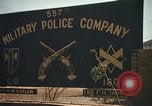
U.S. Military police (557th company) guards highway in Long Binh,Vietnam.
557th Millitary police company guards a highway. Traffic consisting of two,three and four wheelers move on the highway. A policeman and a police jeep is on the side of the highway. He stops a truck loaded with drums and pulls it to the side of the road. He checks ID papers of the driver and allows him to leave.