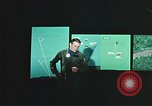
United States Air Force Lieutenant Colonel talks about AC-130 aircraft in the Pave Pronto configuration. Views inside an AC-130 during combat operations over Vietnam. The Fire Control Officer and Pilot viewing screens inside AC-130. The computer correction capabilities are discussed by narrator. Fire control officer clicks miss-distance. The computer computes proper elevation correction for the next shot to be accurate. The co-pilot monitors air speed and altitude. He also coordinates with the gunship fighter escorts. The navigator is in contact with the air borne command force. The fire control officer is responsible for pin pointing corrections and advising the pilot. The flight engineer coordinates with the gunner through intercom and arms the gun. The gunner fires on the target. (Vietnam War period).
UH-1D helicopter arrives at landing zone of U.S. Fire Support Base Nancy in Vietnam. It lands in the fenced area. United States Army soldiers board the helicopters. Wire fence is seen. UH-1D takes off. Some soldiers still wait for pickup. (Vietnam War period).
Vietnamese government faces Vietnam war on two fronts from Buddhist majority and Viet Cong communists. The war is joined by a large number of students who take to the streets. The capital Saigon tuned into an armed camp. Barricades on roads as the army keeps a vigil among the public. A military tank in the city. A mass meeting called by President Diem's regime on the roads of Saigon. Numerous students and supporters gathered in the streets. Banners and posters in support of President Diem. The President makes a rare and brief appearance at the meeting. He inspects the Honor Guard. Madam Nhu and her husband, head of the secret police seen standing with children. Madam Nhu gives marathon interviews stating her views against the United States and President John F Kennedy. Ton That Dinh, Military Governer of Saigon at a press conference blaming foreign interventionists for the riots in Vietnam. Henry Cabot Lodge takes over as U.S. Ambassador to Vietnam. Ambassador gives a statement to the media. He demands the ousting of President Diem's brother Nhu in order to continue American aid to Vietnam. U.S. soldiers known as advisors stand beside a U.S. Army helicopter as they plan their strategy. U.S. Army helicopters in a marshy swamp. Soldiers board the helicopters as they take off. The helicopters with U.S. and South Vietnam troops approach the Ca Mau Peninsula. A view of the village taken over by the Viet Cong Red Guerilla Band. Damaged houses near the water body. A helicopter down in a rice paddy. U.S. soldiers run to the safety of other helicopters as Communist Vietcong snipers begin shooting. U.S. soldiers take cover behind the crashed helicopter. An American soldier running to safety in the water. A village set on fire by North Vietnamese Communists in the Mekong Delta. View of wiped out villages.
United States planes and soldiers are rushed to Vietnam, responding to the Gulf of Tonkin crisis. U.S. Destroyer Maddox seen underway in the gulf of North Vietnam following reported skirmish with North Vietnamese torpedo boats (the "Maddox Incident.") Narrator indicates U.S. war planes from two carriers avenged the unwarranted Red communist assault with 64 sorties against North Vietnam. An airman boards a U.S. aircraft. Night view of the White House in Washington DC. President Lyndon Johnson addresses the American people in a midnight speech on August 4, 1964 describing U.S. actions in response to the Gulf of Tonkin incident. Scenes of South Vietnamese women and children evacuees looking exhausted and scared beside nearby American helicopters. The President's speech continues, including, "We Americans know, although others appear to forget, the risks of spreading conflict. We still seek no wider war." View of the United Nations building in New York and flags of various nations at the UN building. Ambassador Adlai Stevenson is seen making his report of the Gulf of Tonkin attacks to the UN Security Council and affirms U.S. position that it wants the people in Vietnam to be free of North Vietnamese intervention and agression. United States military advisors and U.S. Army soldiers board helicopters. A gunner aims at a target on the ground. Vietnamese troops accompany U.S. soldiers. South Vietnamese forces exit a helicopter and wade through water and rice paddies. U.S. soldiers advance in trucks with artillery. A Douglas TBD Devastator aircraft takes off armed with a torpedo. Another one lands at an airfield. A TBD plane, armed with a torpedo, taxis with wings folded. several TBD aircraft parked on a flight line. The President concludes his remarks referring to "firmness in the right" being indispensible for peace. (Vietnam War period).
United States 1st Cavalry Division soldiers during phase II of Operation Mosby in Vietnam during the Vietnam War. Soldiers of United States 1st Cavalry division walk towards United States Army UH-1D helicopter on a field in Vietnam during the Vietnam War. Soldiers board the helicopter at Ankhe, Vietnam. African American soldier stands beside the helicopter. Closeup view of a soldier inside the helicopter and then it lifts off. Pilot at controls of an airborne UH-1D helicopter.
President of the United States Lyndon Baines Johnson visits Cam Ranh Bay Air Base in Vietnam during the Vietnam War. American General William C. Westmoreland and President Lyndon Baines Johnson mount a trailer platform. William C. Westmoreland at a podium. President Lyndon Baines Johnson speaks and pins Distinguished Service Medals on to officers for their services. William C. Westmoreland, General William Wallace Momyer, U.S. ambassador to South Vietnam Ellsworth Bunker, Deputy Commander of Military Assistance Command in Vietnam Creighton Williams Abrams Jr, Vice President of South Vietnam Nguyen Cao Ky present at the platform. President Lyndon Baines Johnson shakes hands with Nguyen Cao Ky. He talks to Ellsworth Bunker and William C. Westmoreland. President boards a United States Air Force aircraft VC-137B.