


 Francais
 Deutsch
 Italiano
Refine Your Search
Bizerte Tunisia 1943 stock footage and images
- Showing 85 to 90 of 3126 results more
more Hide
Hide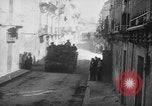
Allies, including U.S. Fifth Army, encounter heavy enemy resistance in amphibious assault at Salerno, Italy, in World War 2
Allied invasion at Salerno, Italy, during 2nd World War. Scenes of U.S. Sherman tanks, military vehicles and troops, moving easily through Sicily. Animated map depicts allied invasion routes from Bizerte, North Africa, to two points on opposite sides of Italy mainland. Convoys emerge from smoke screens in bay of Salerno, Italy. Allied warship creating heavy black smoke screen. Decks of LSTs crammed with trooops and vehicles. Allied warships bombard Salerno coastline. Commandos, Rangers and Seabees, in first assault wave are targets of German guns and dive bombers. Pontoon boat dropped from LST, with 35 Seabees aboard, strikes a mine, and is destroyed, setting off conflagration on the LST. Other LSTs (Landing Ship Tank) discharging vehicles to the beach over floating causeways, under enemy fire. Destroyed U.S. Sherman tanks, vehicles and a U.S. P-40 aircraft , litter the beach. A Seabee uses semaphore flags to direct an LST to beach area. Seabees build shelters for war materiel and dressing stations where allied wounded are treated. Seabees continue to unload supplies to beachhead. Brief view of Lieutenant General Mark Clark, 5th Army commander, on the beachhead. Allied casualties being tended. Stretcher bearers carry wounded. Allied troops advancing on roads in Italy. Admiral Moreell, chief of the U.S. Navy's Bureau of Yards and Docks, concludes narration of the Seabee documentary, from his office in Washington, DC
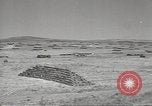
Mechanics work on U.S. Army Air Forces B-25 Mitchell bomber parked inside a wrecked hanger in North Africa.
Mechanics work on USAAF (United States Army Air Forces) planes parked in a hangar in North Africa during World War II. Large gas and oil dump in North Africa. U.S. army trucks pass on highway to Bizerte. Semi-truck and trailer carry wrecked USAAF (United States Army Air Forces) P-38 Lightening fighter aircraft. Interiors of a bomb wrecked hangar. Two mechanics walk to steel work rack at tail of B-25 Mitchell bomber, lift machine gun, and climb up to work platform. They install machine gun on B-25 tail. Large hole in hangar ceiling. Mechanic inside the tail adjusts pivot on the gun of B-25. Mechanic climbs on work rack and works on tail of B-25. Several gliders parked outside bomb wrecked hangar. Crew members clean glider nose.
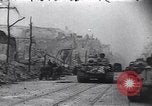
Contrasting views of Berlin, Germany from 1945 to 1943, to 1945 again, during World War II
Soviet Forces battling in Berlin during 1945, in World War 2, employ tanks and heavy machine guns. A Soviet soldier herds two German prisoners from a building. Groups of German soldier prisoners struggle through rubble as they are led from buildings, under guard. Soviet tanks firing as they pass a church building. A Soviet heavy gun being fired point blank on a Berlin street during Battle of Berlin. Buildings on fire. Soviet soldiers firing artillery field pieces. Views of destroyed and damaged German military aircraft on and in hangars of an airfield. Soviet Ilyushin II aircraft land on the airfield. Closeup of distressed German General rubbing his eyes. Flashback in time to 1943, in World War II. Field Marshal Hermann Goering is seen reviewing flyers of a German Luftwaffe (Air Force) unit. A Junkers Ju 52 trimotor aircraft lands and parks on an airfield. Italian leader Benito Mussolini steps from the aircraft after his rescue from imprisonment by the Italian Government at the Hotel Campo Imperatore. He is personally welcomed by Adolf Hitler, who had ordered the mission to rescue him. Change of time, again, to 1945, when Berlin, Germany is attacked by Forces of the Soviet Union. Closeup of a despairing German General. Scenes of utter destruction as Soviet troops batter Berlin, Germany with artillery. Soviet soldier steps down from his tank and gives a Soviet General a handgun, which he pockets and then leads a group of Soviet officers into a building
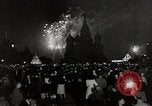
Fireworks in Red Square. Tehran, Iran, conference in 1943. Potsdam conference, 1945.
A crowd enjoys fireworks in Red Square, Moscow, Soviet Union, at night. Past events show Soviet Premier Joseph Stalin, U.S. President Franklin D. Roosevelt and Prime Minister Winston Churchill of the United Kingdom in Tehran, Iran for the Tehran Conference of 1943. U.S. President Harry S. Truman in Germany during the Potsdam Conference of 1945. The Grand Kremlin Palace in Moscow, Soviet Union. Soviet people along a street in Moscow. Foreign Minister of the Soviet Union, Vyacheslav Molotov with others applauding at the Bolshoi theater, in Moscow. Anti-soviet disorders. Street cars being overturned. (Hungary?).
Scenes cursorily illustrating the development of airplanes from 1908 to 1943, from a German perspective.
German slates refer to the dream of "Northern" people to fly, fulfilled by aircraft development. Scenes from Paris airshow in 1908, when it was a feature of the automobile show that year. Hangars bear names of aircraft companies: Bleriot; Vetze and others, with historic vintage airplanes of the period parked on the grass in front of each. A man plays with a dog in the grass. Spectators are seated in stands set up in the background. Scene shifts to 1935, where a long row of German aircraft are shown parked with engines running. Then it shifts to 1943, during World War 2, with a long line of German Messerschmitt aircraft parked with engines running. An animated map shows air lines of communication emanating from center of Germany and extending throughout Europe. Huge formations of German warplanes are seen in flight.

Jews reading from Torah in Jerusalem; Islamic principles of design from mosques in Jerusalem, India, and Tunisia.
Slate notes Muhammad's respect for ideas of Christians and Jews. Jews are seen reading from the Torah and in prayer. A Jewish Rabbi leads a prayer. View of Dome of the Rock at Temple Mount, Jerusalem. Other Muslim mosques: the Moti Masjid (Pearl Mosque, M64V+P7J, Lal Qila, Old Delhi, New Delhi, Delhi 110006, India), seen from the Diwan-e-Khas or Red Fort of Delhi, India. in the Lahore Fort or Shahi Qila (H8Q7+56P, Fort Rd, Walled City of Lahore, Lahore, Punjab, Pakistan), Punjab, British India. View of the courtyard of the Grand Mosque of Kairouan (M4J3+GMR, Rue de La Kasbah, Kairouan, Tunisia) in Tunis, Tunisia. Slate states that Islamic decoration is confined to Arabic script and geometric or floral designs. Architecture of a mosque shows columns, pillars, and arches at the side of a courtyard. As previously noted, the columns and the roof of the mosque are decorated only with Arabic script, floral and geometric designs. A decorative grill in a mosque.