


 Francais
 Deutsch
 Italiano

Refine Your Search
Bizerte Tunisia 1943 stock footage and images
- Showing 1465 to 1470 of 3126 results more
 Hide
Japanese people contribute money and material useful for war purpose in Japan during World War II.
Japanese people work to help soldiers and contribute to the war effort on the home front in Japan during World War II. Man puts charcoal into a gas tank of bus. Charcoal bus departs. Japanese soldier's caps being made on sewing machine. School children collect metals. Boy buys Japanese war bond at a post office. People put coins into a safe. Monoplane (fighter) being contributed by a school. Several Japanese biplane aircraft take off. Small Japanese tanks at a parade in Tokyo with view of Imperial Palace in background. People watch the tanks.

Japanese young men working in munitions factory and women working in a canned rice producing factory in Japan.
Japanese people work to help the soldiers during World War II. Interior of a Japanese munitions factory. Young men in Kokumin-Fuku uniform being trained in mechanical or engineering field. Young men work on machines and equipment in munitions factory. Several coal trucks travel out of the entrance of a mine. Interior of a cast-steel factory. Women work in the factory. Procedures of canning rice. Rice being cooked in a large pot.
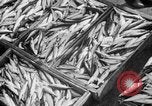
Japanese people process canned food and work at a farm for the soldiers in Japan during World War II.
Japanese people working on home front in Japan to help Japanese soldiers and war effort during World War II. Crates of freshly caught fish. Fish being sundried in racks. A woman gathers dried fish from racks. People in fishing village as they process split, dried fish for the soldiers. Men fasten wooden crates with rope. Women harvesting vegetables near Mount Fuji. Girls plow a farm field with the help of a horse. Piles of rabbit skins in a factory. Men load the rabbit skins in a truck. The truck departs.
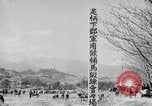
Japanese men train horses to be used by the army Japan during World War II.
Japanese people work to help the soldiers during World War II. Number of people train horses for army use. Houses in the foreground. Men on horses as they move across a waterway.
American industry focuses on defense and war materiel production during World War II
Film opens showing smoke pouring from industrial smoke stacks in American manufacturing plants, during World War 2. Sparks fly from crucible of molten steel. Steel workers silhouetted against fog as they leave on a shift change. Men tapping an open hearth furnace in a steel mill. Hot steel being poured in Crucibles and then into steel containers on rails. Huge overhead cranes moving in a mill. A Bessemer converter furnace tilted and blowing with flames extended from its mouth. (A smoke ring leaves the converter.) Various views of activities in steel mills with flaming steel involved and processing such as extrusion and forging taking place. Closeups of hardworking steel workers handling white hot steel ingots. Sheets of aluminum being processed in rolling mills and then inspected. Scene shifts to an oil field with numerous derricks and then to a refinery, with 10 tall smoke stacks, where crude oil is made into gasoline. Views of Grand Coulee Dam, Bonneville, Boulder, and the Tennessee Valley, where hydroelectric power is produced. Churning waters being discharged through dam spillways. Huge number of men and women war factory workers seen in a shift change at a war production plant. Closeup of machines producing small arms and ammunition. A woman war production worker assembling an M1 Garand rifle. Others working on Browning 30 caliber M1919 machine guns and Browning Model 1917A1 water-cooled machine guns. Belts of machine gun ammunition being boxed in ammunition boxes for shipment. Thousands of bullet rounds pouring through funnel machinery. Shops where torpedoes, shells and bombs are manufactured and seen in piles and stacks. A worker checking out movement of a Anti-aircraft 40-mm Automatic Gun M1. Field artillery pieces covered outside a war plant. A 14 inch barrel, for a coastal gun or Navy ship gun, seen suspended from an overhead crane in a factory. Views of various such barrels including a view through one. Elements of mobile weapons being assembled. Jeeps being assembled and driven out of a factory at the rate of one per minute and temporarily stored in a yard. Special machinery grinding gears and other parts. Arc welders at work on weapons. M4A1 Sherman medium tanks being manufactured. View in factory of M3 Lee medium tanks being assembled. Rear view of one being fitted with its treads. Others are seen suspended from overhead crane.
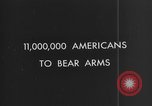
America fully mobilized in World War II
Opening slate announces 11 million Americans to bear arms (in World War 2.). U.S. Army Chief of Staff, General George S. Marshall conversing with Chief of Naval Operations, Admiral Ernest King. Next, Admiral King is seen standing with Commanding General of the U.S. Army Air Forces, Lieutenant General Henry H. (Hap) Arnold, and Admiral William D. Leahy, Chief of Staff to the President of the United States. Scene shifts to a graduating class of cadets from the United States Military Academy, at West Point. They are seen receiving their diplomas. West Point cadets are also seen cheering at an athletic event and in several views of them marching in formations on different occasions. Views of cadets from the U.S. Naval Academy, at Annapolis, Maryland, on parade and at a graduation ceremony in Dahlgren Hall, where each receives a diploma and they toss their hats into the air at the end of the ceremony. Next, ordinary citizen soldiers (mostly draftees) are seen marching in formation They participate in calisthenics en masse. Heavyweight boxing champion, Gene Tunney, is seen leading an exercise session. Soldiers run over an obstacle. Next cadets are seen on parade in the U.S. Merchant Marine Academy, at Kings Point, New York. Some cadets are seen practicing escape from a burning vessel at sea. U.S. soldiers engage in field training that includes live weapons fire above their heads as they crawl under barbed wire on a training course. View of soldier firing a Browning M1917 water-cooled machine gun near the trainees. Another is firing a Browning M1919 air-cooled machine gun.