


 Francais
 Deutsch
 Italiano
Refine Your Search
Bizerte Tunisia 1943 stock footage and images
- Showing 175 to 180 of 3126 results more
more Hide
Hide
V-1 rocket launch from catapult ramp in Germany (WW2)
Title card says “Flakzielgerät 76 V 102 Schnittautnahmen 17.8.1943” (“Anti-aircraft target device 76 V 102 cut recordings 08/17/1943” in English). World War II V-1 glide bomb launches after Argus engine start. View of exit point of Walter catapult. Entire launch ramp shown as camera pans to surface of launch ramp.
Models wear German-designed fashion in Copenhagen during World War 2
Women wearing German-designed fashion in Copenhagen, Denmark during World War II. A pamphlet in Danish reads “Tysk mannequinopvisning i Hotel d'Angleterre 8.-9. Februar 1943” (“German fashion show in Hotel d’Angleterre February 8-9, 1943” in English). A model smiles as she shows her silk dress. Three models in floral coats and dresses at the Hotel d’Angleterre (Kongens Nytorv 34, 1050 København, Denmark). Women in billowing elegant evening dresses. A woman preens before a mirror. Two women in evening dresses leaves together. Models in evening gowns walk in the catwalk. Spectators clapping.
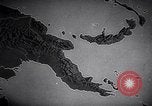
United States B-25 bombers, B-24 bombers, and P-38 fighters attack Japanese positions in Papua New Guinea.
August 1943: Animated map depicts Allied ground advances, 5th AAF air fleet stations, Japanese opposition base at Rabaul as well as Japanese positions and network in Papua New Guinea. Map depicting strategic Japanese positions of Wewak and Boram. 5th AAF soldiers decide to raid the two posts. 17 August 1943: USAAF B-25 Mitchell bombers and P-38 Lightning fighters attack the Japanese post of Wewak. Heavy bombardment by the American bombers. Smoke and explosion from the bombardment. Aerial view of the Japanese airplanes parked on the airstrip. 20 August 1943: USAAF B-24 Liberatoor bombers and P-38 Lightning fighters attack the Japanese position at Boram. Imperial Japanese Navy Air Service Mitsubishi Zeros attack the B-24s, P-38s intervene. Bombs dropped on the target. Smoke and explosion from the bombardment. (World War II period).
Sailors work to extinguish fire on Allied ships at the Tunis Port following aerial attack in North Africa Campaign.
Allied ships on fire in Tunis Port during the North African Campaign. View on shore as a U.S. Navy sailor and a camera man operating a moving image camera view the fire blazing in the harbor on a sunny day. Black and white smoke clouds arise from the ships. Flames leap upward on the ships. Sunken ships in the water. U.S. Navy sailors use water hoses to extinguish the fires at the bow of a ship. Charred gun on the bow of the ship. Sailors survey remains of burned ships and damage at harbor. Men extinguish the fire with water hoses. (This is possibly footage of the surprise day time raid by German Luftwaffe aircraft attacking Allied ships at Tunis harbor on May 19, 1943, six days after the Axis surrender in North Africa.)
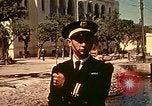
General Dwight D. Eisenhower meets Admiral Sir Andrew Cunningham at Tunis Port during the North Africa Campaign
On shore at Tunis harbor, a British Navy officer gives a sword salute to a senior Naval officer in World War II. U.S. Navy and British Royal Navy sailors lined up on either side of dock for a salute. General Dwight D. Eisenhower accompanied by Admiral Sir Andrew Cunningham and other British and American Navy officers walk past the sailors in review. Cunningham has a walking cane hooked over his left forearm but does not use it. The Union Jack and the British Royal Navy flag are visible. Ship at dock in the background. Eisenhower and Cunningham and the other officers pause and greet in front of a waiting Royal Navy car, RN ME 4096, parked on shore. Eisenhower, Cunningham, and another British officer enter the waiting car and it leaves, passing by a Allied landing ship with number 5 seen on its bow, anchored at the port. Closeup view of U.S. Navy Rear Admiral Richard L. Conolly and another U.S. Navy officer watching after the car drives away. Honor guard sailors march with rifles, departing the dock after the officers leave. (Eisehhower visited Tunis for meetings with British and U.S. Navy officers May 11-13, 1943. This footage is likely during those 3 days.)
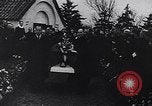
Denmark under German martial law during World War II
Film made by Danes, after increasing tensions between them and German occupation forces that invaded Denmark in 1940, boiled over in August 1943, and the Germans placed Denmark under martial law. It covers the period 1943 and 1944, after which the film was smuggled out of the country. Opening scene shows pallbearers at the funeral of Kaj Harald Leininger Munk (aka Kaj Munk) a Danish playwright and Lutheran pastor, who was assassinated by Nazi Gestapo agents, on 4 January, 1944. Narrator states that Nazi murder leagues assassinated some of Denmark's greatest leaders to intimidate the Danes and quell any rebellions. The coffin of Pastor Munk is lowered into its grave. Memorial stone and flowers are shown. Smoke rising and then a large conflagration are seen, from Danish acts of sabotage. Damaged buildings and more fires, from Danish resistance, are seen. In response, the "Schalburg Corps," a Danish volunteer branch of the Nazi SS, began counter-sabotage (called Shalbotage by the Danes). Film shows fireman on ladders at the building of the Paramount Movie Company, Ltd. where smoke is coming from the windows. (Narrator says film companies that refused every form of collaboration were blown up.) View of severely damaged Nordisk film studio at Helerup. Windows shattered in department stores and in all shops along a street. Illums Bolighus (famous store of Scandinavian design) and many others are wrecked. Camera pans up the side of damaged building with bird painted on its side and the words: "mod lysere Dage.." (Brighter Days). Views of the destroyed Royal Yacht Club pavilion, in Copenhagen harbor. Destruction in Tivoli Gardens. Its concert hall completely destroyed. Fire burning at the Syndicate, Denmark's largest armaments factory, from bombing by saboteurs, in June, 1944. Danes walking in Copenhagen, on a summer evening, flaunting the Nazi curfew from 8PM to 6AM and then lighting bonfires after dark. Abandoned wheel barrows and empty streets are shown when residents of Copenhagen all go home in a general strike. Several German soldiers are seen in otherwise empty street, as the German Commander in Chief declares the city of Copenhagen under siege. A German tank parked in the street amidst pedestrians. Barricades set up by strikers in a street. The American flag flying high over a street. The "Bulldog" a department store in flames. A car serving as an ambulance drives down a street displaying a white flag. A long line of Danes wait at a street corner shop for self-rationed food. Danes drawing fresh water from lakes to be brought to hospitals, where needed. View from above of strikers at a barricade. Narrator states that after 5 days, the Germans gave in and agreed to Danish terms. View of open area in the city, where people stand in silence to commemorate those who lost their lives in the struggle. Danish man looking through chain link fence. More scenes of continued sabotage by Danes.