


 Francais
 Deutsch
 Italiano
Refine Your Search
Bizerte Tunisia 1943 stock footage and images
- Showing 247 to 252 of 3126 results more
more Hide
Hide
The Seabees construct an airstrip at Munda Point in the Solomon Islands during World War II. Daily progress seen over 5 days.
Activities of the Seabees at Munda Point in the Solomon Islands during World War 2. Views of utter destruction from the U.S bombardment of Munda. Destroyed buildings, facilities, Japanese airplanes and dead Japanese soldiers. Leafless trees and damaged wooded area. Seabees commence cleanup and construction. They cremate and bury the dead Japanese. Trucks and bulldozers move over muddy terrain to level the land to construct an airstrip. Views of the steady progress of construction over the period from August 8 to August 12, 1943. The airstrip is completed within 5 days. On the 5th day a Navy F4F aircraft lands on the coral runway. . The pilot in the cockpit smiles. The Spirit of 76 is painted on his airplane. Views of other F4Fs landing on the coral runway.
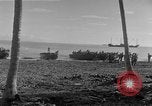
U.S. reinforcement and resupply operations on Guadalcanal, Solomon Islands, during World War II.
Reinforcements and supplies arriving on Guadalcanal during World War 2. Various views of Soldiers and supplies arriving from transport ships. These operations are occuring in 1943, after Guadalcanal has been secured and now being prepared as a base for further allied advances against Japanese-held islands on the road to Japan itself. In one scene Soldiers are seen arrivng on a Higgins Boat from the transport ship, USS George Clymer (APA-27). Most of the film shows supplies being amassed on the beachhead. Local natives are employed helping unload and store the large quantities of supplies.
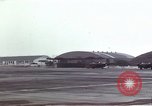
The Memphis Belle, B-17F, buzzes an airfield on War Bond Drive Tour during World War II
The famed B-17F, "Memphis Belle," seen during its June 1943 tour of the U.S. to promote War Bond sales, during World War 2. A group of onlookers watch as the Memphis Belle, piloted by Major Robert Morgan, flies only a few feet above the runway at an Air Base in the United States. (Several A-26 aircraft are seen parked on the field.) A civilian announcer stands on a bunting covered platform on the tarmac beside the runway.
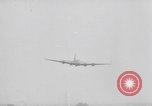
Crew of U.S. AA Force bomber B-17F Memphis Belle greeted and welcomed by Secretary of War and General Arnold in Washington DC
United States Army Air Force bomber B-17F Memphis Belle lands at Washington National Airport, Washington DC, during a War Bonds tour in the summer of 1943, in World War 2. Washington Monument and Jefferson Memorial seen in the background. B-17F No. 24485 lands at the airport and taxis to a parking position. People approach the Memphis Belle as it is parked. The pilot looks out from the window of cockpit. The Secretary of War Robert P. Patterson and General Henry H. Arnold and Barney Mc Giles greet the crew and pose in front of the aircraft.
Russian soldiers take Reshitsa and Gomel and help restore a city in Europe.
A Russian film titled Srazhenie Za Gomel about the Battle of Gomel. Russian soldiers take Reshitsa on November 18th and Gomel on November 26th, 1943. Russians help restore town. Buildings in city. Ruins of buildings. Soldiers enter the city. Old women happy to see the soldiers. Empty streets, bomb damaged buildings. Graves in a cemetery. Boards placed on poles and trees. Civilians return to city. Soldiers march into city. Artillery fired. (World War II period).
U.S. reconstructs captured Japanese airfield at Munda Point, New Georgia Island, in World War II.
Wreckage and debris on Munda Point airfield, New Georgia Island, after its capture by U.S. forces during World War 2. Dead Japanese soldiers. Destroyed aircraft on island as result of U.S. bombing. Reconstruction workers clear and enlarge runway and operations tower as Americans improve and expand the airbase for their own operations. U.S. flag raised on pole. Seen are the first aircraft to land at Munda Point (on August 14, 1943). The first is a Royal New Zealand Air Force P-40 with letter K and white stripe on fuselage and a white tail. It is followed by a J2F Duck carrying U.S.Marine Brigadier General Francis P. Mulcahy to set up his new headquarters at Munda Point.
CRITICALPAST.COM: About Us | Contact Us | FAQs - How to Order | License Agreement | My Account | My Lightboxes | Shopping Cart | Advanced Search | Featured Collections | Website Terms & Conditions | Privacy Policy ©2026 CriticalPast LLC.
License Agreement |
Terms & Conditions |
Privacy Policy
©2026 CriticalPast LLC.