


 Francais
 Deutsch
 Italiano
Refine Your Search
Bizerte Tunisia 1943 stock footage and images
- Showing 319 to 324 of 3126 results more
more Hide
Hide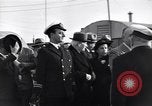
Greek Prime Minister, Themistoklis Sofoulis, boards the Greek Destroyer, RHS Hastings, in the Port of Piraeus.
Themistoklis Sofoulis (Sophoulis) Prime Minister of Greece, arrives at the port of Piraeus. Officials greet and welcome him. A color guard of Greek sailors presents arms in salute as Sofoulis is taken by the arm and escorted by a Greek admiral. He doffs his hat in acknowledgment. With the Admiral at his side, and , surrounded by civilian officials,and several naval officers, he makes his way to the Greek Navy Destroyer, RHS Hastings, tied up at the pier. A junior officer assists him as he ascends a gangway to board the ship. On deck, the ship's captain greets him and introduces several junior officers who salute and shake hands with him. The Greek National flag is seen fluttering in the breeze from the ship's mast. View of ship's bow as forward line is hauled aboard. The Greek State Flag is displayed from the ship. View from the pier as the ship backs away, followed by views of her underway. (This ship is the former British HMS Catterick, Class III Hunt destroyer, which was transferred on loan to Royal Hellenic Navy in 1946,as the Greek RHS Hastings. The number 15 appears on her hull which was formerly assigned to the Greek Destroyer Vasilissa Olga, that was sunk in 1943.)
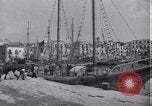
Allied Military Government working to provide medical care and food to Italians in liberated parts of Italy during World War II
Relief activities of the Allies in Italy during World War 2. Opening scene shows a sailing Schooner under Allied Navy control, docked at a port in Italy following the Allied invasion of Italy in 1943. This schooner is being loaded with Allied Military Government (AMG) medical supplies. Closeup of wooden crates containing the supplies. American medical corpsmen checking a stream of water for mosquitoes, and then spraying the area from a DUKW. A hospital building and interior with Italian women holding their infants as they await checkups and vaccinations against disease. Italian citizens in a street anxiously seeking food from the AMG. Local Italian police work to control the crowd in which some persons become unruly and have to be removed. American troops of the U.S. 5th Army marching along Italian roads. Troops riding on a Sherman tank and on a truck pulling an artillery field piece. Supply yard stacked high with food supplies for U.S. troops. (Narrator states it required 750 tons a day to feed the 5th Army.) Views of Naples harbor cluttered with 30 large ships and 300 smaller ones blown up or scuttled by retreating German forces. Firemen manning hoses to fight fires at the waterfront. Smoldering ruins in the port. Three months later, U.S. forces are seen operating supply missions through the port. View from a hill of the port with barrage balloon overhead. Closeup of flour being offloaded from holds of ships by derricks. Italian soldiers unloading the flour bags and placing them aboard trucks for transport to Italian commercial food companies. A U.S. Army Captain at a table with Italian businessmen who purchase the flour from AMG at a fair market price. Italian purchasers examining the flour. Flour being transported to bakers who bake it into bread. Young men busy making and baking loaves of bread. Loaves stacked up at the bakery. A big tray of fresh loaves being sampled by Italian officials and distributed to local Italian civilians who enjoy it.
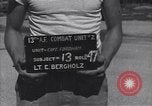
General Twining congratulates pilots of the 339th Fighter Squadron, on Guadalcanal, Solomon Islands during WWII
Major General Nathan F. Twining, Commanding General, 13th Air Force. arrives to congratulate fighter Pilots of the U.S. Army Air Forces, at Henderson Field, on Guadalcanal, Solomon Islands, during World War 2. (The 339th had successfully accomplished a highest priority mission, shooting down Japanese Admiral Isoroku Yamamoto's airplane on April 18, 1943.) Major General Twining, wearing a pith helmet, steps out of his jeep and walks towards a group of 339th Squadron Pilots. He examines the nose wheel of a P-38, as a group of pilots stand around him. General Twining converses for a while with Major John W. Mitchell, Commander, 339th Fighter Squadron, who led the mission to down Admiral Yamamoto's airplane. Later, members of the 339th Squadron are photographed in conversations with one another.
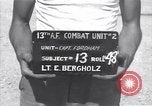
General Twining congratulates Pilots of U.S. Air Force who shot Japanese planes, in Guadalcanal Solomon Islands during WWII.
General Twining arrives to congratulate fighter Pilots of the U.S. Air Force, in Guadalcanal in Solomon Islands, during World War II. General Nathan Twining steps out of his jeep and walks towards a group of Air Force Pilots. He congratulates Captain John Mitchell and then speaks to Pilots of the 339th Fighter Squadron. General Twining and other Pilots stand in front of a P-38 fighter airplane and talk. Pilots who shot three Zero Fighters and three bombers of the Imperial Japanese Navy Air Service (IJNAS) over Ki hill Airfield near Munda Point. The three Pilots, Captain Thomas Lamphier, Jr.,, Lieutenant Busby Frank Holmes and Lieutenant Alex E Barber pose for a photograph. (These three would later participate in U.S. Operation Vengeance, on April 16, 1943, in which they engage a group of Japanese aircraft, including one carrying Admiral Isoroku Yamamoto, the architect of the Pearl Harbor attack. He would perish when they down the Mitsubishi G4M bomber carrying him.) Pilots leaving in a jeep. A Pilot stands on the wing of P-38 fighter, besides its canopy.

WW2 German defensive preparations on French coast; Allied invasion scenes; Allied bombing over Germany
Slave laborers digging during the construction of the Atlantic Wall in World War II. German engineers oversee the construction. Men working around a large gun turret. Nazi German fortifications, bunkers, and artillery posts along coasts facing the Atlantic Ocean in Europe. The 380 mm gun at the Todt Battery near Cape Gris-Nez, Pas de Calais, France. 40.6 cm SK C/34 gun “Battery Lindemann” (German unit MKB 6 / MAA 244) as part of the Dover Strait coastal guns. German emplacements and troops marching along Normandy in France. A German soldier uses binoculars to watch the English Channel. Adolf Hitler and a Nazi German general. Adolf Hitler greets Benito Mussolini as the latter exits a plane in Vichy France. Allied leaders Winston Churchill, Franklin Roosevelt, Joseph Stalin, and General George C. Marshall at the Tehran Conference in 1943 during World War 2. Armies from various European countries march and prepare themselves for war against Germany. Supreme Commander General Eisenhower and other Allied generals during a meeting. Fleet of ships in sea ready to land in Normandy on D-Day. Navy and coastal command aircraft drop bombs on Nazi German submarines. Anti-aircraft guns fire at Nazi bombers. Docks damaged by German bombing receive aid from Allied countries. Cranes and hooks lower relief supplies, medicines and warfare material at dock. Warships loaded with artillery and warplanes lowered in ships by hoists. A locomotive train is being lowered from a ship. A military band plays music in a dock. Soldiers move towards the ships. British and Royal Canadian and Australian bombers at their base take off for bombing on Nazi bases at night. A soldier directs a bomber taxiing in runway. Aerial views of British bomber aircraft bombing targets in Germany at night, with immense explosions.
Test flights of German missile A-4 V2 rocket in Peenemunde. First fully successful flight on Oct. 3, 1942.
Opening slate mentions speed and pressures generated in the test launch of A4 V2 rocket. The rocket launches and appears to be successful, moving up and out of sight. However, some white smoke descends and lingers in the atmosphere afterwards. The next slate states that the causes of the malfunctions have been identified and corrected. It is followed by a slate showing date of 3 October, 1942, and another about last instructions before the 3rd launch. German rocket scientist, Konrad Dannenberg, is seen discussing matters with several German officers at the test site. (Dannenberg is in the center of the group. Second from left is possibly Wernher von Braun. Second from right is possibly General Walter Dornberger.) The next slate reads: 1558 hours (3:58 PM) followed by one reading: Fire free. A German officer is seen speaking those words into a microphone. Camera shows a technicians hand as he sets firing switches on a control panel. ;Closeup of V2 rocket engine firing up. The rocket ascends successfully and disappears from sight. (Note: The footage at the end of clip showing the successful Oct 3 flight of A-4 V2 rocket was reportedly part of a film shown to Hitler at his Wolfe's Lair in 1943.) (World War II period).