


 Francais
 Deutsch
 Italiano
Refine Your Search
Bizerte Tunisia 1943 stock footage and images
- Showing 343 to 348 of 3126 results more
more Hide
Hide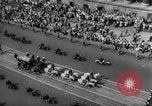
Funeral services for Franklin D. Roosevelt in Washington DC and at Hyde Park, New York (WW2)
Funeral procession of President Franklin D. Roosevelt on the streets of Washington DC. Horse drawn carriage with casket escorted by men on motorcycles. Crowd lined up on sidewalks. Various U.S. military units march. Funeral procession arrives at White House. Casket is carried into building. Casket is placed in East Room, lying in state. Scene change to funeral services for FDR at Hyde Park, New York. President Truman and Franklin D Roosevelt's wife among the mourners. A volley is fired over the president's grave. Symphonic music track in background is interspersed with audio quotations from Roosevelt, including, from his State of the Union on January 7, 1943: "Therefore, let us all have confidence, let us redouble our efforts. A tremendous, costly, long-enduring task in peace as well as in war is still ahead of us. But, as we face that continuing task, we may know that the state of this Nation is good--the heart of this Nation is sound--the spirit of this Nation is strong--the faith of this Nation is eternal." Also heard at the beginning of the clip is Roosevelt saying, "American fighting men looked to the statesmen of the world to finish the work of peace for which they fought and suffered. We failed them then. We cannot fail them again, and expect the world again to survive," from his address to Congress on Yalta, March 1, 1945 (World War II).
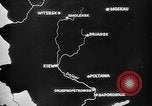
German infantry supported by tanks, artillery, rockets, and Stuka planes move up near Nevel, Russia
Animated map starts the film, showing the Eastern (Russian) front in vicinity of the Dnieper River, during beginning of winter, 1943-44, as German forces battle against Soviet forces in World War 2. German troops are seen in deep trenches and lying prone behind rubble. Light snow covers the ground. Closeups of German tiger tanks moving along a muddy path beside a river. German Panzergrenadiers taking a smoking break during a lull in combat. German soldiers trudging through mud as snow falls. They pass by some German artillery field pieces firing at Soviet positions. Heavy German guns firing. German troops hurrying toward entrenched positions. Closeup of two soldiers conversing as one points toward Soviet positions. A soldier takes up his defensive spot at the mouth of a dugout at the end of a trench. Closeup of two German soldiers smoking cigarettes. A German soldier reports to an officer at the front, who pins a medal on him and shakes his hand. Another view of a soldier smoking a cigarette. German soldiers walk past some knocked out tanks. Closeups as they pass the camera. One soldier looks skyward. A large formation of German Junkers Ju 87 (Stuka) dive bombers is seen overhead. View from a Stuka cockpit, as it dives emitting classic sound. Stuka aircraft diving and dropping bomb that are seen bursting on ground below. Good closeup of Stuka in a dive.
Launches of several U.S. Warships during World War II
Preparations for launch of the USS Hancock (CV-19) at Fore River Shipyard, Quincy, Massachusetts, on January 24, 1944. . Shipyard riggers removing supports from under the ship's hull. Platform at bow is decorated with bunting. Scene shifts to Brooklyn Navy Yard, New York, and the launching of the USS Missouri (BB-63), on January 29, 1944. Crowd gathered around the bow as the Missouri goes down the ways. Another change of scene to the Newport News Shipbuilding and Dry Dock Company of Newport News, Virginia. Here the ways are emptied following the launch of the Light Cruiser, USS Hancock (CL-81) on June 19, 1943. The Hancock can be seen in the water. Tugs attend to the newly launched Cruiser.
Mob uprisings against Fascists in Europe, during the end of World War II. The Third Moscow Conference of the Allied occupying powers. The Belsen trials.
A mob, seeking revenge against Fascist leaders, fills a city square. They pound on steel gates of a government building. Soldiers and police attempt to protect various persons from the mobs. Others are unprotected and suffer beatings and death. Bodies of Benito Mussolini and his Mistress Clara Petacci are seen hung upside down by Italian Partisans in Milan, Italy, on 28 April 1945. Scene shifts to image of postwar occupying powers, United States, Soviet Union, and Great Britain, whose flags are displayed in the center of a conference table during the Third Moscow Conference. Principals signing agreements, in November, 1943, providing, among other things, for lawful and orderly trials of war criminals, following World War 2. Seen signing are: Soviet Foreign Minister Vyacheslav Mikhailovich Molotov; U.S. Secretary of State, Cordell Hull; and British foreign Secretary, Sir Anthony Eden. View of General Dwight D. Eisenhower, leading a contingent of American wartime Generals on a mission to document Nazi atrocities at liberated German concentration camps. Closeup of a man directing local German citizens who were forced to observe the horrors of the camp. Closeup of an oven used to dispose of bodies of victims. Dead bodies of concentration camp victims strewn in a heap. A room filled with documentary evidence to be analyzed and used in war crimes trials. the body of German General Admiral Hans-Georg von Friedeburg , and of Heinrich Himmler, both of whom committed suicide. A hand holding cyanide capsules. Body of Leipzig City Council deputy mayor Dr. Ernst Kurt Lisso slumped over his desk, following suicide. Body of his daughter, Regina Lisso also a suicide victim. Nazi war criminals being rounded up by Allied military.One being carried on a stretcher. Another, a German officer, is taken into custody. Next, Josef Kramer, the Commandant of Bergen-Belsen concentration camp is seen under guard by a British soldier. British soldiers guarding the court room of the second Belsen trial, convened by the Allied occupational forces, in the Gymnasium building of Luneburg. View of the courtroom with defendants wearing numbers. Closeup of numbers 1 and 2, Josef Kramer, and Fritz Klein, respectively. View of Allied military officers sitting in judgment. Closeups of women defendants, including Irma Grese (number 9) and Elisabeth Volkenrath (number 11). Camera pans around the courtroom.
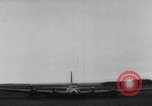
Numerous wrecked Allied warplanes. German ace Adolf Galland and other pilots. FW-190s and ME-109 airplanes in flight (WW2)
German soldiers climbing over a crash-landed B-17 bomber of the USAAF 96th Bomb Group, 337th Bomb Squadron, with tail number 42-3353. Its props are all bent and skin is peeled off its rudder and horizontal stabilizer. (This aircraft, named "Tar Fly," was hit by flak on September 9, 1943, and crash-landed west of Evreux, at Beamont-Le Roger, France. Two crew were killed and 8 taken as prisoners of war.) Smoking wreckage of an Allied aircraft in a field with two dead fliers lying on the ground about 50 yards away. Engines of a downed U.S. aircraft. Numerous views of wrecked American and British airplanes. Sign painted on one piece of wreckage reads: "When I go sightseeing in Tokyo, Tojo's gonna be my Ricksha Boy!" Piles of scrap alumunum from crashed airplanes piled up at a railroad siding, where German workers load it into rail freight cars. German army workers using tools to dismantle parts. Sequence shifts to a Messerschmitt Bf 109 that lands in a field. German airmen run to greet the pilot, who steps from the cockpit and describes some aerial maneuvers to a surrounding audience. Next, German ace, Adolf Galland is seen discussing tactics with other pilots. Several camouflaged Me Bf-109s lined up on a grass field, where ground crews are repairing and maintaining them. Closeups of German pilots climbing into cockpits of planes. Ground crews hand crank their starters. Next sequence shows Focke-Wulf FW-190 aircraft taxiing and then making a formation takeoff from grass field. Then an Me-Bf-109 is shown right after takeoff. FW-190s and Me-109s buzz the field. (World War II period)

United States Army Air Corps film "The Truth About Ploesti."
Formations of B-24 Liberator bombers are seen in flight, headed for Ploesti, Romania, on August 1, 1943, during World War 2. Next, vertical columns of bombs are seen falling from the planes. Animated map of Europe shows Romania and Ploesti. It show paths of oil from the Ploesti oil fields to Germany. (Narrator states Ploesti provides 30% of Axis oil.) Map show path of 9th Air Force bombers from Libya to the Ploesti oil fields. Scenes shift to captured German films from 1944, showing the fires and destruction resulting from the constant B-24 raids. Huge black clouds rise from the area. Firefighters rush to combat flames. They direct streams of water on the conflagrations. (Commenter states: "Delayed action bombs prevented firefighters from rushing in, until too late.") Nighttime views of large fires and heavy smoke from 6 of Ploesti's 7 refineries ripped wide open. Film advances to August, 1944, showing Ploesti with the fires out, following Rumania's capitulation. Next, with some fires still burning, King Michael I of Romania, tours the site with military officers. They walk amidst the debris. Smoke rising near a rail marshaling yard. Against a background of dense smoke rising, a Slate is displayed showing the cost to the United States of the Ploesti raids, as 300 bombers and 3000 American airmen were lost.