


 Francais
 Deutsch
 Italiano

Refine Your Search
Bizerte Tunisia 1943 stock footage and images
- Showing 367 to 372 of 3126 results more
 Hide
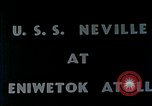
U.S. Marines head towards Eniwetok Atoll in landing crafts during World War II.
Amphibious operation by U.S. Marines and Army Troops at Eniwetok Atoll in Marshall islands during World War II. Film taken from onboard the attack transport USS Neville, APA-9. Starboard side view of the battleship USS Tennessee, BB-43, in measure 32/1d camouflage. Starboard side view of the heavy cruiser USS Indianapolis, CA-35, 1943 measure 21 camouflage. Port side view of the battleship USS Pennsylvania, BB-38, in measure 21 camouflage. Port side view of the battleship USS Tennessee, BB-43, in measure 32/1d camouflage. Stern view of hospital ship USS Solace, AH-5. Smoke rises from the coast of the atoll from bombardment. Marines of the 22nd Marine Regiment on the deck of USS Neville preparing to board landing craft. LCV being lowered along side the ship into the sea. LCV (Landing Craft, Vehicle) loaded with troops pulls away. Landing Crafts Personnel underway as they circle. Other attack transport ships in the background. LVT (Landing Vehicle Tracked) comes up on a beach at Eniwetok Atoll.
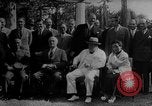
Mixture of scenes from Cairo and Teheran converences with glimpses of Soviet troops on the move and views of bombers and landing craft as well as an atomic test in the Pacific ocean.
Opening scene shows Chinese Generalissimo Chiang Kai-shek seated with U.S. President Franklin D. Roosevelt, British Prime Minister Winston Churchill, and Madam Chiang in their Cairo meeting at a residence of the American Ambassador to Egypt, Alexander Kirk, on November 25, 1943, during World War 2. Foreign ministers of the countries stand behind their leaders. Closeups of the three Country's leaders. Scene jumps to Teheran, with Soviet Leader, Joseph Stalin, President Roosevelt, and Prime Minister Winston Churchill, seated on a veranda of the Soviet Embassy. Suddenly scenes of tanks, trucks, and Soviet troops moving on the Eastern front are seen. Some of the troops move by horse-drawn sleighs through the snow. A line of U.S. Army Air Forces B-17 bombers taxiing on an airfield. View from a B-17 in flight. View f as a cluster of bombs falls from B-17 and explodes on the ground. Animated map illustrating paths of aircraft attacks against the German Atlantic Wall from England. Landing craft underway in an amphibious assault. Brief view from a ship of a post-war test atomic explosion in the Pacific ocean
Life in Britain on eve of War. Chamberlain, Hitler and Mussolini signing the Munich Agreement during World War II.
An Allied propaganda film to solidify Anglo-American solidarity within the ranks as well as to counter Nazi propaganda aimed at weakening the alliance shows British soldiers in Great Britain during World War 2. 1938: in the United States New York Yankees win the pennant in baseball; scene of Yankees team members shaking hands. View of aviator Douglas Corrigan nicknamed Wrong Way Corrigan after his accidental flight from New York to Ireland instead of California as planned. View of trains on the 6th Avenue Elevated (or Sixth Avenue El) before that service was halted in Manhattan New York City. British citizens go about their daily life. Derby horse race in a stadium. A British boy and his father shovel dirt for a backyard garden. Players play a football (soccer) game at Wembley Stadium in England as spectators cheer the 1938 FA Cup Final with Preston North End taking the Cup versus Huddersfield Town as George Mutch scores the winning goal. Scenes in Germany: People cheer for German Chancellor Adolf Hitler and give Nazi salute. Newspaper headlines about Czech occupation. Graves in a cemetery. British Prime Minister Arthur Neville Chamberlain, Adolf Hitler Italian Prime Minister Benito Mussolini sign the Munich Agreement. Despite a peace agreement Hitler invades Czechoslovakia. People read 'Military Training Act, 1939'. British soldiers march along a road. View of Adolf Hitler smiling and laughing. Artillery is fired. A poster reads 'Britain Declares War on Germany'. Airplanes in flight and drop leaflets over Germany. German airplanes in flight. Parachutists jump from the airplanes. Hitler talks to officers and considers the war to be over. Radio news broadcast of the British declaration of war on Germany by Neville Chamberlain. Many different British citizens and families shown in living rooms and work places gathered around radios to listen to the so called "We shall fight on the beaches" speech of Winston Churchill on June 4, 1940. Clip includes scenes from 1938 through 1940; from a film produced in 1943.
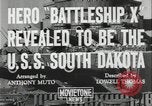
Views of USS South Dakota aka "Battleship X" during World War 2.
Slate reads, "Hero Battle Ship X revealed to be USS South Dakota" Aerial view of USS South Dakota at sea with airplane wing tip in foreground. Sailors assembled on the deck of the USS South Dakota. Overhead view of ship's guns. The ship had been dubbed "Battleship X' for reporting to the press around January 1943 when it was undergoing repairs. Guns firing on the USS South Dakota. An officer speaks.

U.S. pilot Lieutenant Rex T. Barber describes his mission to shoot down Yamamoto in the Solomon Islands during WW2.
Title sequence “Air Force Now”. Image of Lieutenant Rex T. Barber, the United States Army Air Force pilot who shot down Admiral Isoroku Yamamoto during a military operation in the Solomon Islands in 1943, taken during World War II. Rex T. Barber is interviewed by Air Force Now. Lieutenant Rex T. Barber describes how he shot down a Japanese bomber that carried Admiral Isoroku Yamamoto during WWII.
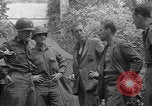
Escaped U.S. Army bomber pilots speak with officers after rescue during World War 2
Two escaped U.S. Army Air Force aircraft pilots, shot down in enemy territory in December 1943 during World War II, speak with U.S. officers after their rescue in 1944. Both pilots are dressed in civilian clothing, and one wears improvised shoes. (Footage shot around the time of the Battle of Cisterna).