


 Francais
 Deutsch
 Italiano
Refine Your Search
Bizerte Tunisia 1943 stock footage and images
- Showing 37 to 42 of 3126 results more
more Hide
Hide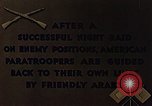
American parachute troops in a desert near Tebourba in Tunisia.
Shows American parachute troops accompanied with armed Arab guides in a desert near Tebourba in Tunisia, during World War 2. Troops take shelter from sun under a large rock. Troops rest on sand in open. Allied convoy comprising of U.S. M3 Grant tanks, half-tracks and jeeps rolls near Tebourba in Tunisia. The convoy crosses a bridge guarded by French soldiers. U.S. P-38s circle the skies above the convoy. (November 1942-December 1942).
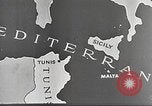
People offer prayers in a mosque and visit the Roman ruins in Kairouan, Tunisia.
Life of Muslims in Kairouan, Tunisia. A map of Tunisia depicts the location of Kairouan. The Great Mosque of Kairouan. A Muezzin climbs up a minaret and gives a call for prayers. Men offer prayers. Men at the mosque of the barber. A man takes off his shoes as he enters the mosque. Men pray at the mosque and read the holy Quran. A man prays with a rosary in his hands. Market area in the city. A group of people visit Roman carthage in the city. Ruined structures of the ancient Roman empire. A Coliseum in the city.
French colonial Army soldiers parade in desert in Kairouan, Tunisia.
French colonial army in Kairouan, Tunisia. A map of Tunisia depicts the location of Kairouan. French Saphis on camels in a desert. French colonial troops march past a French officer. African Americans march during the parade. Camels lift their heads to view planes flying overhead. Saphis ride camels and soldiers march. Tanks roll during the parade. (World War II period).

Allied pre-invasion base and activities in Scotland,1941. Allies in Algeria preparing for invasion of Sicily,1943
Activities of the Seabees in Scotland in 1941 and in Algeria in 1943, during World War II. News headlines in 1943 read : ' Italy is out of war' and '17 more Italian towns taken'. An animated map. The Clyde valley in Scotland showing a base built by the U.S. Navy Seabees, in 1941. Numerous quonset huts and vehicles are seen. View of the River Clyde, where 2400 feet of oceangoing dock are being assembled. A ship anchored at a harbor displaying U.S. flag. Allied troops board a landing ship with their belongings. An animated map tracing travel of Allied invasion forces from Scotland to Oran, Algeria, where Seabees are seen testing a floating causway that would be used for invasion of Sicily. Scuttled axis ships and other obstacles and damage that Seabees must repair in occupied ports. Allied ships and troops proceeding for invasion of Sicily. Allied warships bombarding Sicilian coast.
A 1942-1943 film report to the American public about the progress of World War II in Europe and the Pacific.
Opening slate at start of film reads: "1942--1943 The Turn of the Tide." A column of British armor enters Bengazi, Libya, led by several troops in tankettes. Next seen are a Lee Medium Tank, M3 followed by an infantry tank, a jeep, another infantry tank and another Lee M3 Medium tank. Closeup of local people greeting the troops with upraised hands giving the "V" for victory sign. Another Lee M3 tank passes close by the camera. Black smoke is rising in the background. Scene changes to a half sunken ship near another burning in the harbor. Another view of this from further away above port buildings. Closeup of three smiling British soldiers leaning over a cartoon on a tank, of Winston Churchill (As a bulldog smoking a cigar and wearing a cap with the word "Victory" written on it). A crumpled captured flag with swastika on it. British Field Marshal Bernard Montgomery stands atop a vehicle (unseen) and looks through binoculars. Below, a column of British supply vehicles is making its way along a path in the desert. Two tanks coming toward the camera through sand. Animated map shows Nazi territory being threatened by the Allies from the Mediterranean, the USSR, and the English Channel. Views of Soviet infantry advancing against German forces in the snow of winter on the eastern front. Soviet troops firing updated 76-mm divisional gun model 1902 hidden in woods. Shells exploding in snow-covered field as Soviet BT series tanks advance. Various Soviet artillery firing from fixed gun batteries and from woods. A shell striking in distance. Fallen German soldiers lying on snowy field. Makeshift battlefield crosses marking graves of fallen German soldiers. German steel helmets lined up in the snow. A sign, posted on a birch tree, lists the names and birth dates of 16 German soldiers from the 3rd Panzer Division (3Pz-Pi-BH.39) buried at this site on November 28, 1941. Scene shifts to Joseph Stalin addressing Soviet troops in Red Square, Moscow, Russia. All the soldiers in formation seem to be singing (unheard). Film switches to animated map again. This time delineating the Eastern front being pressed by the USSR, and showing area of the 2nd Soviet winter offensive in 1943. Change of scene from Europe to the War in Asia, against Japan, shows General Douglas MacArthur after arriving by a B-17 bomber at a Pacific island American base. He ascends a steep hill in a jungle area, accompanied by other officers. Closeup of MacArthur. American infantry moving in single file in New Guinea, as a field piece fires a round in the direction they are headed. U.S. artillerymen load shells into a 105mm howitzer gun. A fire burns as mop-up operations begin on New Guinea. An Australian soldier is seen firing a Bren gun in jungles. Other Australian soldiers fire a mortar that explodes, raising earth and dust. More views of shells exploding near Allied soldier advancing. A soldier with fixed bayonet makes a fake charge toward the camera. Views of Japanese prisoners of war guarded in an outdoor compound. Japanese dead soldiers on Guadalcanal. An animated map shows new battle lines in the Pacific, closing in on Japan, with pressure from China, the USSR, and the Pacific islands being captured by the U.S. Arrows are added showing new pressure from American naval fleets and from British and American bombers out of Australia and captured islands.
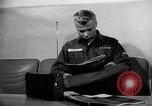
The story of AFN ( American Forces Network) Radio. Founding announced in 1942. First broadcast in 1943; growth in 1944.
U.S. Army soldier reads newspaper while listening to radio. Soldiers doing their respective chores, listen to AFN (American Forces Network) Radio. General Marshall and General Eisenhower announce the creation of AFN, in 1942. July 4, 1943, the first broadcast of AFN. General Eisenhower mingling with paratroopers of the 101st Airborne Division, on the eve of D-day. U.S. B-26 aircraft in flight. United States soldiers aboard landing craft and wading ashore at Normandy, France, on D-day, June 6, 1944. Soldiers tuning radios in the field. United States Sherman tanks and infantry move along country road in France. Audio includes portions from AFN broadcasts, including an announcer saying "You are listening to AFN Paris. This is the American Forces Network, on the road to Berlin." Road sign points to St. Lo. Group of U.S. soldiers gathered around a jeep with a radio, listening to AFN, in Germany. (World War II period).