


 Francais
 Deutsch
 Italiano
Refine Your Search
Bolinas Beach California USA 1934 stock footage and images
- Showing 6331 to 6336 of 26867 results more
more Hide
Hide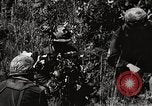
Squad members take positions before enemy attack.
Part of the U.S. Army training film describes the role of Light Weapon Infantrymen. Squad members check their rifles and take positions. Automatic rifleman determines the direction of fire. The Squad leader checks the positions of his team members. Bushes and logs kept in place to hide from the enemy. Logs are laid over the hidden area with sacks on top and camouflaged with bushes. United States soldiers fix the wire and place land mines on ground. Gasoline barrel placed on ground and camouflaged.
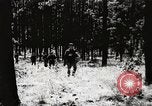
Squad members ready to defend their area from enemy attack.
Part of the U.S. Army training film describes the role of Light Weapon Infantrymen. Squad members ready to defend their area from enemy attack. Positions constructed and area is well camouflaged. Enemy tanks advancing. Supplementary positions taken and communication trenches dug. Squad leader informs platoon leader of advancing enemy infantry. United States soldiers open fire on enemy. To counter attack, the enemy blows a gap in the tactical wire. Squad reorganizes before another enemy attack
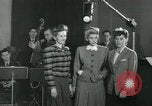
Andrews Sisters Patricia Marie, Maxine Angelyn and Laverne Sophie record Boogie Woogie Bugle Boy for 'V-Disc
A Colonel thanks Andrews Sisters on behalf of the Music Section of the Special Services Division for recording the three discs. Patricia Marie, Maxene Angelyn and Laverne Sophie record a song named 'Boogie Woogie Bugle Boy'. Musicians check instruments during the recording. Studio staff work on the pressing of the phonograph record. (Note: Although "Boogie Woogie Bugle Boy" was recorded commercially for Decca Records on January 2, 1941, this filmed V-Disc recording session took place over three years later on September 25, 1944.)
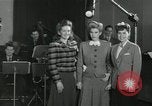
Andrews Sisters Patty,Maxene and Laverne record Boogie Woogie Bugle Boy on a V-Disc during World War II.
Lieutenant Colonel Carl Bronson thanks the Andrew Sisters on behalf of the Music Section of the Special Services Division for making V-Disc recordings that are sent to American soldiers overseas during World War 2. Patricia Marie (Patty), Maxine Angelyn (Maxene), and Laverne Sophie (Laverne) Andrews, perform 'Boogie Woogie Bugle Boy' for a V-Disc recording.
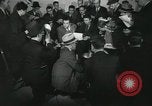
George Orson Welles interviewed by journalists on the day after the War of the Worlds broadcast
Director, actor and producer George Orson Welles interviewed by journalists. He talks about his movies and future broadcasts. He apologizes for his broadcast of 'War of the Worlds' on radio, the prior evening, which caused panic among people.
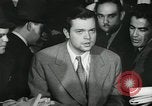
George Orson Welles apologizes for his broadcast of The War of the Worlds.
Director, actor and producer George Orson Welles interviewed by journalists. He apologizes for his broadcast of 'War of the Worlds' on radio on October 30, 1938 which caused panic among people.
CRITICALPAST.COM: About Us | Contact Us | FAQs - How to Order | License Agreement | My Account | My Lightboxes | Shopping Cart | Advanced Search | Featured Collections | Website Terms & Conditions | Privacy Policy ©2026 CriticalPast LLC.
License Agreement |
Terms & Conditions |
Privacy Policy
©2026 CriticalPast LLC.