


 Francais
 Deutsch
 Italiano
Refine Your Search
Bolinas Beach California USA 1934 stock footage and images
- Showing 13657 to 13662 of 26867 results more
more Hide
Hide
Rodeo competitors between various units of Texas Prison System gather in Huntsville, Texas.
Performers from various units of Texas Prison System gather in Huntsville, Texas. They exhibit their skills against wild rodeo animals in a field. People gathered to watch the event. Spectators seated. Horses fall down. Men on ground. (World War II period).
President Harry S. Truman announces surrender of Germany in World War II. Crowds celebrate in streets of Manhattan
VE Day (Victory in Europe) May 8, 1945. From the White House, in Washington DC, President Truman announces that Germany has surrendered, bringing World War 2 in Europe to an end. Americans are seen celebrating the good news in the streets of downtown, Manhattan, New York City. Crowds on Wall Street and cheering on steps and in front of statue of George Washington at Federal Hall. Ticker tape falls on Wall Street. View of Trinity Church between tall buildings. Cheering crowd fills Times Square. Many in the crowd are soldiers, sailors and other military servicemen in uniform. American flags are seen on buildings and some carried by people in the crowd.
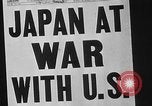
United States declares war on Japan, December 8, 1941, marking U.S. entry in World War 2
New York Daily News headline reads 'Japan at war with U.S.' Journal American newspaper headline reads:'US votes war'. Boxes of M-1 ammunition being off-loaded from a ship by African American soldiers, and placed on a roller conveyer. U.S. Army tank, trucks, and aircraft ready for shipment overseas.
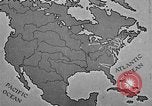
British film intended to acquaint British people with United States landscape, rail transportation, and farming history.
British World War 2 era film showing scenes in the United States from earlier in the 1900s. Film opens showing 19th Century animated map of the United States. It traces the development of the railroads in the U.S. It shows rail lines reaching the Missouri River by the year 1860. (Narrator states this took 250 years to happen.) But in another 10 years, the map shows the Union Pacific and other rail lines extending two the West Coast, and U.S. commerce shifting, from North-South movement, to East-West (with an animated steam locomotive moving across the map). Chicago is highlighted as the greatest railway junction in the world (the "Piccadilly Circus" as the British narrator describes it). View of a late 1800s model steam locomotive train pulling freight railroad cars on railroad tracks in a desert area of the Western United States. Point of view from camera on moving railroad train pointing straight down at railroad tracks moving by at high speed. Landscape and wide views of the arid Western parts of the U.S. Group of Native American Indians watching a railroad train pass. Construction supplies being offloaded from a train. A wind-driven water pump. Buffalo herds affected by the railroads. Wire fencing installed to control cattle on large Western ranches. Large team of horses pulling late 1800s wheat harvesting farm equipment as it harvests wheat in fields. Views of wheat grains being poured at high volume. Cattle roaming in the high country. Views of Chicago stock yards. A man marking in chalk on a Board of Trade chalk board, indicating the prices of farm commodities including wheat, corn, oats, and rye. Various views of steam locomotives pulling trains throughout the rail network, including some 20th century trains near the end of the film, and some close-up views of wheels turning fast on moving railroad trains.
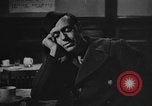
Model community, growth in cities, and town meetings in the United States.
A U.S. Army soldier seated on a chair takes a nap. A cup kept in front of him on the table. Children walking on sidewalk in small town America. Downtown view of small Indiana town. View of an American family of a small town seated in dining room for a dinner meal. Children exit a one room school house. Both a well-kept high school building and a rural simple school are shown, with boys and girls in bare feet exiting the poor rural school down a wooden ramp. Men lined up for work. Children playing in slum and tenement areas in poverty stricken areas. Quick views of skyscrapers, new schools, buildings, colleges (including view of Rice University in Houston Texas) and art galleries in the United States, including the National Gallery of Art entrance. A Texan in a cowboy hat delivers a John Randolph famed "Texas Brag" saying, "If all the hogs in Texas were one big hog, he could dig the Panama Canal with three roots and a grunt.” The National Gallery of Art in Washington, D.C. Labor organizer John L. Lewis, president of the United Mine Workers of America (UMW) states, "The American Federation of Labor can help if it will, it can uphold anything, but we shall carry on." An American town hall meeting in progress. (World War II period).
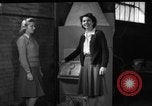
Working and parts of a smokeless coal furnace explained by an instructor in United States.
Two women stand near a coal furnace in United States. They open the upper door of the furnace. Burning coal in view. A woman adds coal from a bucket. She turns the coal with a poker. A woman checks ash from a tray in the bottom. A man checks the furnace. Another man shows that no smoke is in stove pipe above the furnace. Students gather around as designer explains the parts and the functioning of the furnace with the help of a diagram. The designer and another man demonstrate how the smokeless fire box can be retrofit into existing furnaces. (World War II period).
CRITICALPAST.COM: About Us | Contact Us | FAQs - How to Order | License Agreement | My Account | My Lightboxes | Shopping Cart | Advanced Search | Featured Collections | Website Terms & Conditions | Privacy Policy ©2026 CriticalPast LLC.
License Agreement |
Terms & Conditions |
Privacy Policy
©2026 CriticalPast LLC.