


 Francais
 Deutsch
 Italiano
Refine Your Search
Bolinas Beach California USA 1934 stock footage and images
- Showing 14683 to 14688 of 26867 results more
more Hide
Hide
Harry S. Truman and his family
President Harry S. Truman at his home in Missouri with his wife and daughter Margaret. He visits a men's wear store and shakes hands with neighbors. Truman kissed by March of Dimes poster girl.
Work and achievements of Harry S. Truman during his first Presidential term in the United States
President Harry S. Truman marches with veteran soldiers of U.S. Army Company D (129th Field Artillery) with whom he served as an officer in World War 1. Wide view of men lined up on White House lawn. Disabled veteran soldiers of World War 2 greet the President. Narrator discusses problem of lack of housing for veterans and their families after World War 2. Aerial view of trailer homes or recreational vehicle (RV) camper units lined up in open space, serving as temporary housing for veterans. Truman sitting at desk while he signs the Veterans Emergency Housing Act of 1946. Views of long lines of new homes being built, and construction workers hammering to build frames of new houses in the United States. During a time of price inflation, scene shows grocer changing price signs on eggs, meats, cheeses to show increasing prices. Truman ata work in his office reviewing paperwork at his desk. Narrator mentions Taft Hartley Labor Act that Truman vetoed. View of car on road with sign on side that reads, "Veto Hartley Taft Slave Labor Bill." President Truman reading at his desk. Close up view of cover page of report entitled "To Secure These Rights. The Report of The President's Committee on Civil Rights. View of Episcopal church Bishop Henry Knox Sherrill seated at a desk. Bishop Sherrill is talking to another man. Narrator states that Truman acted on a civil rights program recommended by Bishop Sherrill, head of the Civil Rights Commission. Car pulling up to portico of White House and view of President Truman shaking hands with visiting President of Mexico, Miguel Alemán. President Truman being presented a sacred Torah by Israeli President Weizmann. Discusses foreign policy matters with Secretary of State George Marshall and comes up with Truman doctrine, Marshall plan and European recovery program. View of Truman signing Economic Cooperation Act of 1948 on April 3, 1948 (of which the Marshall Plan was a part).
President Franklin D. Roosevelt and Churchill meet a number of times to discuss the strategy for World War 2
President Franklin D. Roosevelt and English Prime Minister Winston Churchill meet a number of times during Atlantic Conference, then in Washington and at Casablanca Conference to discuss the preparations and strategy for World War II. Weapons manufactured and transported.
American invasion of French Africa during World War 2
General Dwight D. Eisenhower, Secretary of State George Marshal and other officers prepare the strategy for American invasion during World War II. America invades French African territories. Bombs dropped over the area.
The United States demobilizes following World War II
Opening illustrated slate shows reduction of Amercan Armed forces personnel from more than 12 million in 1945 to only a little over 1 and a half million in 1947. U.S. Navy submarines are seen docked in storage. Men work spraying protective coatings over guns on Navy ships as they are placed in storage in the "Mothball Fleet." A lone sailor is seen on the deck of a ship with vast number of mothballed Navy destroyers in the background. A B-24 Liberator bomber being dismantled and a B-17 parked with engines removed, seen through stack of propellers in foreground. Airman sets a demolition charge. Views of several bomber aircraft being blown up as junk. Stacks of junked and scrapped American war materiel rusting. View inside a mill where molten metal is being processed (ostensibly recycled from junked war materiel). Narrator speaks of beating guns into plow shares. Several views of molten metal being poured into and from ladles. Views inside post-war factories returning to peace-time production, where industrial heavy equipment, railroad wheels, kitchen appliances, home appliances, rubber tires, and new 1946 Ford automobiles are assembled (looking exactly like the 1942 models).
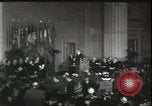
Signing of the NATO treaty in Washington D.C., United States
President Harry S. Truman introduced to foreign ministers of NATO member countries by Secretary of State Dean Acheson in Washington D.C., United States. President delivers a speech on the occasion of signing of NATO (North Atlantic Treaty Organization) treaty. He hopes that members will cooperate in solving common problems and in their efforts of development.
CRITICALPAST.COM: About Us | Contact Us | FAQs - How to Order | License Agreement | My Account | My Lightboxes | Shopping Cart | Advanced Search | Featured Collections | Website Terms & Conditions | Privacy Policy ©2026 CriticalPast LLC.
License Agreement |
Terms & Conditions |
Privacy Policy
©2026 CriticalPast LLC.