


 Francais
 Deutsch
 Italiano
Refine Your Search
Bolinas Beach California USA 1934 stock footage and images
- Showing 14845 to 14850 of 26867 results more
more Hide
Hide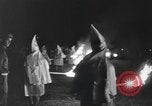
Members of Ku Klux Klan perform ceremonial cross burning in the United States.
Ku Klux Klan (KKK) members during a cross burning ceremony in the United States (possibly Stone Mountain Georgia but location is not confirmed). A U.S. Army soldier in uniform is seen at far left Members of Ku Klux Klan dressed in robes and masks move in a circle carrying lit torches. The U.S. Army soldier sets fire to a huge cross using a lit torch. He steps away from the burning cross. The fire soars up and across the cross quickly. The soldier and KKK members stand in a wide circle around the burning cross. They throw their lit torches in the direction of the cross, landing on the ground..
African American airmen being trained for World War II at the Tuskegee Institute in Alabama.
African American colleges in the United States during World War II. College curricula adjusts to war needs as they prepare students for various military and civilian occupations. A statue of Booker T. Washington. Tuskegee Institute campus in Alabama. African American United States Army Air Force pilots being trained at the institute (Tuskegee Airmen). An aircraft takes off. Airmen in a class. Students being trained for jobs in an aviation plant. Scientists and technicians in a laboratory as they conduct research on the science of nutrition. They work to get alcohol from agricultural products like potato. Women learn automotive maintenance skills to take up jobs during the war time.
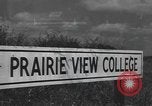
African American students gain knowledge of medicine, economics, chemistry at Prairie View College and Howard University in the United States (WW2)
African American colleges in the United States during World War II. College curricula adjusts to war needs as they prepare students for various military and civilian occupations including war material production at factories and manufacturing. A sign reads ' Prairie View College' (Present day Prairie View A&M University, 100 University Dr, Prairie View, TX 77446) in Prairie View, Waller County, Texas. College campus with students milling about. Students at an agriculture class learn to maintain farm equipment, animal husbandry. African American students work in forges and machine shops making vital parts for the war effort in World War 2. They work on machines helping to meet war production worker manpower requirements. A building at the Howard University (2400 6th St NW, Washington, DC 20059) in Washington DC. Students in a mechanical design class learn to make designs of tanks, guns, and other war equipment. Students in a meteorological class study celestial navigation to guide airplanes. Students in a laboratory study the chemistry of a powder. At Howard University medical school students being taught the use the gravity of blood plasma in the battlefield by noted pioneer in blood plasma, Charles R. Drew. At the Howard University College of Liberal Arts, students learn the economics of war. An African American professor teaches a class on Industrial Accounting.

War industries lead to overcrowded cities and lead to problems of housing, education and congestion in Mobile, Alabama (WW2)
"War Town" shows how War industry leads to problems in Mobile, Alabama during World War II. A large number of war workers at a shipyard in Mobile as they go to work building ships for the war effort in World War 2. Cranes at the shipyard. Men work at the shipyard as they fit Allied torpedoes. The men weld and rivet ship parts. Men work in various other factory and manufacturing industries like paper, aluminum, gypsum, steel, and machine shops supporting need for war material. Many men move out walking through the gates of the "Alabama Dry Dock and Ship Building Company" in Pinto Island, Mobile, Alabama. Many people in war materiel industry leads to congestion on roads and traffic on streets of Mobile. Crowd of workers on foot leaving manufacturing areas. Crowd of workers tries to board a city bus. Woman bus driver puts full bus in gear and drives away. Bus, car, and pedestrian traffic in Mobile on street corner with W.T. Grant Company in background. Long queues outside liquor stores, restaurants, and pay windows. Overcrowded schools as children exit the Barton Academy (Barton Academy Foundation P. O. Box 571 Mobile, Alabama 36601-0571) and are seen playing on playgrounds. Men drink in a crowded bar and men and women dance in a makeshift tented dance hall. Various rides including a Ferris wheel at an amusement park.
War industries lead to overcrowded cities and housing shortage in Mobile, Alabama; also pre-war poor housing in Mobile
Views of old Mobile Alabama downtown areas and homes during early 1940's. War industry leads to problems in Mobile, Alabama during World War II. Buildings in the city which now have been converted into homes for men war workers and women war production workers in the shipyards and factories making ships and airplanes, tanks, guns and other war material. A building converted into a dormitory for women. Men outside a building with a sign that reads ' Room board '. Girls in a room. A garage that has been converted into a boarding facility for women war workers. A tent area with a large number of migrant worker families living in it. Children play outside the tents. A woman washes clothes. A man cooks. A woman stands next to a cow and a man sits with his dog outside a shanty house. Next scene is pre-war view of dilapidated and run-down shacks housing African American families in Mobile. African American men, women, and children outside shanty houses in slum areas of Mobile. Scene changes to during war time again, with people at the office of the National Housing Agency. A sign reads ' Mobile housing board'. People at the office of the housing board.
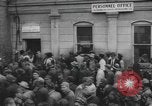
After solving problems related to housing, war production goes up at a shipyard in Mobile, Alabama in World War 2.
War industry leads to problems in Mobile, Alabama during World War II. A large number of people gathered outside the Personnel Office in Mobile. Congress provides 2 million dollars for housing of war workers (building tanks, guns, ships and other war material in factories, manufacturing plants, and shipyards for the war effort). Shows racially segregated housing and facilities for African American workers versus white workers. Views of a cleared slum area where African Americans had been living been living in poor quality homes before the war. Shortage of housing is addressed with new housing for African American war workers, "Certified Colored War Workers". African American children play and eat at a nursery. Dormitory units for single war workers equipped with gymnasium and other basic facilities. Government owned trailers built by the Maritime Commission near a ship yard. The problem of providing a day nursery is undertaken. Modern permanent homes for war workers who can afford them. After meeting the problems like housing and sanitation, production goes up at the ship yard. A new ship being launched at the ship yard. A sign on the ship reads ' Cedar Mills'.
CRITICALPAST.COM: About Us | Contact Us | FAQs - How to Order | License Agreement | My Account | My Lightboxes | Shopping Cart | Advanced Search | Featured Collections | Website Terms & Conditions | Privacy Policy ©2026 CriticalPast LLC.
License Agreement |
Terms & Conditions |
Privacy Policy
©2026 CriticalPast LLC.