


 Francais
 Deutsch
 Italiano
Refine Your Search
Bolinas Beach California USA 1934 stock footage and images
- Showing 145 to 150 of 26918 results more
more Hide
Hide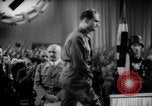
Adolf Hitler speaks at the closing session of the Nazi 6th Party Congress at Nuremberg in 1934
Scene is in the Luitpoldhalle meeting hall at the Nazi party Congress Grounds (Reichsparteitagsgelände) in Nuremberg Germany, during the 6th Party Congress of 1934. Rudolf Hess strides to the podium and simply says "The leader speaks," whereupon the assembly cheers enthusiastically, as Adolf Hitler stands quietly at the podium, until the cheering subsides. He then begins his speech noting that the 6th Party Congess is ending. As he continues to speak about the significance of the National Socialist Party, extoling its virtues and importance, the camera shows closeups of party leaders listening, including: Rudolf Hess; Joseph Goebbels; Hermann Goering; Heinrich Himmler; Baldur von Schirach, and others. As Hitler reminisces about the days when it was hard to be a National Socialist, the assembly responds with cheers of recognition. Thereafter, the film shifts back and forth between Hitler at the podium, and scenes of the audience responding, and of individuals listening intently. Glimpse of Goering standing and looking about, as Hess takes the podium in the noisy wake of Hitler's speech. Hitler giving arm-bent Nazi half salute. As enthusiastic cheering continues, Hess turns again and salutes Hitler. But it is difficult to quiet the crowd. Finally, Hess shouts that the "The Party is Hitler's but Germany is Hitler's and Hitler is Germany's (Die Partei ist Hitler, aber Deutschland ist Hitler und Hitler ist Deutschland). Then he turns and leads a round of "Sieg Heils" for Hitler. Then the entire assembly begins to sing the Nazi Party anthem (Horst-Wessel lied), in a slow deliberate tempo, as light fills the stage area of the hall. Camera focuses on a giant swastika, zooms in, and fades to marching troops.
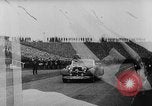
Rally scenes from the 6th Nazi Party Congress in Nuremberg, 1934
Rally at the Zeppelin Field, during the 6th Nazi Party Congress, Nuremberg, 1934. 6th Hitler rides around the field in an open car to the cheers of attendees. In dramatic scene, Heinrich Himmler, Adolf Hitler, and Viktor Lutze walk slowly along wide path between sea of rally participants standing silently at attention on both sides of them, as mournful music is played. A large memorial wreath is seen and several large burning flames, on pillars.
U.S. Army Air Corps 1934 Alaskan flight progressing through Prince George, British Columbia, and White Horse Yukon, Canada
YB-10 aircraft, of the U.S. Army Air Corps 1934 Alaskan flight, are parked on a flower-covered meadow in Prince George, British Columbia, Canada. An animated map shows onward flight from Prince George, to White Horse, Yukon, Canada. A formation of YB-10s in flight, and then, parked on a grassy field in White Horse. Lieutenant Colonel Henry H. "Hap" Arnold, leader of the expedition, and some of his fliers stand, conversing. In the background, others are busy refueling their aircraft. One flier is seen rolling a 55 gallon drum of gasoline. Animated map depicts futher progress to Fairbanks, Alaska. Views of rivers and mountains, and ground below with patches of snow, as seen from one of the aircraft in flight.
Professor Eugen Sänger's S.R.11 and 12 Rocket motors in 1934
Drawings and pictures of Professor Eugen Sänger's S.R.11 and 12 Rocket motors from August, 1934. He holds a motor in his hand and points out fuel inlet ports and the flame exhaust port. Views of the S.R.12 rocket motor on the test stand in Sänger's workshop in Vienna.
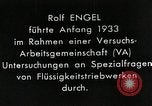
The German Air Sports Association is absorbed into the Experimental Department of the German Air Guard in 1934
Rolf Engel led a 1933 study group on special problems of liquid fueled rocket engines. Engel and members of the study group are seen at work. Beginning of a standardization and classification for the rocket problems. A diagram showing characteristics of rocket engines with standard nomenclature. A man with standardized rocket engine testing equipment. View of the standardized 6-copy multiple professional device for recording rocket engine performance. The work of Rudolf Nebel on the Rocket field of Berlin-Reinickendorf was continued under the leadership of Fritz Beck of the testing department of the German air guard (LSS) in 1933. But it was canceled in the spring of 1934 when the LSS took over direction of the German Air Sports Association. Letters to the Association noting that lessons of World War One point out the value of the Associations technical capabilities to National defense. They also mention matters of particular interest to the German Air Guard, such as rockets and Rocket torpedoes. An organizational chart showing various components under the Experimental Department of the German Air Guard.
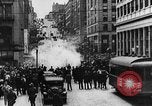
1934 West Coast waterfront strike and other labor strikes; scenes of violence between strikers and police
Labor riots and strikes on streets in San Francisco, California. Striking workers of Maritime Union on street. Strikebreakers and strikers start a riot in the street. Several men are hit by strike breakers, with clubs. and are beaten. A man sits with blood streaming down his face. A man sits near him. Men grab a man and push him along the street. Policemen fire tear gas into crowd. Police officers mounted on horseback push back the huge crowd. Soldiers with bayoneted rifles push back strikers. Man with cut on his head receives medical attention from another man. Police push back protestors. Strikers of the International Seamen's Union (I.S.U.) on picket line. Signs for Ship's masters, mates, and Pilots on strike. Striking workers use clubs and smash windows of a warehouse during violent protest. Final scenes show unrelated labor strife, elsewhere, with United States soldiers standing guard near railroad tracks at entrance to a coal mine.
CRITICALPAST.COM: About Us | Contact Us | FAQs - How to Order | License Agreement | My Account | My Lightboxes | Shopping Cart | Advanced Search | Featured Collections | Website Terms & Conditions | Privacy Policy ©2026 CriticalPast LLC.
License Agreement |
Terms & Conditions |
Privacy Policy
©2026 CriticalPast LLC.