


 Francais
 Deutsch
 Italiano
Refine Your Search
Bolinas Beach California USA 1934 stock footage and images
- Showing 15985 to 15990 of 26867 results more
more Hide
Hide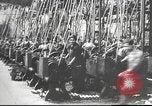
Ammunition manufacturing in the United States during World War I
Men and women work at belt-driven lathes on a crowded machine shop floor in an armaments factory during World War 1. A stack of machined shell cylinders sits on the floor. In another area of the munitions plant, workers are seen with large shells and caps for them. At another machine shop, workers turn large diameter shells in lathes. Camera pans across various work stations where different manufacturing processes are taking place. Closeup of a woman working on a standard size lathe, and of other women working in the machine shop. Men and women sealing hot shells and handling them large tongs. Women working on small caliber ammunition. Women stacking finished shell in trays. Women weighing out gunpowder into sacks, and others loading the sacks into boxes that they dump onto open shells, where women use them to fill shells. A group of women placing objects into shells (fuses?) and sealing them, as a superviser watches. A man taking the shells from a conveyer belt and packing them in boxes. Another area of the plant where items are packed into containers. (World War I; World War 1; WWI; WW1)
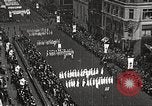
U.S. women nurses parade; Navy Yeomen (female) and women Marines are reviewed, on Red Cross Day, in World War I, May 1918
U.S. Nurses from wartime service units parade on Red Cross Day, in May, 1918, Washington, DC. Views of nurses in white uniforms and others in black, parading on the streets, accompanied by military bands. Red cross flags fly from various places along the streets. A mass of red cross flags near a reviewing stand. Secretary of the Navy, Josephus Daniels, walking with Naval officer and Assistant Secretary of the Navy, Franklin D. Roosevelt, inspecting rows of uniformed U.S. Navy women Yeomen (F) on a field in Washington DC. Behind Roosevelt, is Admiral William Shepherd Benson, the first Chief of Naval Operations (CNO), accompanied by Major General George Barnett, Commandant of the U.S. Marine Corps. The tower of the Post Office Building is visible in background. The women yeomen parade on the field, watched from the sidelines by Secretary Daniels and Assistant Secretary Roosevelt, who is conversing with Admiral Benson. The sequence closes with women U.S. Marines, in uniform, on parade. (World War I; World War 1; WWI; WW1)
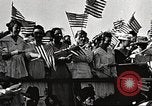
American Expeditionary Forces arriving in France, during World War I
A large group of French women stand on a pier, waving American flags, as a troop ship arrives at a port in France, during World War 1. American Expeditionary Forces (AEF), soldiers of the U.S.1st Infantry Division, crowd her deck. The troops are seen leaving the ship by gangplank, and crowding the pier. They then assemble and march off. They proceed through dense crowds on both sides of their line of march. U.S. troops marching along a French city street are approached by French women expressing their appreciation. A French policeman walks with a bicycle, alongside the troops. French policemen march along, behind the Americans. Scene shifts to American soldiers playing musical instruments as others dance with women at an outdoor waterfront cafe, as they wait for transport. Allied officers are seen standing in front of a collection of canvas covered shelters, with a sign above, reading: "Camp Franco-Americain." (This is where arriving American troops undergo training by the French.) (World War I; World War 1; WWI; WW1)
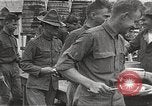
American Expeditionary Forces newly arrived in France, getting settled, during World War I
American Expeditionary Forces (AEF) soldiers of the U.S. 1st Infantry Division, in camp, after arrival in France, in World War 1. The troops, wearing campaign hats (M1912 Service hats) are seen going through a mess line, with cooks dispensing food into their individual mess kits. One soldier clowns around with a large loaf of bread. He bites a piece from it and offers the loaf to other who do likewise. American soldiers sitting on the ground, appear to be enjoying themselves as they drink from small bottles.
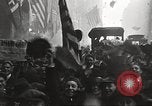
Americans celebrate the Armistice ending World War I
Scenes of Americans celebrating the end of World War 1, in several cities. Revelers in New York City, wave flags and cheer. Several hold up newspapers announcing German surrender. Some men ride atop a car and pummel an effigy of the Kaiser. Scene shifts to other locations where joyful crowds are celebrating. Cheering crowds in front of the Old Executive Office Building, in Washington, DC, wave flags. One group holds up an effigy of the Kaiser, holding a white flag of surrender.
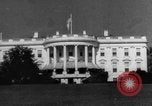
President Roosevelt and Cordell Hull in Washington DC; U.S. war production; German U-boat attack
Japanese newsreel during World War 2 shows United States President Franklin D Roosevelt signs the Lend Lease Act in Washington DC. A view of the White House. The United States flag flutters on the top of the building. United States Secretary of State Cordell Hull speaks. United States factories gear up for war production. War production workers busy with machines in a factory. A partially completed U.S. fighter aircraft on a factory floor. Men work on hand operated machines. President Roosevelt signs the Lend Lease Act. Supplies are loaded aboard ships. United States military tanks, trucks and ammunition carried by cranes onto the ships. A Red Cross van loaded aboard a ship. Scene changes to Atlantic Ocean and a convoy of ships at sea. A German submarine crew gets ready to submerge. German U-boat submerge. A convoy of ships underway at sea. Heavy seas and large waves as seen from deck of ship during rough seas. The ships are hit by German torpedoes. A ship sinks after being hit. Survivors of the Allied ship on a raft. Clip contains Japanese slates and Japanese narration.
CRITICALPAST.COM: About Us | Contact Us | FAQs - How to Order | License Agreement | My Account | My Lightboxes | Shopping Cart | Advanced Search | Featured Collections | Website Terms & Conditions | Privacy Policy ©2026 CriticalPast LLC.
License Agreement |
Terms & Conditions |
Privacy Policy
©2026 CriticalPast LLC.