


 Francais
 Deutsch
 Italiano
Refine Your Search
Bolinas Beach California USA 1934 stock footage and images
- Showing 163 to 168 of 26917 results more
more Hide
Hide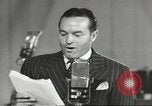
Judy Garland sings 'Over the Rainbow' on the 'Command Performance U.S.A.' radio program
Comedian Bob Hope introduces Judy Garland on the radio program 'Command Performance U.S.A as it is being recorded at a Hollywood studio in Los Angles, California. Judy Garland sings 'Somewhere Over The Rainbow.'
U.S. Army Air Corps airplanes and crews preparing for Alaskan Flight in 1934
Slate lists planned flight legs of U.S. Army Air Corps aircraft as: Washington DC to Edmonton, Alberta; Fairbanks Alaska to Seattle Washington; and Washington DC to San Diego California. Another slate explains that under command of Lieutenant Colonel H.H. Arnold,ten B-12 bombers demonstrate their capabilities in an 18,000 mile flight. Lt. Col Henry H. Arnold, U.S. Army Air Corps, stands in front of a large map on which planned flights are charted. Sign behind him identifies "Engineering Office," at Patterson Field. Arnold uses pointer to show the routings to another officer who has joined him. The next sequence shows Arnold describing the flight plans to more participants, using more charts. Camera pans across ten assembled Army personnel. Lt. Col. Arnold poses with 15 aviators in front of a YB-12 bomber (displaying air intake on port side of engine). Camera pans over eighteen mechanics and ground crewmen posed in front of the bomber. Symbol of eagle superimposed over map of alaska, is painted on side of forward fuselage. Arnold discussing the mission with Army officers and civilian officials, as they walk past a YB-10 (with air intakes atop the cowlings). Camera pans across Patterson field ramp, where officials, automobiles, YB-10 aircraft, and local civilian workers, including several women, are seen. Crew chief seen refueling a YB-10 with long hose from an underground fuel tank installed at edge of the ramp.
Babe Ruth honored before his final baseball game with New York Yankees, 1934
Brief newsreel clip covering Babe Ruth's final game with the New York Yankees at the Griffith Stadium (Present day Howard University Hospital, 2041 Georgia Ave NW, Washington, DC 20060, United States) in Washington DC, USA. Players, photographers, and dignitaries honor Ruth before the game with ceremony around home plate. Man presents Ruth, wearing the New York Yankees road uniform, with an award. Ruth accepts it and talks briefly, standing next to his wife Claire, seen at right. Brief shot of Washington Senators pitcher Orville Armbrust throwing. (Armbrust would get the only win of his major league career in this game.) Ruth, pictured in a different game and in home uniform, steps into batter's box. Scene of Ruth hitting a home run from earlier in his career.
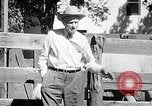
Farmers explain how they suffered the drought and dust bowl storms in Dalhart, Texas, during 1934.
Farmers of Dalhart, Texas describe the terrible sand storms they suffered in the region during 1930s. In 1960 interview, farmer Harold Hogue describes a severe dust storm he experienced in 1934. Scene change to mid 1930s footage showing dust bowl views of desolated farms, drought stricken lands and houses and farm equipment all piled high and buried in dust and dirt. A 1960s' farmer on his tractor describes how the dust storms destroyed his wheat crops and left sand and dust on everything. He states that they experienced 110 dust storms in the Spring of 1934.
Ford promotional film about progress made by Ford in 1934 and prospects for 1935 during Great Depression
Ford promotional film. Man talks about the progress made by Ford in 1934. Views of Ford's Administration Building in United States. Henry Ford in conference with two other men. Reporter talks over prospects for 1935. Henry Ford says, "As far as we're concerned, the Depression is over....we'll build a million cars next year." Interviewer says, "Well that will do a lot to pull the country out of the Depression." Ford answers, "Well maybe we'll do better." Newspaper plant with newspaper printing presses rolling new edition. Views of several processes in printing newspaper. Headlines reads, 'Ford Will Build Million Cars in 1935', 'End of Depression seen in Ford Plant'.
Philadelphia sportswriters present trophy to 'Dizzy' Dean, named the outstanding athlete of 1934
Jerome Hanna 'Dizzy' Dean named outstanding athlete of 1934 by Sports Writers Association in Philadelphia, Pennsylvania. Dean, who led baseball's St. Louis Cardinals to World Series title that year, accepts a drink and the trophy. Men in tuxedos eat at the banquet. The man in closeup at TC: 00:35 is longtime Philadelphia Athletics owner and manager Connie Mack. Dean bites into his chicken and laughs.
CRITICALPAST.COM: About Us | Contact Us | FAQs - How to Order | License Agreement | My Account | My Lightboxes | Shopping Cart | Advanced Search | Featured Collections | Website Terms & Conditions | Privacy Policy ©2026 CriticalPast LLC.
License Agreement |
Terms & Conditions |
Privacy Policy
©2026 CriticalPast LLC.