


 Francais
 Deutsch
 Italiano
Refine Your Search
Bolinas Beach California USA 1934 stock footage and images
- Showing 17281 to 17286 of 26867 results more
more Hide
Hide
In his address President Johnson confronts the problem of racism and racial discrimination in the United States.
On March 15, 1965 U.S. President Lyndon B. Johnson addresses a joint session of the Congress to urge the passage of new voting rights legislation in the United States. Members of the Congress applaud. President Johnson addresses that government will treat every citizen equal. Every American will be given equal opportunity and every American citizen must have an equal right to vote in the Voting Rights Act.
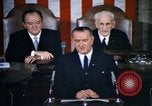
President Johnson addresses joint session of Congress and advocates equal voting rights and end of racial discrimination.
U.S. President Lyndon B. Johnson addresses a joint session of the Congress to urge the passage of new Voting Rights Act legislation in the United States. He references the Emancipation Proclamation. In his speech, a week after racial violence in Selma, Alabama, President Johnson says that this is the time for civil rights, racial equality, and justice and 'It is right in eyes of men and God'. He says that the real hero of struggle is the American African American and equality depends upon moral rights and we should respect the law and its orders. Members of the Congress applaud. He adds in his address that he wants to be the President to educate young children, to help to feed the hungry, to help poor to find their own way and to promote laws. The joint session of the Congress stands and applauds after President Johnson's speech.
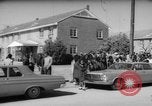
Activities of marchers in Selma, Alabama during the Civil Rights Movement.
Activists work to register African American voters in Selma, Alabama during the Civil Rights Movement. Tow cars parked beside a road. African Americans standing near the cars. Demonstration notices for marchers on a tree pole for the Selma march. The marchers standing outside Brown Chapel. They come out from the building. Views of demonstrators organizing and assembling, some gather in a circle and sing and clap their hands. A group of white religious clergy men standing and talking together.
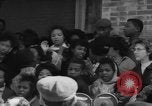
A large crowd of demonstrators in Selma, Alabama during the Civil Rights Movement.
Activists work to register African American voters in Selma, Alabama during the Civil Rights Movement. African Americans and White Americans demonstrate and march for civil rights. A man holds a microphone in his hand. A man at the demonstration takes photos with a camera. A large crowd of demonstrators. Two cars in the foreground. African American civil rights movement leader John Lewis is interviewed by media persons.
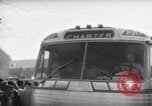
Civil rights demonstrators assemble for their march from Selma, to Montgomery, Alabama
Demonstration growing out ot frustrated efforts to register African American voters in Selma, Alabama during the Civil Rights Movement. Large number of civil rights demonstrators assemble in Selma, preparing to march from Selma to Montgomery, Alabama. A charter bus arrives carrying marchers for demonstration. A crowd of demonstrators in the background. A large crowd of demonstrators assembling. A traffic jam on a road. One of the organizers of the march instructs participants and they line up prepared to proceed. Demonstrators hold protest banners. The banners read : 'White Alabamians, Say what is right, Do what is right', 'Police intimidation enslaves us all', 'We saved our children a just society' and 'Silence is no longer Golden'. A White American woman, holding a protest banner, is asked questions by media persons. Marchers standing on a road.

Civil Rights leaders, including members of the Civil Rights "Big Six" pose for photographs at the White House in Washington DC
Civil rights leaders at the White House in Washington DC. The "Big 6" leaders pose at the White House. Martin Luther King, Jr., a leader in the American Civil Rights Movement moves ahead and is greeted by leaders present. Cameramen take photos. Martin Luther King Jr. and other leaders stand in a group and talk. Martin Luther King Jr. and Dorothy Height speaking to Robert Kennedy. James Farmer, A. Philip Randolph, Roy Wilkins, and Whitney Young also seen, as well as Vice-President Lyndon B. Johnson. View of the White House.
CRITICALPAST.COM: About Us | Contact Us | FAQs - How to Order | License Agreement | My Account | My Lightboxes | Shopping Cart | Advanced Search | Featured Collections | Website Terms & Conditions | Privacy Policy ©2026 CriticalPast LLC.
License Agreement |
Terms & Conditions |
Privacy Policy
©2026 CriticalPast LLC.