


 Francais
 Deutsch
 Italiano
Refine Your Search
Bolinas Beach California USA 1934 stock footage and images
- Showing 17929 to 17934 of 26867 results more
more Hide
Hide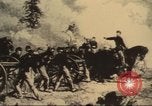
Union soldiers print the first issue of Stars and Stripes newspaper during the Civil War in the United States.
The history of the Stars and Stripes newspaper. Union soldiers print the first issue of Star and Stripes newspaper in a captured press in the U.S. on 9th November,1861 during the Civil War. World War I scenes show soldiers disembarking from a ship and advancing on a battlefield. Commanding Chief of the American Expeditionary Force John J. Pershing writes for the newspaper. Soldiers greet the Chief and wish him luck. After the end of World War I newspaper publication is ceased. During World War II the newspaper publication starts in London, England in 1942. Publication of the Pacific Stars and Stripes newspaper after the end of hostilities in Europe. Headlines in various editions of the Stars and Stripes.
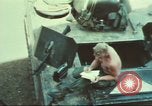
News report and informational programs are broadcast to a large majority of servicemen in the United States.
American servicemen are kept informed by American Forces Radio and Television Station facilities. A soldier listens to a radio and writes a letter. Another soldier in southeast Asia looks at a post with directional arrows showing distances thousands of miles away to cities like Seattle, San Francisco, and Denver. He sits on a bench and listens to the radio. Aerial view of the broadcasting station part of the American Forces Radio and Television Station. Power is supplied by portable generators housed in wooden shacks. View of radio studios, control rooms and administrative blocks. A man serving as Disc Jockey or DJ operates a control panel and a phonograph turntable to play a record. He turns dials on the control panel and works on a program schedule. View of a reel to reel tape machine running. News report and informational programs are broadcast to a large majority of servicemen. Military cooks working in a kitchen to prepare food. Army soldier standing at washroom sink and shaving, while listening to a portable radio. Two Army soldiers, one white and one African American, playing pool or billiards while listening to a portable radio. Soldiers on a rest break during a patrol in the Vietnam War listen to a radio.
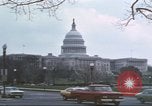
Men work with news ticker tapes in a newsroom at the American Forces Radio and Television Station in Washington DC, U.S.
American Forces Radio and Television Station facility in Washington DC, United States. The U.S. Capitol. Traffic on streets. A man sorts and checks news ticker tapes. Rolls of ticker tape emitting from a printing machine and growing in large coil piles. Another man feeds the ticker tapes in a teletype in a newsroom at the American Forces Radio and Television Station.
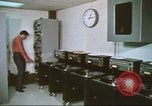
Personnel edit recordings at the American Forces Radio and Television Station in Washington DC, United States.
American Forces Radio and Television Station facility in Washington DC, United States. A man checks recordings of news, sports and special events at a station. The recordings are edited to remove commercial messages. Officials read program details at a operating schedule board. Men work at a station and feed the programs to a American Forces Radio and Television Station by short wave transmitters.
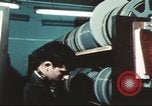
Operation of an American Forces Radio and Television Station.
Work of members at a American Forces Radio and Television Station in the United States. A man examine 16mm motion picture film before a program telecast. Station technicians playback 2-inch Quad reel-to-reel videotapes. Closeup of a monitor displaying a sports event. Closeup of waveform monitor. Men undertake technical maintenance of the television broadcast station. Transmitter is adjusted by one technician. A maintenance man examines a transmission dish.
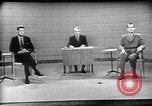
Senator John F. Kennedy and Vice President Richard Nixon face off in their first Presidential debate, in Chicago Illinois.
The first Kennedy-Nixon Presidential Debate in Chicago, Illinois. Moderator Howard K. Smith introduces the candidates-- Republican candidate U.S. Vice President Richard M. Nixon and Democratic candidate Senator John F. Kennedy. He talks about the opening and the closing statements to be given by the candidates. He talks about the questions which the panel of correspondents would ask the candidates. Senator Kennedy begins his statement. Kennedy talks about the direction of freedom for the Americans. He discusses domestic issues and the kind of society people live in. He talks about the strengths and the progress rate of the Americans. He urges people to make their country more powerful in every field. He feels disappointed about the unused steel-mill capacity, low rate of economic growth and poor educational system. He says he's not satisfied when he sees men like Jimmy Hoffa in charge of the largest union in the United States, and still free. He insists on overall infrastructural development and improvement of hydro power production where he says the Soviet Union has a lead. He states that every American should enjoy his full constitutional rights and they should meet their responsibilities. He says African American and Puerto Rican babies have much lower chances in education, work ,and advancement in the United States, and that this needs to change. He states that the government should provide effective programs and social security system for its citizens.
CRITICALPAST.COM: About Us | Contact Us | FAQs - How to Order | License Agreement | My Account | My Lightboxes | Shopping Cart | Advanced Search | Featured Collections | Website Terms & Conditions | Privacy Policy ©2026 CriticalPast LLC.
License Agreement |
Terms & Conditions |
Privacy Policy
©2026 CriticalPast LLC.