


 Francais
 Deutsch
 Italiano
Refine Your Search
Bolinas Beach California USA 1934 stock footage and images
- Showing 193 to 198 of 26917 results more
more Hide
Hide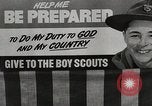
Boys of Japanese descent in an American Boy Scout Troop assemble and prepare a meal while camping
Japanese-American boys in Scout troop activities early during World War II, just before the opening Japanese internment camps and relocation centers.. A Boy Scout recruitment and fundraising poster with a smiling boy. Boys of Japanese descent stand in a line, raise their hands in the scout sign and say the scout oath, led by a Scout leader. Boys in scout troop prepare meal on campfire beside a tent. The Japanese flag flying. Likely west coast USA; possibly California.
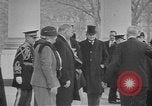
Franklin D. Roosevelt helps Americans to recover from the Great Depression in the United States.
Great Depression scenes and recovery efforts in the United States. U.S. President Franklin D. Roosevelt inaugurated as President on March 4, 1933. Scenes of Roosevelt and outgoing President Herbert Hoover leaving the White House together in a top-down convertible limousine before the ceremony. Roosevelt at the U.S. Capitol building during the inauguration ceremony as President of the United States. Roosevelt delivering the famous line in his speech, "The only thing we have to fear is fear itself." Jobless American men wait in unemployment relief lines to get work or jobs. Men in a bread line. Unemployed man with a large sign "Will take any job." Scenes of families migrating in the United States, with vehicles filled with belongings. Families and children suffering poverty and in makeshift camps and tenement dwellings during migration (usually migration west). Troops and bands march with American flags on Constitution Avenue during the Roosevelt Inauguration parade. Exterior view of U.S. Capitol Building framed by tree limbs. Men in an office empty heavy mailbags filled with letters (presumably to congress and senate). Government officials at a long table working on emergency banking laws in March of 1933. Scene of people flooding into a bank and making a run on the bank to retrieve deposits. President Roosevelt signs Emergency Banking Act in his office on March 9, 1933. View of White House lawn and White House. The CCC (Civilian Conservation Corps) is created to put unemployed young men to work on various conservation projects. CCC boys and men working on planting trees with pick axes and mattocks. Men and women in line to sign up for Emergency Work Relief programs. Officials write down the information for each worker as they are put to work in a variety of projects. Women and men, including white and African American men are seen getting assigned to work projects. A sign "USA Work Program WPA" advertising a suspension bridge work project of the Works Progress Administration in Los Angeles, California. People build roads, bridges and post offices. Cable fed out of a large spool as construction of a suspension bridge is shown. People work in factories. Four steam railroad locomotives preparing to run on parallel tracks. Close up views of railroad train locomotive wheels as they start moving and the train on tracks near factories. Various factory scenes including smokestacks, groups of workers entering factory for work shift and two different closeup views of a steam whistle blowing to mark the start or end of a work shift. A coal mining operation. Automated tools dig coal in shaft. Two coal miners take a break and eat. Crane hoists material at mine. A steel factory and hot molten steel pouring from a ladle.

Soviet flyers who flew from Moscow, Russia, to Vancover Washington, begin journey back to Russia
United Airlines DC-3 Mainliner aircraft lands and taxis to the airfield ramp,at Oakland, California. U.S. military and civilian officials, and newsmen gather around the airplane as its doors open. A crowd of spectators and well-wishers fill an area at the airfield terminal. Closeup of three Soviet flyers, standing and waving from the top of stairs at the plane's door. They are Pilot Valery Chkalov; Co-pilot Georgy Baydukov and Navigator Alexander Belyakov. They left Moscow, Russia, June 18, 1937 in a single-engine Soviet Tupolev ANT-25 aircraft on a flight over the North Pole and finally landed after 63 hours and 25 minutes, at. the U.S. Army Pearson Field in Fort Vancouver Barracks (Washington State, USA). Scene shifts to Pearson Field, where their airplane is being prepared for shipment back to Russia. U.S. Army soldiers package up recording instruments preserving evidence of the flight necessary to document their accomplishment. They remove and package loose articles, such as parachutes. View of the airplane being completely covered in protective tarp wrappings.
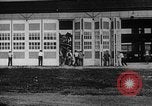
U.S. Army Air Service Fokker T-2 flown coast to coast nonstop by Lieutenant John A Macready and Lieutenant Oakley G Kelly.
On May 2, 1923, scenes of the first successful non stop flight across USA. Men open accordian doors to large hangar, revealing a specially modified Fokker T-2 airplane. Lieutenant Kelly and Lieutenant Macready, on the field, pose with Orville Wright. United States Army Air Service Fokker T-2 plane is pushed out of hangar by men. Painted on side of the plane is: 'Army Air Service Non Stop Coast to Coast'. Pilot gets ready as the airplane is fueled. Pilots and other Army officers on airfield. Animated map of the United States map illustrates course the flyers will take. Plane taxis on airfield. The Plane in flight and over Rockwell field, San Diego, California, and making a landing. Spectators on field greet the pilots as they climb down from the airplane.
United States aircraft carrier USS Independence (CVL-22) damaged in Operation Crossroad "Test Able," risk in daily lives and discussion of radioactivity.
'Radioactive contamination' about the hazards posed by the sinking of a United States aircraft carrier and the methods to control radioactivity. United States Navy F6F-3 Hellcat aircraft taking off from United States aircraft carrier USS Independence (CVL-22) in the Pacific Ocean during World War II. F6F-3 Hellcat firing rockets in air. Landing signal operator LSO using flags while guiding plane for landing on USS Independence. Kamikaze attacks at Tarawa. Anti aircraft guns on carrier cut down kamikaze planes as they attack. USS Independence flying USA flag at Tokyo Bay. Scene of surrender of Japanese at Tokyo Bay aboard the USS Missouri. Aerial view of atomic bomb blast at Bikini in 1946. The wrecked carrier Independence being towed away after it was used as a target for an atomic bomb test in 1946 as part of Operation Crossroads. Men at a construction site talk about contamination caused in sea water due to sinking of Independence containing radioactive waste. They comment, "she's all full of that radioactive poison" and with respect to eating fish in water near the ship, "would you eat fish again?" Two women dressed in furs, in a car, also discuss radioactivity. One woman says, "from what I've heard it's very dangerous. " View of 1940s car backing into oncoming traffic and almost causing an accident. An aerial view of atomic explosion at Bikini. Damaged USS Independence ship after TEST ABLE. Signs on board warn of radioactivity with words, "Keep Clear, Danger! Very Radio-Active" and "Radioactivity. Do not remain more than 2 hours." Men in small boat near USS Independence examine damage to the ship. Parts of the USS Independence being tested for radioactive contamination at the Naval Radiological Defense Laboratory NRDL, Hunter's Point Naval Shipyard in San Francisco, California. The USS Independence being sunk in 1951. View of Bikini atomic bomb blast within a bay surrounded by ships. Simulation shows the effect a similar blast would have on a coastal city as a radioactive cloud covers the city. Officers holding handkerchiefs to their mouths as they enter an office building from outside. Firemen climb ladders while putting out a large fire. A house wife working in a kitchen and responding to a pot boiling over on the stove burns her hand. A man slips on a bar of soap in the shower while singing. An officer honking at an oncoming car as he is run off the road. Woman driver dressed in furs exclaims to her friend about the bad driving of men. Officer just run off the road by woman driver exclaims, "Women !" with frustration. Aerial view of test nuclear explosion at Bikini Atoll.
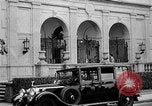
Creation of Good Neighbor Fleet of ships operated by Moore-McCormack Line with service from the U.s. to South America and Latin America
Exterior view of Pan American Union Building in Washington DC, with a 1930s Packard four door sedan-limousine parked in front. A man entering the building. Jefferson Caffery, U.S. Ambassador to Brazil, seated in an office and reviewing paperwork. Narrator describes the creation of the Good Neighbor Fleet (where Moore-McCormack Lines, also called Mooremack, was contracted to run three ocean liners of the U.S. Maritime Commission between the USA and South America, called the Good Neighbor Fleet.) Close up picture of brochure advertising the new fleet, and picturing the three ships (The California, Virginia and Pennsylvania from the former Panama Pacific Line, with new names Uruguay, Brazil and Argentina.) Next scene shows 3 men meeting (this is possibly Moore-McCormack Lines founder Albert V. Moore, on right, seated at a table and in discussion, possibly with U.S. Maritime officials. Man on left is possibly Emmet McCormack.) Passengers aboard liner SS Brazil as it departs port. Crowd on docks wave at the ship leaving New York harbor. View from on board SS Brazil in New York Harbor as a nearby tug boat sprays water. Skyline and skyscrapers of New York City's Manhattan Island seen in background. Map of South America showing route of a Good Neighbor ship. Good Neighbor Fleet ships at a harbor in South America. U.S. State Department diplomats in South America beside one of the ships as fleet service is inaugurated. Exterior view of Pan American Union building and its sign in Washington DC (later called the building of the Organization of American States). President Ortiz of Argentina, President Alfredo Baldomir of Uruguay, and President Getulio Vargas of Brazil are shown in discussion with various officials.
CRITICALPAST.COM: About Us | Contact Us | FAQs - How to Order | License Agreement | My Account | My Lightboxes | Shopping Cart | Advanced Search | Featured Collections | Website Terms & Conditions | Privacy Policy ©2026 CriticalPast LLC.
License Agreement |
Terms & Conditions |
Privacy Policy
©2026 CriticalPast LLC.