


 Francais
 Deutsch
 Italiano
Refine Your Search
Bolinas Beach California USA 1934 stock footage and images
- Showing 20029 to 20034 of 26867 results more
more Hide
Hide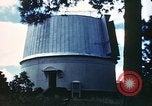
Native American Indian pow-wow event in Flagstaff; Indian people on reservations; cowboys roping and branding cattle in Arizona
Exterior view of Lowell Observatory building in Flagstaff, Arizona. People exiting a main building of the Arizona State Teachers College. Color film scenes from the annual Native American All-Indian Pow-Wow parade circa 1939 in Flagstaff, Arizona. Citizens line the parade route street and native American Indian Men in traditional regalia walk and dance traditional Indian dances on the streets of Flagstaff, Arizona during the Pow Wow. People watch on the sides of the parade route. A native American Indian Apache tribe woman with her young baby in a traditional wrapping. Close-up of an old Apache Indian woman who leans on a cane. The elderly native American woman then smiles and laughs. Cattle herds on a field. Apache horsemen and cowboys on horses work among the herd. Close views of cattle and calfs. Cowboys rope and lasso cattle. View of a burning fire and brands heating in the fire. Cowboys turn a cow on its side and cowboy brings a hot brand to brand the cattle.
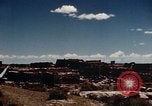
Lifestyle of Hopi Indian people at Oraibi, Arizona, and Navajo Indian people in Monument Valley area of Arizona
Native American Indian people of the Hopi people are shown living in Oraibi, Arizona in the late 1930s. Lifestyle of the Hope people. A woman climbs the stairs of a traditional Hopi dwelling, unchanged by modern civilization. Construction of houses is seen. Hopi women fashion pottery in an ancient village, while kneeling on a blanket on the ground. They shape bowls by hand. Completed Hopi bowls and vases, and ceremonial mats and baskets are shown. A man paints religious dolls known as Kachina dolls, each a replica of costumes worn during religious ceremonies. Children play with the dolls. Indian men work at a mining site, but they are constrasted with many Indian men who choose their traditional way of life. A Navajo American Indian man riding a horse passes near monuments and natural rock formations in the Monument Valley area of Arizona. A young navajo girl herds sheep and goats with Monument Valley rock formations in background, showing how children assist the tribe. Arid lands needing irrigation are shown, and narrator discusses need for irrigation to support growth of the Navajo nation. A Navajo brush shelter dwelling is shown, typical of those erected by the nomadic Navajo following their grazing animals from place to place. Navajo woman grinds corn in traditional manner by hand with a stone. Two Navajo boys watch her. A navajo woman wearing turquoise and silver jewelry. A navajo woman makes a rug by hand, using wool from Navajo sheep. The rug weaver follows no drawn pattern and uses her memory only to make the pattern. Prehistoric Native American Indian dwellings in the Canyon de Chelly are shown, protected as National Monuments, and originally home to ancient Navajo and Anasazi Pueblo people. An anthropologist or archaeologist participating in excavation at the Canyon de Chelly examines a piece of pottery. Scientists at a Canyon de Chelly ruin from end of 11th century AD extract a core sample from timber to determine the year of the dwelling construction by wood growth rate pattern.
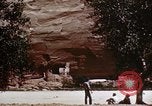
Native American Indian ruins, Oak Creek Canyon, Petrified Forests, and natural rock features and canyons in Arizona
Monuments ruins of native American Indian civilizations in Arizona, United States. People sit at the side of a waterway near a ruin. They view the ruined monuments. Canyons, ridges, rock formations and water streams in Oak Creek Canyon. A 1930s car on a road in Oak Creek Canyon. Tourists look at the ruins prehistoric trees turned to stone in the Petrified Forest National Park. Close-up views of trees in the petrified forest, and of various cross-sections cut and polished. Elevated view of colorful ridges in the Painted Desert on the Little Colorado River. View of Sunset Crater and dried rock of old lava flows from the volcano. Scenes of the Grand Canyon and a man and woman looking out over the Grand Canyon. Montage of scenes of farmers, American Indians, prospectors, and miners in Arizona. Mining operations and smoke rises from the chimney of a smelting factory. Saguaro cactus plants with the setting sun behind at dusk.

U.S. Army giant heliostat solar furnace produces extreme heat in Natick, Massachusetts, United States.
Solar energy furnace for production of enormous heat at Massachusetts, United States. The Army Quartermaster Corp shows a new solar furnace that captures the suns rays in a 1400 square foot heliostat. Situated at Lake Cochituate, it is capable of generating heat close to that of a nuclear explosion. Officers watch the furnace as it burn through a steel sample. It will be used to test effects of nuclear bombs on various materials, without the logistics and expense of nuclear test firings.

George Wilson Malon, Senator of the United States reports to voters in Nevada, United States.
George Wilson Malon, Senator of the United States gives a speech in his office in Nevada, United States. He reports to the voters. He talks about the war time excise taxes, live music taxes and their effects on the State of Nevada. He assures the people that he will work to aid the hotel and restaurant industry, and jobs for young people of Nevada.

Officers, equipment and instruments at a newly opened underground civil control defense center near Wheaton, Illinois
A civil control defense center and bunker designed to withstand a near direct nuclear blast opens near Wheaton, Illinois, during the Cold War. It is to provide an emergency nerve center for disaster relief work in Chicago, Gary and Hammond. Officers and other men gather outside the building. Heavy stair covering being moved into place over underground access stairs. Charts on a wall in the board room inside the building. Equipment and instruments in the defense center including special air handling equipment and independent power supplies including large battery arrays. View of maps and planning areas, and bunk rooms and supplies that would allow staff to stay underground for an extended period of time in the event of a nuclear bomb attack.
CRITICALPAST.COM: About Us | Contact Us | FAQs - How to Order | License Agreement | My Account | My Lightboxes | Shopping Cart | Advanced Search | Featured Collections | Website Terms & Conditions | Privacy Policy ©2026 CriticalPast LLC.
License Agreement |
Terms & Conditions |
Privacy Policy
©2026 CriticalPast LLC.