


 Francais
 Deutsch
 Italiano
Refine Your Search
Bolinas Beach California USA 1934 stock footage and images
- Showing 20437 to 20442 of 26867 results more
more Hide
Hide
Series of atomic bomb explosions on ground during continental atomic tests in Nevada, United States
Continental atomic tests in Nevada, United States. B-29 bomber in flight. A cactus on a barren land. Views of cacti in field. Mountains in the background. Series of atomic bomb test explosions, including small and large bursts, both high and low, and a ground burst. Mushroom clouds rise due to explosions.
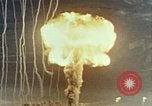
Operation Hardtack II Atomic testing in New Mexico
A low yield atomic explosion is conducted for experimental purpose. Smoke rises due to explosion. Sign reads "Headquarters Special Weapons Command." U.S. Air Force Major General John S. Mills steps from the headquarters building accompanied by another officer. View shifts to B-29 aircraft parked on the tarmac. A tug is pulling a B-47 aircraft. Mechanics on maintenance stands working on aircraft. Aerial view of an Air Force F-86 fighter airplane speeding past a B-29 in flight. View from directly overhead of a B-29 in flight over desert terrain. Scene transitions to view from directly underneath a B-29 in flight. Change of scene shows two women in the Weather Central of the Atomic Energy Control point, where teletype machines are printing out weather data. Meterologists plot wind data on maps. View of an atomic explosion. Closeup of the "atomic cloud." Technicians standing in a group, outdoors, observing the movement of the cloud. Next a technicial with a radiation counter walks to a helicopter, waiting with pilot already in the cockpit. He boards and the helicopter takes off. Closeup from the ground of the helicopter flying low directly toward the camera. Occupants can be seen as it fies past. Another post-explosion atomic cloud is seen. A B-29 in flight overhead. View of a pilot wearing helmet and oxygen mask, inside the cockpit. View of cloud through which they are flying. More views of pilot inside. A B-36 aircraft in flight with blue sky in background. Closeup of a C-47 aircraft in flight, with a sampler attached to the top of its fuselage. Crewman inside an aircraft attending to camera equipment. Other cremen at complex recording devices. View of a B-29 directly overhead. Crew members inside a cloud tracking aircraft. Men in a military control center receiving and plotting the cloud movement data. More views of B-29 and crew members inside. Men with hoses decontaminating a B-29 after it completed cloud tracking mission.
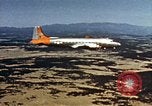
Testing effect of Atomic explosion on aircraft parked at different angles in Nevada, United States
Continental atomic tests Nevada, United States. Air Force C-54 aircraft in flight. Air Force Flight Surgeons wear masks and observe the atomic bomb explosion from an aircraft to test its effect on a pilot's vision. They immediately test their vision, while aboard the airplane, following the atomic blast. A truck drags a P-47 airplane. B-17s, P-47s, and newer aircraft are stationed at different angles. Atomic explosion tesst the effect of this explosion on the aircraft. High-speed cameras record effects of atomic blast. Elevator on tail of a B-17 in flames. Afterwards, technicians examine the damage on the various aircraft. Views of damaged aircraft after explosion on ground. USAF B-57B aircraft in flight. B-47 takes off with JATO. Smoke trails from the boosters.
U.S. B-50 Superfortress drops bombs over target areas during atomic tests in Nevada, United States
Continental atomic tests in Nevada, United States. An Air Weather officer at podium speaks to the high ranking people that includes Dr. Alvin C Graves, scientific test director and Carol Tyler, test manager for atomic energy commission. They decide upon an atomic test. An army sentry stands guard as B-50 named "Rosebud" starts engines for the test mission. Wheels and bottom of the aircraft. U.S. Air Force B-50 Superfortress aircraft in flight. Pilot , radio navigator and bombadier at their crew positions inside the B-50. Monitoring personnel track progress of the B-50, against flight plan, at the Atomic Energy Commission control room. Navigator in the aircraft communicates to the pilot, who turns to align with final bomb run. The bomb bay of the aircraft opens. The Bombardier takes control of aircraft. Aerial view of the target to be hit by the bomb. When bomb is released, aircrew and all observers on ground don protective glasses or goggles. The bomb detonates on the target with blinding flash of light. Mushroom cloud seen from aircraft, above.
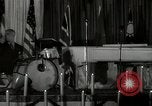
Count Basie and his Orchestra perform in New York City during a 46th birthday tribute for Paul Robeson in New York City
Count Basie and his orchestra members participate in a celebration of Paul Robeson’s 46th birthday and on the anniversary of the Council on African Affairs. The event is held at the 17th Regiment Armory, at 34th Street and Park Avenue in Manhattan. Basie's jazz and swing band plays and he leads his orchestra from the piano. The audience fills the hall to capacity.
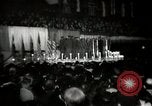
The 372nd Infantry Glee club sings the Invictus, a British poem in New York City, at 46th birthday party of Paul Robeson.
The U.S. 372nd Infantry Glee club, comprised of African American soldiers, performs in New York City during a Celebration of Paul Robeson’s 46th birthday and on the anniversary of the Council on African Affairs. The 372nd Infantry Glee club sings the Invictus, a British poem, during the event at the 17th Regiment Armory at 34th Street and Park Avenue in Manhattan. Candles lit up in front of stage. After they sing, banner above stage is visible that says '17th Regiment'. Audience seated. (World War II period).
CRITICALPAST.COM: About Us | Contact Us | FAQs - How to Order | License Agreement | My Account | My Lightboxes | Shopping Cart | Advanced Search | Featured Collections | Website Terms & Conditions | Privacy Policy ©2026 CriticalPast LLC.
License Agreement |
Terms & Conditions |
Privacy Policy
©2026 CriticalPast LLC.