


 Francais
 Deutsch
 Italiano
Refine Your Search
Bolinas Beach California USA 1934 stock footage and images
- Showing 22621 to 22626 of 26867 results more
more Hide
Hide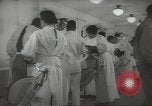
U.S. WACs (Women's Army Corps) during a close order drill and drive jeeps in Astoria during World War II.
African American Women's Army Corps of U.S. Army undergo military training in Astoria, New York during World War II. Interiors of building show African American dentists at work on patients. African American women of U.S. WACs (Women's Army Corps) perform a close order drill and drive jeeps.
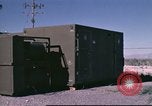
A U.S. soldier enters a portable decontamination chamber during chemical warfare defense training in Utah.
A film covers chemical warfare defense training received by U.S. soldiers at Dugway Proving Ground in Utah, United States. A soldier wearing special clothing enters a portable decontamination chamber and removes gloves, jacket and gas masks in separate chambers. The soldier removes his shirt and gas mask and puts it into a machine marked with a sign which reads 'contaminated apparel outlet'. He pushes 'shower push' button on the machine. The soldier in the decontamination chamber uses a towel and puts on a shirt. He walks away.
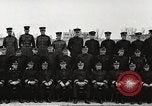
Naval officers photographed at The Naval Operating Base, Hampton Roads, Virginia in 1925.
The Naval Operating Base, Hampton Roads, in 1925 (re-designated "U.S. Naval Station Norfolk," in 1945). Opening scene shows Senior Naval officers (mostly captains plus a couple of rear admirals) seated in front row, and two rows of others officers standing behind them. At one point, they all remove their caps. Behind them is a concrete wall. But tops of some some buildings can be seen behind in the background. Closeup of a seated young rear admiral flanked by captains. In change of scene, all the officers are seen standing at attention, side-by-side on a gravel waterfront area, with a river and numerous buildings on the opposite shore visible in background. The camera pans across the assembled officers. Next, officers are seen on the waterfront, marching in white hats and carrying swords. (In these scenes, the motion is too fast, due to lack of compensation for low hand cranking speed of source camera.) The officers stop and stand in formation, and then march away.
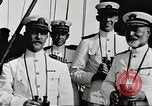
Chief of Naval Operation, Vice Admiral Edward W. Eberle at The Naval Operating Base, Hampton Roads, Virginia in 1925.
Vice Admiral Edward W. Eberle at Naval Operating Base, Hampton Roads in 1925. (The base was re-designated "U.S. Naval Station Norfolk," in 1945). Opening scene shows Admiral Eberle, Chief of Naval Operation, standing on deck of a ship with a captain, a Commander, and a Lieutenant Commander. They are pointing and peering through binoculars at objects (likely aircraft) passing overhead. Next, a Navy launch is seen entering a channel and moving toward the camera. It arrives at a dock is made secure by sailors. Vice Admiral Eberle then steps to the dock, followed by a Captain, a Commander, and several other naval officers, who line up on the dock They exchange salutes with the Admiral, who then ascends stairs followed by his retinue. The last scene is reconstituted and re-filmed. This time, naval staff officers are lined up beside the launch. They salute as Admiral Eberle steps from the launch, followed only by a staff Lieutenant Commander. The admiral then proceeds up steps, followed by officers on his staff. Another scene shows Admiral Eberle, standing on the dock with senior members of his staff behind him.
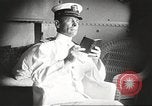
Scenes of Naval Operating Base, Hampton Roads, Virginia in 1925
Naval Operating Base, Hampton Roads, Virginia (renamed U.S. Naval Station Norfolk, in 1945 ). U.S. Navy Commander seated in a chair aboard a ship. A large group of civilian businessmen and officials pose on board a ship with several American Navy officers and one British Naval officer, for a photograph. Some of them stand and some are seated. One civilian stands in front of the group and poses with an American Navy Captain. Change of scene shows Admiral Way on the Navy Base, containing mansions and other structures from the 1907 Jamestown Exposition. It is a very windy day and several civilians are seen on a sidewalk and entering a large building on Admiral Way. Numerous Navy personnel in uniform are seen in the area, including a number of Naval officers entering that building and others heading there along a sidewalk. Residential mansions are seen in the vicinity along Admiral Way.

City Manager George W. Welsh introduces a new civic plan for unemployed men in Grand Rapids, Michigan.
Under the direction of City Manager George W. Welsh a new civic plan is introduced for unemployed men in Grand Rapids, Michigan, during the Great Depression. George W. Welsh poses. Unemployed men are employed on the Highway and Street Improvement projects for which they receive food and fuel as supplies from the municipal relief stations. Men work on road with shovels and use wheel carts. Exteriors of the Social Welfare Store. Supply bags in the store. Bottles of milk and bread are distributed to children in a bread line.
CRITICALPAST.COM: About Us | Contact Us | FAQs - How to Order | License Agreement | My Account | My Lightboxes | Shopping Cart | Advanced Search | Featured Collections | Website Terms & Conditions | Privacy Policy ©2026 CriticalPast LLC.
License Agreement |
Terms & Conditions |
Privacy Policy
©2026 CriticalPast LLC.