


 Francais
 Deutsch
 Italiano
Refine Your Search
Bolinas Beach California USA 1934 stock footage and images
- Showing 22771 to 22776 of 26867 results more
more Hide
Hide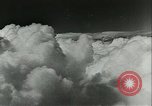
WPA laborers work at various development programs in New York City, United States.
Works Progress Administration (WPA) projects in New York City during the Great Depression. Aerial view of New York City as a plane flies by and clouds part to show Manhattan island below. Buildings and skyscrapers of New York City as seen from river and harbor views, with some ships and tugboats seen. Trucks on roads of Governor's Island at tip of Manhattan. An older home seen under renovation and reconstruction. View of the Brooklyn Navy Yard with WPA workers busy building and improving new roads and shops and warehouses near the docks. A bulkhead construction project is shown at Sheepshead Bay in Brooklyn, to reclaim land from the waters of the Bay. The work includes construction of a new Boulevard and sanitary and sewer system improvements. View of the front entrance of the Beaux Arts style Alexander Hamilton U.S. Custom House on Bowling Green at the tip of Manhattan. Pedestrians and WPA workers are seen in front of the building. WPA laborers on an unidentified Manhattan street (with elevated railway running in background) are busy removing old street car rail lines from the streets, in sections, and loading them into truck beds to haul away. Large public swimming pool and bath house construction projects are shown, influenced by city planner and avid swimmer Robert Moses (scene possibly shows McCarren Park pool - note archway seen under construction). WPA workers are seen building the new East River Drive, including highways, walks, and flanking parks. Construction workers seen building the roadway, with the Williamsburg Bridge in the background. A model of the project is shown with the new drive from Grand Street to 14th Street. Camera pans down from the Empire State Building to show the roof of the New York Public Library teeming with WPA workers as they remove the old corroded copper roof and replace it with a new metal roof. View of busy Manhattan streets below the workers, including a street car passing by.

Children play games and receive instructions in handicraft during WPA supported play programs in New York City
Great Depression era Works Progress Administration (WPA) projects in New York City. A sign reads: 'Play Street Closed'. Children play various games and sports on a street in New York City that has been closed to traffic, under the supervision of WPA employees. A man instructs them. They play checkers, jacks, and a small court tennis game using ping pong paddles. They play round games holding hands and moving together. Children seen entering the toyery, an experimental program at the Heckscher Foundation For Children. A boy smiles as a woman in the toyery hands him a truck toy to borrow from the lending library of toys. Several children are shown trading in a toy for a different toy. Children seated in a room show each other flashcards to improve their reading skills, during remedial instruction time. Women in a Long Island City kitchen prepare school lunches for 800 needy children. A woman cook prepares a sandwich and a group of women wrap up batches of sandwiches. View of a day nursery, with a nap or rest area with small beds. A nurse in the nursery examines a child's mouth with a tongue depressor. Young children play with blocks in the nursery. They sit at tables in a dining room. Children drink milk and eat food.
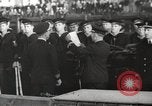
United States sailors and officers transferring old submarines to British Navy and Polish Navy early in World War 2.
US Navy ceremony handing over older submarines, early in World War 2 to the British Navy and Polish Navy, in New London, Connecticut. U.S. Navy officer reads a document as sailor stand and watch. U.S. Navy officers and sailors leave submarine and walk onto dock. British sailors take possession of the submarine. British officers conduct review of sailors on the submarine. Polish flag raised on another submarine as personnel salute. A sailor raises a ribbon flag on the conning tower. A Polish Navy sailor holds the flag of Poland on the submarine deck. An officer near a deck gun.
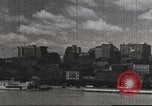
Ships docked at Mississippi river at the harbor in Saint Louis, Missouri; brief views of Louisville and Cincinnati.
The working of weather bureau in the United States. View of the harbor and skyline in Saint Louis, Missouri. Buildings in the background. Ships underway at the Mississippi river. Some ships docked at the harbor. Smoke from the stacks of an excursion steamer ship. Scene changes to a steamship on the Ohio River at harbor of Louisville, Kentucky. Change of scene again to skyline of Cincinnati Ohio.
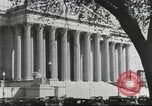
A map locates the flood affected areas in Ohio and the high and low pressure areas in the Ohio river during floods of 1937.
View of the United States National Archives Building (700 Pennsylvania Avenue, NW Washington, DC 20408-0001) in March 1936. in Washington, DC. Washington DC escapes damage from the great Potomac River flood. Next scenes cover damage caused due to a flood in Ohio, United States in January 1937. View of a weathervane in stiff winds. The level of the Ohio river rises. The flooded tributaries of the river. A map locates the flood affected areas. It depicts the high and low pressure areas. Map depicts heavy rains continuing for 20 days from January 6 to January 26, totaling 16 to 20 inches in the affected area.
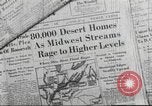
Flooding and rescue work in 1937 as Ohio River Valley floods
Damage caused due to flood in Ohio Valley , United States. Newspaper headlines read: '80000 desert homes as Midwest streams rage to higher levels'. People engaged in the rescue and relief work. Men aboard small boats as they carry on rescue work in the steets of downtown Louisville Kentucky. Buildings along the flooded area. Flooded buildings in Evansville Indiana and Paducah Kentucky. Flooded farms and fields washed away. Marooned livestock atop a levy. A dog atop a car. A cat perched in a 2nd story window just atop flood waters. Aerial views of the flooded Ohio Valley heading toward the Mississippi River. View of the blasting of the so called "fuse plug" in the levy below Cairo Illinois (on the Missouri Side at the junction of the Ohio River and Mississippi River) to prevent the flood waters from destroying Cairo. An army of workmen building extensions on top of the levees near Cairo Illinois to protect it from the flood. Water lapping at the wall built by the workers.
CRITICALPAST.COM: About Us | Contact Us | FAQs - How to Order | License Agreement | My Account | My Lightboxes | Shopping Cart | Advanced Search | Featured Collections | Website Terms & Conditions | Privacy Policy ©2026 CriticalPast LLC.
License Agreement |
Terms & Conditions |
Privacy Policy
©2026 CriticalPast LLC.