


 Francais
 Deutsch
 Italiano
Refine Your Search
Bolinas Beach California USA 1934 stock footage and images
- Showing 301 to 306 of 26917 results more
more Hide
Hide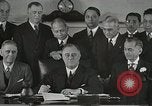
United States President Franklin Delano Roosevelt signs Philippine Constitution produced by Contitutional Convention
Pursuant to the terms of the Tydings-McDuffie Act of 1934, United States President Franklin Delano Roosevelt signs the Philippine Constitution presented to him by Philippine President Manuel Quezon, in Washington DC. View of the signed Philippine Constitution cover document. President Roosevelt signs one copy and hands it to one of the officials present. Then he signs another for President Manuel Quezon, who stands, shakes hands and thanks President Roosevelt, and then sits again. Audio of casual discussion during the signing ceremony is heard. President Roosevelt reads provisions of the act. President Manuel Quezon gives a brief speech to thank the United States.
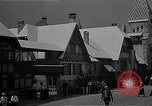
Scenes from "Midget Village" in the Chicago "Century of Progress" World's Fair.
"Midget Village" scenes at the "Century of Progress" Chicago World's Fair of 1933-1934. Buildings in the "Midget Village" which was modeled as a miniature reproduction of the ancient German Bavarian walled city of Dinkelsbühl, and staffed by three groups of midget professional performing artists: the Ritter Troupe, Rose Troupe, and the Singer Troupe. Bavarian-type building with sign reading: "The Black Forest." Visitors strolling through the area. A Hawaiian show performed on stage by midgets, who play guitars while a little person performs a Hula dance. Midgets play a "craps" dice game on the street, with wagers of silver coins tossed on the ground. Fair visitors gather around the group and watch the game, before it is broken up by a group of midgets dressed as police officers.
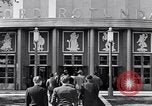
People examine new Ford cars inside Ford Rotunda building in Dearborn, Michigan.
Exterior view of the Ford Rotunda building, relocated to Dearborn, Michigan after serving as a visitor's center during the 1934 World's Fair in Chicago. Men and women enter Ford Rotunda building in Dearborn, Michigan, across Schaefer Road from the original Ford Administration Building. People examine new Ford cars inside the building. Views of Ford Cars, a spinning world globe, and a rotating sphere showing various materials used in Ford cars. Next scene shows new Ford cars and trucks exiting the gates of the Ford River Rouge plant following their completion on the production line. Ford Plant's picture superimposed over upper part of the image for first part of these final scenes.
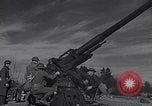
Eddie Rickenbacker, President of Eastern Airlines, hosts Cyrus R. Smith, President of American Airlines, after both airlines acquire DC-3 airplanes
Glimpse of U.S. Army gun crew operating a 3-inch M3 Anti Aircraft gun. Glimpse of 1st Lt Joseph H. Eastman and Captain Eddie Rickenbacker standing beside Rickenbacker's SPAD S.XIII #1 parked in front of a hangar at Foucaucourt Aerodrome, France, 1918. Sequence shifts to 1936, and office of Rickenbacker, now President of Eastern Airlines. A poster on the wall contains memorabilia from the 94th Aero Squadron, with which Rickenbacker flew in World War I. Camera pans over photographes bordering the poster. Next, Rickenbacker is seen conversing with his guest, Cyrus R. Smith, President of American Airlines, as they look at a picture of Rickenbacker and his Spad airplane, signed by numerous pilots who also served with the 94th Aero Squadron. A mounted model of a Douglas DC-3 airplane sits atop a table in the foreground. Rickenbacker and C.R. Smith, both hold onto the DC-3 airplane model as they shake hands. Closeup of the DC-3 model as Rickenbacker rotates it before the camera. (Note: Both Smith and Rickenbacker, presidents of their respective airlines, had mutual admiration for the Douglas DC-3 airliner. In 1934,Smith arranged to purchase 20 new DC-3 airplanes from the Douglas Aircraft Company. American's first DC-3 "Flagship Illinois," had its maiden flight on June 25, 1936. Eastern Airlines took delivery of its first DC-3 in December 1936.)
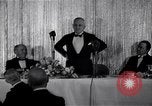
Official of the Boys Clubs of America awards a Medal to J Edgar Hoover at a ceremony in the United States.
First Director of the Federal Bureau of Investigation (FBI) of United States, John Edgar Hoover awarded a Medal in the United States. An official of the Boys Clubs of America addresses the attendees. He states that Hoover is only the second person to receive the Medal after John Hays Hammond in 1934. He talks about a poll at the New York Boys' Club that depicts Hoover as an inspiration to the youth. He reads out the citation and presents the medal to Hoover. Hoover accepts. The official displays the Medal.
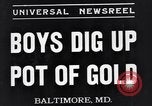
Boys speak about their discovery of buried gold coins and how it will help them financially.
A film titled 'Boys dig up pot of gold'. View of the three story row house at 132 S. Eden Street in Baltimore, Maryland. View of a basement window on the building. View inside an office of two teenage boys, Theodore Jones and Henry Grob, standing in front of a desk covered by gold coins they discovered when digging a hole in the basement of the Eden Street building in August 1934. Close-up view of the gold coins and the degraded metal can that had held them when they discovered it underground. (Their discovery yielded 3,558 gold coins dating from the 1830s-1850s, with a face value of $11,200.) Henry Grob speaks and says, "I'm glad tthat the decision of Judge O'Dunne (Judge Eugene O'Dunne) was in our favor, because now I can complete my education, buy my mother a home, and help others in my family who are in need." Theodore Jones then adds, "That's a swell idea. I think I'll do the same." Close-up view of hands of a man picking up a number of the coins.
CRITICALPAST.COM: About Us | Contact Us | FAQs - How to Order | License Agreement | My Account | My Lightboxes | Shopping Cart | Advanced Search | Featured Collections | Website Terms & Conditions | Privacy Policy ©2026 CriticalPast LLC.
License Agreement |
Terms & Conditions |
Privacy Policy
©2026 CriticalPast LLC.