


 Francais
 Deutsch
 Italiano
Refine Your Search
Bolinas Beach California USA 1934 stock footage and images
- Showing 3301 to 3306 of 26867 results more
more Hide
Hide
Highlights of the War on various European Fronts captured by U.S. Coast Guard combat cameramen.
'Highlights of the War' depicts work by combat cameramen that has been honored with citations for outstanding photography. 'The Coast Guard at War' depicts the work of combat cameramen on the U.S. Coast Guard. U.S. Coast Guard Arctic Patrol. CG personnel aboard a cutter. Deck gun and the U.S. flag. A sailor communicates over the radio. Sailors on deck, the bow and deck. Combat cameramen record the CG activities including a religious ceremony. Sicily Invasion, 1943: Combat cameramen capture the scene as a German bomb hits an ammunition ship off the coast. Explosion on the ship, a mushroom cloud rises up. Sailors watch with binoculars. Normandy, 1944: Allied troops climb down rope ladders into Landing Craft Personnel (LCP). which deliver the men and cargo to the Normandy beaches. Soldiers wade through the water towards the shore under enemy fire.
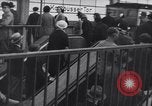
A Zeitgeist film about life of 1930s German people shows people working and relaxing, contrasted with rising Nazi movement
Film which contrasts typical German lifestyle in Germany in 1930s, with rise of NSDAP or Nazi movement, pre World War 2. German Civilians on an escalator. 1930's German Police officer lead kids across city streets. Traffic in a German city. A workman on a barge and gets off the barge in Hamburg. Laborers unload sacks of flour. Lumbermen at work on trees and men working in a steel mill. Workers blowing glass to make glass itmes. Workers paint theatrical masks. People in an outdoor café or restaurant. A couple dances. People move on a snow covered ground. A man takes snapshot of a German family. An old man wearing a striped bathing suit walks out of water. Burgomeisters or (burgermeisters) in a town ceremony. German Army soldiers or Freikorps (before third reich) marching in a parade on city streets. People get off a suburban train at a railroad station. A puddler works in the steel mill. A girl and a boy on bicycles riding close together as the boy has his arm around the girl. A carnival ride called "Ausgang". A merry-go-round at a carnival or fair, and people playing games at a carnival. Children crowd around a clown wearing a high hat. Middle aged men play cards. Middle aged couples at an outdoor cafe. Sudden contrast to Nazi SA or Sturmabteilung stormtroopers in training. Paramilitary training of brownshirts and of boys in a group (future Hitler youth). German citizens at a Nazi rally giving a Nazi salute in unison. A view of vineyards. A Nazi officer gives a speech. German Sturmabteilung marching in a parade with Nazi salutes. Children playing in a game where they roll a large ball using only their heads while hopping along. A woman swimmer enters water at a beach. Several Sturmabteilung in a training drill in water.
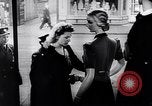
British women work in various war time jobs, British prepare for war, and people greet Winston Churchill
Contribution of British working women to the war effort in England during World War 2. British women prepare for German aerial warfare Battle of Britain. British women stand and talk. A woman reads from a paper. British women put up barrage balloons and man the antiaircraft guns. British women working jobs that are traditionally handled by men. They work on a train. Another woman cleans a wheel. Women fly and taxi planes. Women in war time drive ambulances and buses. They cook food and serve it to men. British men and women work overtime in a various factories, including war production factories on airplane production and operating various industrial equipment. A British woman welding with a mask. Workers yawn. Two British soldiers with guns walk. The Germans begin their bombing campaign in the Battle of Britain. A British soldier leaves a house. Soldiers walk with rifles on their shoulders. People greet British Prime Minister Winston Churchill. He waves to the people. British people listen to excerpt from Churchill speech on radio with his famous lines "We shall fight on beaches..." and "We shall never surrender." British Soldiers move up a hill. View of barbed wire defenses with Big Ben clock tower in distance behind. British civilian man covering a newly built Anderson Shelter (air raid shelter) with dirt. British civilians walking. Soldiers march and work. A man on a horse cart. An air raid by German aircraft begins and an alarm sounds. British boy and girl children look up in the sky and then run for shelter. Blitz Air attack on London by Nazi German Luftwaffe aircraft during Battle of Britain. A warden blows his whistle and runs, guiding citizens into an underground shelter. Parents are seen trying to fit gas masks onto young British children and an infant, as the children squirm and protest.
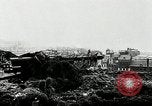
Damaged Allied British and Canadian military equipment and dead Allied soldiers after Dieppe Raid (WW2)
German camera views of wrecked city, damaged equipment, and debris after the Battle of Dieppe during World War II. Dead bodies of British and Canadian soldiers on the beach, up near a sea wall, and near German fortifications. Wrecked British landing crafts and other vehicles strewn around. (World War II period).
U.S. Liberator bomber planes destroy the Japanese planes and ships on Makin Islands and reinforcements land in Bougainville.
The U.S. turns offensive against Japanese in the Pacific during World War II. U.S. Liberator bomber planes fly towards island of New Britain. Map of New Britain. Pilots in the cockpit pull a trigger and drop bombs on the island. An invasion fleet moves towards the island. U.S. Marines land on the island and move forward. A map shows Makin Islands. U.S. Planes drop bombs on a Japanese ship. The planes drop bombs on a Japanese airstrip causing the destruction of the Japanese planes. The 6th U.S. Army General and Lieutenant Colonel James Roosevelt on a ship with other officers. Sailors climb down step ladders and move into a boat. A Japanese bomber is driven off and another is hit. Amphibious Forces land on the beach. Dead Japanese soldiers on the island. Japanese are defeated and Prisoners of War taken. A map shows Bougainville in the Solomons Islands. Troop reinforcements land.
U.S. campaigns against Japanese in Marshal Islands, New Britain, and Rabaul, in the Pacific during World War II
U.S. offensives against Japan in the Pacific Theater during World War 2. A United States Carrier Task Force in the Pacific Ocean. Fighter planes and dive bombers on the deck of the Task Force. Sailors push trolleys containing bombs. A map shows Marshall Islands. Douglas Dauntless dive bombers take off to strike against the enemy. U.S. Navy fighter planes engage defending Japanese aircraft and down many of them, as seen in gun camera footage. The first wave of Douglas Dauntless dive bombers returns to its carrier for refueling, rearming, and debriefing. Sailors on the aircraft carrier man anti-aircraft guns to defend against attacking Japanese aircraft. Black flak fills the sky and a number of Japanese aircraft are destroyed by the anti-aircraft fire. A Japanese bomb explodes near the flight deck of a carrier. (Narrator notes that 85 Japanese aircraft were destroyed in this one operation.)An animated map shows New Britain Island. U.S. Major General William Henry Rupertus, Commander of U.S. Marines on a ship. He looks through a pair of binoculars as a U.S. planes (B-24 Liberators) drop bombs on Rabaul. U.S. warships launch an attack at the enemy positions. Fire and explosions. The Marines load into landing craft and move towards the shore. They land behind an intense naval bombardment. Marines head ashore from beached LCI-1 Class Landing Craft Infantry (Large), number 343. M 16 tanks, equipment, and artillery roll ashore from Landing Ships Tank (LSTs). . The tanks lead the way through the jungle terrain and the marines advance behind them. Marines fire mortars as they advance. They flush out Japanese from trenches and bunkers. A damaged Japanese Mitsubishi fighter plane and wreckage of others. Some dead Japanese soldiers. The Marines wade through deep water as they push on to Rabaul. Others advance through deep mud. More views of them slogging through mud.
CRITICALPAST.COM: About Us | Contact Us | FAQs - How to Order | License Agreement | My Account | My Lightboxes | Shopping Cart | Advanced Search | Featured Collections | Website Terms & Conditions | Privacy Policy ©2026 CriticalPast LLC.
License Agreement |
Terms & Conditions |
Privacy Policy
©2026 CriticalPast LLC.