


 Francais
 Deutsch
 Italiano
Refine Your Search
Bolinas Beach California USA 1934 stock footage and images
- Showing 3799 to 3804 of 26867 results more
more Hide
Hide
Minuteman II ICBM launch site under construction at Malmstorm AFB in Montana and Vandenberg AFB in California.
A report covering the expansion and modernization of U.S. ICBM force. Site selected for Minuteman II missile launch at Malmstorm Air Force Base in Montana. Car passing through hilly region near Malmstorm AFB. Construction of Minuteman II missile site showing army engineers and men at work. Construction of missile silos. Aerial view of Minuteman base under construction at Grand Forks Air Force Base in North Dakota. Control centers and silos under construction. Building missile capsules at air base. Sign reads 'Site Activation Task Force Ballistics Systems Division Air Force Systems Command - Grand Forks AFB No. Dak.'. Exteriors of building. Officer at charts and desks in conference. Flooding at missile base showing heavy equipment operating. Construction of launching facilities at Vandenberg AFB. Test facilities to flight test integrated Minuteman II launchers and missiles. Aerial view of Minuteman II test site at Vandenberg. Officers working in launch control center.

Heavy explosive blasted in a canal to avoid a hazard in California.
1375 tons of high explosive is set off in a canal to avoid a hazard in Canada. The blast area of the canal. Explosive shells are dumped in a tunnel beneath the canal. A man presses a button to set on the blast. The huge blast splashes the water of the canal.

Movie stars travel in project: "Movietime U.S.A." to bring the story of Hollywood to America.
Opening scene shows Hollywood notables climbing stairs to board a TWA Constellation airplane at Los Angeles International Airport, on October 7, 1951. They are participating in a program entitled "Movietime U.S.A." sponsored by the Council of Motion Picture Organizations, to bring the story of Hollywood to places throughout America. A sign at the airplane steps reflects this. Ronald Reagan stands chatting with Nancy Davis (his future wife) in front of the sign. Next, the Hollywood personalities are seen entering and conversing and on the airport tarmac. The following are seen among others: TC:00:27 Dan Duryea on the right. TC:00:32 Zazu Pitts, on the left. TC:00:35 Vera Ellen, on the right. TC:00:39 McDonald Carey, on the right. Other scenes show them walking toward an aircraft, and then ascending the aircraft ladder (seen from the airplane doorway).
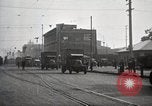
U.S. Army motor transport convoy in Oakland and San Francisco after Transcontinental Motor Convoy trip across America in 1919
U.S. Army trucks of the 1919 motor transport convoy drive past a moving trolley car on a street in Oakland, California. Spectators gather along side of street at ferry slip to watch as convoy trucks board a ferry boat for trip to San Francisco. Several men watch from upper deck of the ferry. A boy with a bicycle watches from beside a fence. View from upper deck of the ferry boat, of trucks driving aboard. A line of civilian cars sits to the side as the army vehicles drive aboard. View from the ferry boat underway in San Francisco harbor. Next, the convoy is seen driving along street in San Francisco, on September 7, 1919. The Mayor of San Francisco, James Rolph Jr., conversing with officers of the convoy, as they stand on a flag wrapped stand during a formal greeting ceremony. More views of convoy trucks in the city and lined up on hill overlooking San Francisco Bay.
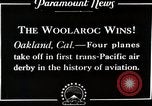
Scenes from the Dole Trans-Pacific Air Derby of 1927
Aerial view of airfield at Oakland, California. Pilot, Bennett Griffin, is seen with his wife and child, standing beside his Travel Air 5000 airplane,"Oklahoma." Registration number:"N-X 911" is stenciled on its tail. Pilot Martin Jensen, saying farewell to members of his family in front of his airplane,"Aloha" (that finished second in the race). Aircraft being readied for takeoff. Starter with checkered flag stands ready as nine men push the Travel Air 5000 "Oklahoma, the first to take off, forward into starting position, with engine running. Next scene shows starter holding stopwatch and flag. He signals start with the flag. Scene shifts to the second aircraft to take off, the Goddard Special metal monoplane, NX5074, "El Encanto." Camera tracks as the airplane has difficulty breaking ground, skipping several times in a long ground roll. Suddenly, it veers off the the right in a crab, wiping out its landing gear and breaking part of its right wing as it flips over in a crash leaving it tilted on its left wing facing backwards. Some smoke is seen but quickly disappears. Men and rescue personnel rush to the scene. (Reportedly the crew was unhurt.) Next, the prototype Lockheed Vega 1 monoplane, NX913, "Golden Eagle," is making smooth takeoff. Navigator Gordon Scott waves to spectators below as the plane climbs out. Aerial view of the plane in flight. The "Miss Doran," a Buhl CA-5 Air Sedan, number NC2915, is seen next on takeoff, past photographers and spectators, and then airborne. Next, the Breese-Wilde 5 Monoplane, NX914, "Aloha" is seen taking off. It climbs out very slowly. Navigator Paul Schluter waves as they depart. Pilot Arthur C. Goebel and navigator, Willian V. Davis Jr. are seen next by their plane "Woolaroc." A woman wishes them good luck, with a bouquet of flowers. Next, men are seen pushing the "Woolaroc" and it takes off and climbs. Pre-departure footage of Pilot Gordon Scott and navigator John W. Frost, with friends, near their airplane, "Golden Eagle." (Their aircraft vanished in the Pacific.) Pre-departure footage of pilot John Augie Pedlar, navigator Lieutenant Vilas R. Knopie, and their passenger, Mildred Doran, whose aircraft, "Miss Doran," was also lost in the Pacific.

Amelia Earhart successfully spans a 2400-mile course over the Pacific.
Amelia Earhart's plane lands on an airfield in Oakland,California. She emerges out of the cockpit and welcomed by press, media and public. Earhart gives an interview to the journalists and explains about her flight from Honolulu to the mainland. It took her 18 hours to span a 2400-mile course over the Pacific.
CRITICALPAST.COM: About Us | Contact Us | FAQs - How to Order | License Agreement | My Account | My Lightboxes | Shopping Cart | Advanced Search | Featured Collections | Website Terms & Conditions | Privacy Policy ©2026 CriticalPast LLC.
License Agreement |
Terms & Conditions |
Privacy Policy
©2026 CriticalPast LLC.