


 Francais
 Deutsch
 Italiano
Refine Your Search
Bolinas Beach California USA 1934 stock footage and images
- Showing 5245 to 5250 of 26867 results more
more Hide
Hide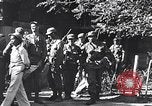
U.S. Rangers and Filipino guerrillas rescue Allied prisoners from Japanese prison camp in Philippines during World War II.
On January 30, 1945, 121 members of the 6th Ranger Battalion and 286 Filipino guerrillas are seen setting out on a 30 mile trek behind Japanese lines, to free Allied prisoners of war (POWs) and civilians from a Japanese camp near Cabanatuan City, in the Philippines, during World War 2. They stretch out in a long, informal column as they traverse low flat lands and ford a wide shallow river. The men carry weapons and supplies (some on their heads) as they move along, almost like a Safari. Scene shifts to rescued prisoner, Major Emil P. Reed, U.s. Army Medical Corps,26th Cavalry. He was the senior officer among prisoners at the Cabanatuan prison camp number 1. He recounts being told by the Japanese Commandant that commencing January 7th, they were free at their own risk, but also assured them they would not be molested by the Japanese if they stayed within their regular camp area. Sergeant Samuel E. Goldy, Signal Corps, also speaks a few words about that period when Japanese were departing. Next the camera records the Rangers and Filipino guerillas returning with the approximately 500 freed POWs. Some Filipino women and children watch them return. At one point, the cadre climb aboard army trucks and continue their journey in a convoy. The POWs climb down from their trucks at the 92nd Evacuation Hospital, in Guimba, Luzon. Some take pleasure is simply lying down on the grass at the site. Many gather around hospital staff handing out packages of treats, including cigarettes, candy and the like. A couple of them express pleasure as they smoke cigarettes. Two frail and injured are seen hobbling with canes. Some appear seriously malnourished. A group are seen trying on new clothes. A British prisoner, Sergeant Robert Bell, Manchester Regiment, British Army, speaks of his experience. He was taken prisoner in Singapore and sent to Thailand where he worked to build a railway for the Japanese. Many prisoners died there from disease and malnutrition. He was one of a small number who survived after being on a Japanese ship with other prisoners when it was sunk by American dive bombers. Sergeant Walter Ring, of San Roque, Luzon, is seated, relaxed on a chair, as he recounts his experiences. Two young Filipino boys sit on the grass at his feet. He reaches to one, whom he says is his son Louis and to the other, his son Sam. His captivity began on Bataan in 1942. Finally, after rest and rehabilitation, the former POWs are seen heading away from the battle fronts to be transported back to the U.S.A.

'Shirley Lykes' dropping supplies in Cuba as ransom for Fidel Castro's war prisoners and taking refugees to America.
Ships and boat moving in water. Crated Russian farm equipment on transport vehicles on road. Close view of propaganda pamphlets. Cuban children in a classroom are taught Russian language by teacher. View of children and guard wearing military uniform. Supplies unloaded by workers from cargo ship, 'Shirley Lykes'. Supplies as ransom for Fidel Castro's war prisoners. Refugees who are mostly relatives of prisoners boarding the ship. Wounded refugees are carried on litters. View of large number of wounded refugees. Refugees disembarking from 'Shirley Lykes' at USA.
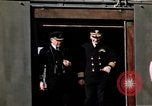
Gun crew fire guns mounted on Queen Elizabeth ship.
Ship's C.O. with a U.S. Navy Captain, come out on the deck. A British Merchant Marine Captain talks with the U.S. Navy Captain (Navy Captain has a sub. insignia over his breast pocket). U.S. Navy officer smokes a pipe on the deck. Two junior U.S. Navy officers on the deck. U.S. Navy Commander on weather deck. Two British crewmen with a U.S. Navy officer, look out over the sea. Rocket-type launcher in a tub, above weather deck. Sign reads 'Stand Well Clear, When Klaxon Sounds'. Rocket launchers on ship. One of the gun mounts fire in the background. Crew on weather deck, near fantail area. Wake of the ship in the background. Crew fires 4'' gun on stern of the ship. Gun crew on gun, breech opened. Crew works around rear of the gun. Gun fires. Small group of weather deck. U.S.A. officer, U.S.N. officer and a ship's officer talk. Weather deck of the ship and crew walk by in foreground. Personnel look at a plane in flight. (World War II period).
Men and women dance aboard United States Lines flagship S.S. Leviathan.
United States Lines flagship, the S.S. Leviathan on its way to Cherbourg and South Hampton from New York City, USA. Recreational pursuits aboard the ship. A man plays violin and people dance aboard SS. Leviathan. Couples of men and women dance on ship deck. A stylish young 1920s woman in with flapper style dances the Charleston or something similar on the ship deck, with enthusiasm.
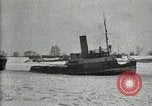
Food supplies delivered by foreign relief organization to Petrograd, Russia during Russian Revolution and World War 1
Steamers on the frozen River Neva deliver food supplies sent by foreign relief organization to Petrograd, Russia during period of Russian Revolution and World War I. Soviet Russian children stand next to ship 'Marcus' from Newark, New Jersey, USA. Men unload food supplies. American relief administrator Colonel Haskall looks at a map. Food sacks being transported along snowy streets by horse drawn sled and sleigh. Civilians walk in snow covered streets, bundled in warm winter clothing. People gathered together in the cold eat hot food in the streets of Russia.
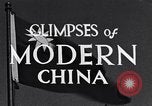
Various scenes depicting animated maps of China, seaplane landing in San Francisco, and streets in Beijing
Flag of the Republic of China (ROC) flying. Map shows travel routes between West Coast USA and Shanghai or British colony of Hong Kong. A seaplane or flying boat takes off. Seaplane flying over Golden Gate Bridge. Chinese American women wave at plane. Aerial view of a palace, pagoda, and surrounding grounds in China. Animated map comparing the sizes of United States and China. Yankee clippers underway at sea. Map shows position of Canton (Guangzhou). View of Canton harbor from a ferry. View of ferry's rail. Map of Beijing, also known as Peking or Peiping. Streets and buildings in Beijing.
CRITICALPAST.COM: About Us | Contact Us | FAQs - How to Order | License Agreement | My Account | My Lightboxes | Shopping Cart | Advanced Search | Featured Collections | Website Terms & Conditions | Privacy Policy ©2026 CriticalPast LLC.
License Agreement |
Terms & Conditions |
Privacy Policy
©2026 CriticalPast LLC.