


 Francais
 Deutsch
 Italiano
Refine Your Search
Brest France 1920 stock footage and images
- Showing 55 to 60 of 5746 results more
more Hide
Hide
Excerpts from British movie about trench warfare in France during World War One
Scenes from a popular British movie about World War One, released after the war, in the 1920's. British troops fight against the Germans in Thiepval and Gommecourt, France during World War I. British soldiers advance across no man's land. Germans fire machine gun at them from fortified position. Views of the German gunners inside their position. Advancing British troops fall to the machine gun fire. German troops firing rifles at the British troops from sandbagged bunker. Scenes of German troops regaining their trenches at Gammecourt, climbing over the bodies of fallen British troops from the London and Midland Divisions.

Morning in Paris, with the River Seine, Eiffel Tower, Place de la Concorde, and a busy street
Dawn and morning time in Paris. Sunrise in Paris. A bridge over the River Seine. Clouds over the city. A Statue of Liberty replica on the Ile aux Cygnes Island (Pont de Grenelle, 75015 Paris, France). Men sleep on the riverbank. The Eiffel Tower (Champ de Mars, 5 Avenue Anatole France, 75007 Paris, France) on the riverbanks. Two pillars flank a road. Smoke from a stack. The Rue Royale, the Obelisk and a fountain at the Place de la Concorde (75008 Paris, France). Trucks spray water around the fountains. A man sweeps the street. Women push a cart full of baked goods. A busy market street. Men carry heavy load, push, and pull carts. A mail man at a window. Children walk to school with book bags. 1920s and 1930s cars moving on the roads, as seen from unusual point of view of a moving camera at low level, just a few feet above the road surface.
Scenes of World War 1 and the period between the wars, illuminating career of U.S. Air Force General Henry (Hap) Arnold.
Newspaper headline in Washington post reads 'United States and Germany at War'. Civilians recruited into the army. American pilots of the 103rd Aero Pursuit Squadron, in France, with their Spad aircraft. American airplane production factories in operation, with manny women war production workers seen assembling aircraft. People celebrate in the streets at end of World War I at time of armistice. Airplanes, under command of General Billy Mitchell bomb obsolete warships in demonstration of aircraft power in warfare. 1920s: Postwar flyers and stunt wing walkers perform in the roaring twenties. Developments and improvements in parachutes, and view as stunt men parachute from high buildings and airplanes. Aircraft flying forest fire patrols. Aerial view of burning forest fire below. Lieutenant Colonel Arnold commands emergency airlift and drop of food to snowbound Native American Indians in American Southwest, in 1932. World War I scene of American 103rd Aero Pursuit Squadron Spad airplanes taking off, in France. Lieutenant Colonel Hap Arnold with his family, including two young boys and a young girl (his sons and daughter) and his wife.
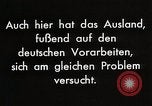
Rocket motor designs by International scientists and inventors, reflecting early work by German rocket researchers
Designs by various international scientists and inventors who have contributed to solving the problems of rocket motor development, based on the German preparatory work. Their combustion chamber designs owe much to the German pioneers in the field. Shown are design sketches by Russian scientist, Konstantin Tsiolkovsky (Ziolkowsky) in 1914; French inventor Henri Melot, in 1920; German Friedrich Zander, in 1931; Bull, 1932; The American Rocket Society, with several designs from 1932; and The Cleveland Rocket Society. Views of rocket combustion research activity by Ernst Loebell of the Cleveland Rocket Society in 1933. He is seen outdoors in the snow with his apparatus. View of Loebell's test firing stand, and a picture of an actual test firing, outdoors. Ernst Loebell with model and rocket motor from his spaceship projects of 1934 and at the International Exposition dedicated to Art and Technology in Modern Life held in Paris, 1937. Cutaway views of the spaceship. The rocket motor wrapped in cooling coils. Rocket motor design by John Shesta of the American Rocket Society, from 1934. Design by Rene Armengaud of France, in 1934 and Deich in 1935.
Warren Harding assumes office of the President and changes in the life of American people from the early to modern times.
The life of people during 1920s in the United States. Sketch of Warren Gamaliel Harding taking oath of office of the President of U.S. Sketches of the U.S. President Warren G. Harding. People in the factories. Sketches of the people in the various towns of America. The President addresses the people. Horse drawn wagons on the streets. Modern cars on the street. Women in houses as they perform various activities. Sketches depict the revolution brought about due to the invention of cars. People enjoy at various occasions in a car. Cars on streets. People listen to radio. Sketches depicts the motion pictures of the times. A family posing for a picture, each with one leg kicked out. Sketches of American writers like Fitzgerald and Hemingway who chose to live abroad. Footage of Moulin Rouge night club in Paris France and neon lights of other Paris night clubs seen at night. Women dance on a Paris night club stage. Sketches of famous writers and their view of modern America. Brief scene of people at Coney Island Amusement Park in New York sliding down a slide and riding on the "Human Pool Table" ride.
Chemical Warfare Service laboratories at Edgewood Arsenal, Columbia University and the Massachusetts Institute of Technology.
A film based on chemical warfare tests in the United States. Shows usage of poison gas on the Allies by the Germans in France during World War I. Casualties of chemical warfare being evacuated. The U.S. Capitol Building and the Washington Monument in Washington DC. Brief aerial view of White House. Establishment of U.S. Army Chemical Warfare Service on July 1st , 1920 shows a sign which reads 'Office of the CHIEF Chemical Warfare Service'. Chief of the Chemical Warfare Service Major General William N. Porter at his desk. Various processes carried out by the Chemical Warfare Service. The Edgewood Arsenal Laboratories in Baltimore. Samples of gas are analyzed by technicians. Chemical warfare laboratories at Columbia University and the Massachusetts Institute of Technology.
CRITICALPAST.COM: About Us | Contact Us | FAQs - How to Order | License Agreement | My Account | My Lightboxes | Shopping Cart | Advanced Search | Featured Collections | Website Terms & Conditions | Privacy Policy ©2026 CriticalPast LLC.
License Agreement |
Terms & Conditions |
Privacy Policy
©2026 CriticalPast LLC.