


 Francais
 Deutsch
 Italiano
Refine Your Search
Brest France 1920 stock footage and images
- Showing 79 to 84 of 5746 results more
more Hide
Hide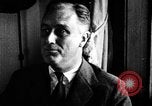
Scenes of Franklin D. and Eleanor Roosevelt in 1920s and 1930s.
New York Governor, Al Smith, candidate for President, seen with Franklin D. Roosevelt (FDR), encouraging him to run for Governor. FDR and Eleanor Roosevelt in an open car following his successful election as Governor. On July 14, 1933, now President Roosevelt, is seen in an open car, with Eleanor, on the grounds of the Catholic University of America. He is dressed in top hat, and Eleanor holds large bouquet of flowers. FDR is later seen,wearing mortar board and gown, as he and Eleanor converse with University Rector James H. Ryan, after receiving an honorary degree as part of the day’s commencement exercises. Montage of scenes showing Eleanor Roosevelt in various political and charitable activities during the 1920s and 1930s.
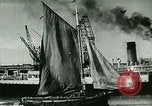
Tourists arriving in Paris; views of downtown Paris sidewalks in mid 1920's, and as seen from a moving car.
A steamship carrying tourists arrives at port in France. Tourists board a steam locomotive passenger train from the port to Paris. View of railroad train at station, passengers on platform, and train departing. Locomotive engineer's point of view (POV) from moving train of the track ahead and surrounding scenery as the train speeds toward Paris. Point of view (POV) through open window in moving train car. A man and woman relaxing in their passenger compartment on the train. Paris street scenes. Street vendors. Luggage handlers. Luggage being loaded into taxicab. Paris policeman directing traffic on the streets. A nun in habit wearing a large white hat. Pedestrians on sidewalks. Dog in a car. Traffic in downtown Paris and many Paris landmarks as seen from point of view of a moving car. Car approaching Arc de Triomphe. Guests arriving at a hotel. Woman and man exit car and step into hotel.
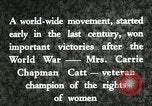
Mrs. Carrie Chapman Catt speaks about the 19th Amendment to the U.S. Constitution (ratified on August 18, 1920)
Mrs Carrie Chapman Catt speaks after ratification of the 19th amendment to the U.S. Constitution, giving women the right to vote. Catt, President of the National American Woman Suffrage Association, is seated in a chair in an office or library and reads from a prepared script. She traces the roots of the struggle, for the rights of women in America, back to an 1848 convention in Seneca Falls, New York. She notes that grievances related to woman suffrage were the same in number as grievances enumerated by male colonists in America against the British crown. She notes that it took George Washington 6 years to resolve those grievances via war, but it took 72 years for women to resolve their suffrage grievances via the law.
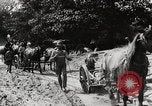
Road building in the United States during the 1920s
Men, with horse drawn leveling tools, prepare ground for road construction. Workers with wheelbarrows put concrete into chute of road building machine. Road building machine constructs concrete road along side a railroad track. Road machine moves on chained wheels. Workers with the help of machines build road. Views of automobiles moving along new concrete roads, wide enough to allow cars to pass.
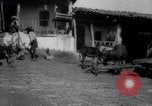
Turkish recruits muster for the Greco-Turkish War circa 1920
Turks muster to fight in the Greco-Turkish War, leaving homes and villages, bidding farewell to loved ones and assembling as infantry and cavalry.
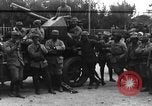
Scenes of Berlin Germany during the Kapp Putsch of 1920
The Kapp Putsch in Berlin during the Weimar Republic period. In opening scene about 20 Freikorps soldiers in uniform, are seen gathered around a motor vehicle on which an anti aircraft gun is mounted. One wears a fez. One soldier cranks a handle to raise the elevation of the gun to a high angle. Civilian spectators watch the demonstration. A warship can be seen in water behind the soldiers. Masts of docked sailing vessels are seen close behind them. Freikorps soldiers walk about. A military band plays as some of the soldiers stop and listen to them and pedestrians and motorists pass by. Flag of Prussia flies over top of a building. Helmeted German soldiers with rifles, stand about, casually, at the gates of a building. Soldiers, loaded onto a Benz truck, pass out newspaper flyers to passersby. People milling about in the street. Freikorps soldiers lined up as an officer inspects their rifles. Their insignia is visible on their left coat sleeves. Crowd of spectators stand behind barbed wire barrier surrounding a cleared square in the city secured by Army soldiers in steel helmets. One of them has Freikorps insignia on his left sleeve. Weimar Republic officials, including Philipp Scheidemann stroll across the square and proceed through the crowd outside the barbed wire barrier. Soldiers examine papers of civilian officials trying to enter the restricted area. One of them is allowed access. Army troops and Freikorps soldiers mingle together as civilians pass by them.
CRITICALPAST.COM: About Us | Contact Us | FAQs - How to Order | License Agreement | My Account | My Lightboxes | Shopping Cart | Advanced Search | Featured Collections | Website Terms & Conditions | Privacy Policy ©2026 CriticalPast LLC.
License Agreement |
Terms & Conditions |
Privacy Policy
©2026 CriticalPast LLC.