


 Francais
 Deutsch
 Italiano
Refine Your Search
Brest France 1920 stock footage and images
- Showing 3403 to 3408 of 5747 results more
more Hide
Hide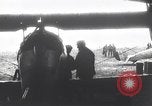
The Layfayette Escadrille of the French Army is transferred to the U.S. Army 103rd Aero Squadron in World War I.
Slate reads: "Coucy, France. The American Aero Corps, which has seen active service with the Allied Armies, is now ready to fly for Uncle Sam." Aircraft are seen on a grass flight line. Closeup of one airplane fuselage shows Indian Head dress Squadron Insignia of the French Army, Lafayette Escadrille, that continued to be displayed on aircraft of the American 103rd Aero Pursuit Squadron. French flier, Gervais Raoul Lufbery, sits on the ground leaning against the airplane. Another French flier sits nearby, accompanied by a German Shepherd dog. American flier,, William Thaw, stands against the propeller of the airplane. A group of American and French fliers display a large American flag, in recognition of the the 103rd Aero Pursuit Squadron commencing operations in France, as a U.S. entity.
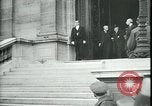
Arrival and departure of various delegates during the Paris Peace Conference.
Series of events during the Paris Peace Conference. President of France Raymond Poincaré seen departing hotel. Member of Arab delegation, Prince Emir Faisal seen departing with others and talking. Members of the Paris Conference arriving. Crowd of people gathered to see the delegates. United States President Mr. Woodrow Wilson and his wife arrive on foot at Quai d' Orsay, French Ministry of Foreign and European affairs (37, Quai d'Orsay - 75007 Paris. President Wilson helps Mrs. Wilson to get into the motor carriage. Prime minister of France Premier Georges Clemenceau seen leaving.
Mrs. Woodrow Wilson and Madame Raymond Poincare arriving at Murat Mansion in Paris during the Paris Peace Conference.
Edith Bolling Galt Wilson, wife of United States President Woodrow Wilson and Madame Poincaré, wife of President of France, Raymond Poincaré arriving at the Murat Mansion (28 Rue de Monceau 75008 Paris, France) in Paris. They are on their visit to Paris during the Paris Peace Conference. The French guards helping them to get the horse carriage. (World War I; World War 1; WWI; WW1)
President Woodrow Wilson arrives for lunch at Luxemburg Palace during his visit to Paris for the Peace Conference
United States President Woodrow Wilson with General Leorat of France. President Wilson gets out of the car. French guards help him to get out of the car. The President had arrived for lunch at Salle des Conference of Luxemburg Palace. Prime minister of France Georges Clemenceau also arrives at Salle des Conference. The lunch had been arranged by the French Senate in honor of President Wilson.
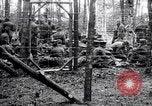
U.S. 1st Division troops process German prisoners following the Battle of Cantigny in World War I
German prisoners of war (POWs) held in an outdoor wire enclosure, by U.S. First Division troops behind the lines near Catigny, France, during World War 1. Closeups of two German prisoners, each with a U.S. Army interrogator. The second one is being spoken to by a U.S. Army lieutenant. View of several prisoners, including a German medical corpsman, attending a wounded on a litter. German prisoners being searched and processed by two French soldiers under supervision of a U.S. Army officer. U.S. troops in the background. U.S. General John J. Pershing, Commander of the American Expeditionary Forces (AEF) steps from a headquarters building, behind the lines near Catigny, France, accompanied by Major General Robert L. Bullard, Commander of the U.S. First Division, and staff. They proceed along pavement in front of several buildings. Next scene shows Pershing and Major General Bullard entering a wooded area, where U.S. troops line a path and several German prisoners are faced away from the path. The American generals look over some German officer prisoners drawn up in a small group on one side of the path. They continue past a wire enclosure containing German prisoners, on the other side of the path.
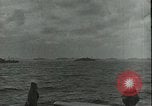
Soldiers of the 1st Infantry Division in England and during the invasion of Normandy and subsequent campaigns toward Germany (WW2)
Soldiers of the 1st Infantry Division training in England under General Clarence R Huebner, in preparation for the D-Day Normandy invasion in World War II. U.S. Navy ships underway at sea. Heavy naval guns bombard the coast of France on D-Day. U.S. Army soldiers seen during assault on Omaha beach with heavy losses on D-Day. U.S. soldiers and tanks encounter heavy German resistance in the "hedge rows." American soldiers digging trenches with shovels and picks and treating wounded comrade. Dead German soldier lying in street as Americans enter the town of Caumont (Caumont l'Eventé). Frenchman civilian pours wine for American soldier after they liberated Caumont l'Eventé from the entrenched German forces. An American helps a French civilian woman to reach a safe place crossing rubble. Damaged French houses along the sides of street. During rest, a soldier gives another a haircut, and another writes a letter. U.S. Air Force B-17s fly overhead and bomb near St. Lo, France on July 25, 1944. Other U.S. Army artillery units, the 4th and 9th Divisions, and General Patton's tanks provided support so the 1st Infantry (First Infantry or Big Red One) could occupy the area. Army combat engineers dig up mines and use construction equipment to clear debris. Wrecked houses and rubble. U.S. soldiers keep advancing through towns and eat and rest as they can. Road sign reads: "Coutances." First Infantry goes through Mortain, Etampes, Meaux, Soissons and across the Belgian border. German prisoners of war walk with their hands raised. German soldier digging out of fox hole. Siegfried Line and dragons teeth. Strong German resistance encountered at Aachen. Tanks fire in the field. House to house fighting in Aachen. Surrender of Aachen. A German flag laying in the street is run over by a U.S. military vehicle. German resistance is heavy during battle scenes in Battle of Hürtgen Forest. German and American artillery are seen in Hurtgen Forest. U.S. wounded treated. The 1st Division is pulled out for rest at the rear, in Belgium.
CRITICALPAST.COM: About Us | Contact Us | FAQs - How to Order | License Agreement | My Account | My Lightboxes | Shopping Cart | Advanced Search | Featured Collections | Website Terms & Conditions | Privacy Policy ©2026 CriticalPast LLC.
License Agreement |
Terms & Conditions |
Privacy Policy
©2026 CriticalPast LLC.