


 Francais
 Deutsch
 Italiano
Refine Your Search
Brest France 1920 stock footage and images
- Showing 4531 to 4536 of 5747 results more
more Hide
Hide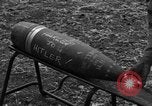
African American soldiers of Field Artillery Battalion of 92nd Infantry Division operate a 8-inch howitzer during WW2
United States Army Field Artillery Battalion of 92nd Infantry Division (Colored), "Buffalo Soldiers," equipped with tractor-drawn 8-inch Howitzers, in Mantes de Gassicourt, France during World War 2. Opening scene shows an 8-inch howitzer shell on a stand. It has the words: "Harlem to Hitler" written on it in chalk. A gunner screws a fuse into its nose. Closeup of the shell and chalk message. Four soldiers then pick up the shell and walk it towards the breech of their 8-inch howitzer. Cloeup of the gun breech as gunner locks breech and then unlocks and opens it for the camera. Scene shifts to gun crew member communicating on field telephone. Camouflage netting is visible behind him. Next, a gun crew member is seen holding his ears as if to protect against the noise of a gun firing. Change of scene shows members of gun crew relaxing near their 8-inch howitzer, near a grove of trees. New scene shows brief glimpse of a shell exploding in hill above Mantes. (The tower of the Mantes Notre Dame cathedral is seen in lower left of the shot.) (Note: These scenes probably show members of the 795th or the 999th Field Artillery Battalion)
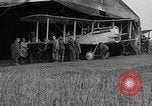
U.S. 96th Aero Squadron mechanics line up Dehavilland DH-4 airplanes on airfield in World War I
Activities of U.S. 96th Aero Squadron at the First Air Depot in Colombey-les-Belles, France during World War 1. Mechanics and soldiers push a DH-4 biplane bomber out of a canvas-covered hangar and onto the airfield. Five DH-4s parked on the grass field. The mechanics and the soldiers push two more DH-4 aircraft into the line at the field. The tails of all the aircraft are painted in the French scheme of vertical blue-white-red stripes, with the blue forward.
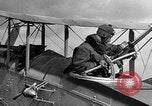
De Havilland DH-4 bomber preparing to depart on a mission from a French airfield, in World War I.
U.S. 96th Aero Squadron at the First Air Depot in Colombey-les-Belles, France during World War 1. A gunnerchecking out the Scarff ring mounting of his Lewis machine gun in the rear cockpit of a De Havilland DH-4 bomber aircraft. His pilot approaches the aircraft and gets in the cockpit. The pilot and the gunner both shake hands with an American officer who reaches up to them from the ground. Then they settle down in their cockpits for engine start. Three ground crewmen with hands linked together, pull the propeller through several times before they manage to start the aircraft engine. They move away from the aircraft as the engine fires. They pull chocks from in front of the wheels and the aircraft taxis onto the airfield. The airplane tail displays the French blue-white-red vertical paint stripe scheme.
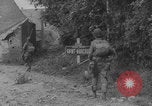
United States soldiers talk to villagers in Saint-Marcouf, Normandy (WW2)
United States soldiers enter the village of Saint-Marcouf, in the Manche department in Normandy, France during World War 2. Soldiers pass by sign “Saint-Marcouf”. United States troops carry rifles. French villagers walking. Soldiers talk to an old French man and woman. Soldiers sitting on the street side of what is now known as the “Route du 5 Juin 1944”. Soldier smoking a cigarette during a break. Groups of soldiers crowd outside a damaged house. Soldiers talking to a French man. A soldier talks to children. A little girl points upwards. A statue of the Virgin Mary stands among the rubble. A statue of Jesus Christ on the Cross leaning sideways inside a church wrecked. Words by George C. Marshall, Chief of Staff of the United States Army says “No compromise is possible and the victory of the democracies can only be complete with the utter defeat of the war machines of Germany and Japan”. A “V” is superimposed over marching soldiers and a ringing Liberty Bell.
Generals Eisenhower and Taylor review 101st Airborne with Marlene Dietrich attending, WW2,
United States General Dwight D. Eisenhower and General Maxwell D. Taylor inspect the 101st Airborne troops in Mourmelon-le-Grand, France during World War II. Generals Eisenhower and Taylor ride a Jeep while inspecting the troops. The troops stand at attention, some are holding United States flags. Officers stand on review stand. Actress Marlene Dietrich attends the event. Marlene Dietrich is wearing a helmet and a military-style uniform. She watches General Eisenhower make a speech. Eisenhower speaks to the troops from the review stand. The insignia of the 101st Airborne on display in the review stand.
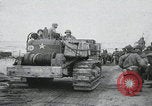
African American soldiers in foxholes; General Bradley in Normandy on D-Day (WW2)
A tractor after landing on the beach in Normandy, France during D-Day landings in World War II. The tractor carries soldiers and Jerry cans as Jeeps trail behind it. African American soldiers talking and eating in the foxholes on the beach. Barrage balloons flying over the beach. A sign in German reads “Minen” (“Mine”). General Omar Bradley, wearing his helmet and field jacket, stands next to another officer.
CRITICALPAST.COM: About Us | Contact Us | FAQs - How to Order | License Agreement | My Account | My Lightboxes | Shopping Cart | Advanced Search | Featured Collections | Website Terms & Conditions | Privacy Policy ©2026 CriticalPast LLC.
License Agreement |
Terms & Conditions |
Privacy Policy
©2026 CriticalPast LLC.