


 Francais
 Deutsch
 Italiano
Refine Your Search
Brest France 1920 stock footage and images
- Showing 5221 to 5226 of 5746 results more
more Hide
Hide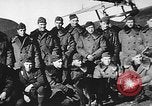
Some of the first American flying squadrons in World War I. The 1st and 103rd Aero Squadrons and their members
During World War 1, in 1918, American Expeditionary Force's 1st Aero Squadron members, including a mascot dog, pose on airfield. Airplanes in the background. Crewman pastes paper iron cross over enemy bullet hole in tail of airplane. Colonel Billy Mitchell decorating a flyer. General Benjamin Foulois in cockpit of a DH-4. United States officers shake hands with Colonel Thomas D. Milling. Colonel Frank Laub talks with a French officer. Members of the Lafayette Escadrille converted to the American 103rd Aero Squadron. July 1918 - Major William Thaw, steps forward and salutes, followed by Lieutenant Gordon D. Larner, Lieutenant Charles I. Merrick, and Lieutenant Edgar G. Tobin. Ace Captain Field Kindley, stands by a Sopwith Camel, supporting a small dog perched on its propeller. Ace Major Raoul Lufbery, smoking a cigarette, poses in front of a Nieuport 28c.1. Ace Captain Elliot Springs, also smoking a cigarette, poses in front of another airplane. Ace of Aces, Captain Eddie Rickenbacker, poses by SPAD S.XIII, number 5 ( its number not seen in this image) with "Hat in Ring" insignia painted on fuselage. (WWI,WW1, World War One, First World War)
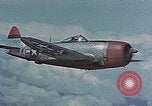
P-47 aircraft in flight over clouds.
A Republic P-47D Thunderbolt aircraft, with bubble canopy, in flight over clouds as seen from another plane flying extremely close. At one point, the two airplanes move a little too close as slipstream of lead plane (unseen) forces the P-47 to adjust. The P-47 has tail number: "226716" and "K" and "E4" are painted on its fuselage which indicates it was one of the P-47D-27s of the 362nd Fighter group, 377th Fighter Squadron (or later, of 86th Fighter Group, 525th Squadron). Slate at start notes the P-47 footage was shot by Air Force Lieutenant Colonel William Clothier, a famous cinematographer.
View backwards underneath a P-47during takeoff roll. A bomb falling over mountains. Flight of four P-47s
Backwards looking view from underside of a P-47 plane on takeoff roll. there is noticeable movement of rudder to keep plane straight during the roll. View from an airplane of bomb falling over mountainous terrain. Four P-47s flying low over water and farm country. Their moving shadows are clearly visible on the ground. (World War II period).
French antiaircraft battery firing during World War I. Burning airplane spinning down. Sinking ship. Battleship bombed and sunk
Various dramatic scenes captured by newsreel cameramen. French antiaircraft batteries firing during World War I. Aircraft in flame tailspins into earth after being struck by gunfire. Bombs falling towards earth. A capsized ship sinks in water. Bombing of the obsolete battleship New Jersey (BB-16), by one of General Billy Mitchell's bombers, during test, in 1923. View from directly above the battleship as it is hit by a bomb, and view as it capsizes and sinks.
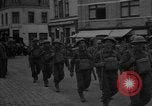
Troops of the British Expeditionary Force in Europe during the "phony war," at beginning of World War II
Soldiers of the British Expeditionary Force (BEF) marching informally, on the cobblestone streets of a town on the Belgian—French border during the so-called "Phoney War," at start of World War 2, in 1939. Some local residents watch and wave to the troops. Some children are seen, including a small girl held in her mother's arms. Soldier on bicycle and a canvas-covered utility vehicle are seen along with the marching infantry. The atmosphere is relaxed with no hint of hostilities.
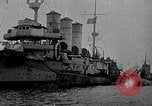
German submarines group together after armistice ending World War I. Men on Italian ship display their flags.
Following the Armistice ending World War 1, several German submarines are seen pulled up beside a ship. Washed clothes from crew members is seen drying on the decks. One of the submarines is U-91, commanded by Paul Koenig, which surrendered to the French on November 26, 1918. A large ship is crowded with men displaying Italian flags with cross and crown on them.
CRITICALPAST.COM: About Us | Contact Us | FAQs - How to Order | License Agreement | My Account | My Lightboxes | Shopping Cart | Advanced Search | Featured Collections | Website Terms & Conditions | Privacy Policy ©2026 CriticalPast LLC.
License Agreement |
Terms & Conditions |
Privacy Policy
©2026 CriticalPast LLC.