


 Francais
 Deutsch
 Italiano
Refine Your Search
British-Gliders stock footage and images
- Showing 805 to 810 of 3412 results more
more Hide
Hide
A German Destroyer Flotilla destroys a British ship in the Bay of Biscay (WW2)
A German Destroyer Flotilla underway in the Bay of Biscay. The German destroyer patrols the bay with mortar torpedo boats. A fleet of German Junkers Ju 87 Stuka dive bombers in flight. A British ship underway. Officers look through binoculars aboard the ship. The German Destroyer Flotilla fires torpedo on the British ship and sinks it. The ship is sinking. (World War II period).
British Army tanks undergo tests against beach obstacles on a beach in Europe.
British Army tanks tested against various beach obstacles. Insignia of Combined Operations Headquarters. Tanks on roadway of 2nd in Tubular of matting. British tank moves on coir matting laid over sommerfelt.
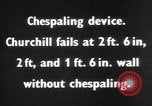
British Army tanks cross obstacles on a beach using Chespaling device in Europe.
British Army tanks tested against various beach obstacles. They move using Chespaling device on a beach. The tanks advance over a raised platform. A British tank moves in water and advances towards the beach area. It uses roller carpet device to move on the beach. Chespaling device placed on the obstacle on the beach. The tank moves on it.
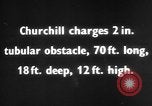
British Army tanks passes through a tubular obstacle in Europe.
British Army tanks tested against various beach obstacles. A British Churchill tank charges 2 tubular obstacles, 70 feet long, 18 feet deep and 12 feet high. The tank drives through the obstacle. Officials inspect the broken obstacle.
Field Marshal Bernard Montgomery and Air Marshal of British Air Force arrive at Gatow Airport in Berlin, Germany (WW2)
Field Marshal Montgomery and Air Marshal of British Air Force at Gatow Airport in Berlin, Germany during World War II. Air Marshal gets in staff car at Gatow Airport. A C-54 'Argonaut IV' parked on the ground which carried highest ranking army personnel to Berlin. Airmen await a dignitary's arrival at Gatow Airport. Field Marshall Montgomery and other British officers disembark from a C-47.
British troops in trenches don gas masks after hearing a warning by a Strombos horn on the Western Front in World War I
British troops in deep trenches lined with woven branches, on the Western Front in World War 1. Slate refers to gas alarm with Strombos horn. British soldiers immediately don their gas masks and take up defensive firing positions in their trench. Gas fumes are seen drifting over the trench. View from the trench, of gas cloud over No-Man's land, with barbed wire and some snow on the ground. [Note: The Strombos horn,was operated by compressed air and could be heard for several miles. But as use of gas shells increased, and such attacks tended to be localized, other alarms were employed, instead, such as metal shell cases, steel triangles, watchmen's rattles, klaxon horns, etc.] (World War I; World War 1; WWI; WW1)
CRITICALPAST.COM: About Us | Contact Us | FAQs - How to Order | License Agreement | My Account | My Lightboxes | Shopping Cart | Advanced Search | Featured Collections | Website Terms & Conditions | Privacy Policy ©2026 CriticalPast LLC.
License Agreement |
Terms & Conditions |
Privacy Policy
©2026 CriticalPast LLC.