


 Francais
 Deutsch
 Italiano
Refine Your Search
British-Gliders stock footage and images
- Showing 1399 to 1404 of 3412 results more
more Hide
Hide
British RAF bombers of No 2 Group bomb the Philips Electrical works at German-occupied Eindhoven, Holland, during World War II.
Film starts wirh slate reading: "R.A.F. Blasts Holland." At an Royal Air Force (RAF) base in England, United Kingdom, ground crewmen work on a British Supermarine Spitfire aircraft. Closeup of RAF pilot in cockpit of an airplane. Closeups showing fires burning and severe destruction of the Philips Electrical works at Endoven, the Netherlands, in aerial photographs taken during a bombing attack by RAF 2 Group, on December 6, 1942. Animated map illustrates the flight path of the attacking bombers from England, across the North Sea and the German occupied Holland, to Endoven. View of a de Havilland Mosquito bomber with propellers turning and then one of a Mosquito bomber in flight overhead. View from a warship of several RAF 2 Group aircraft flying low over the North sea. Glimpse of a Mosquito bomber flying low enough to affect the ocean surface. View from another aircraft in the formation, of a Mosquito bomber underway low over the water. View of a pilot in a cockpit, wearing learher helmet with earphones and an oxygen mask. View from aircraft approaching the coast of Holland, with two others already low above the mainland. More views of the bombers flying extremely low over Holland. View from a bomber showing agricultural land and the Philips Electrical works at Endoven, dead ahead. German flak guns fire and the bombers return fire by strafing the target building. The camera aircraft pulls up climb above the building and maneuvers over a river and city. Scene shifts to views from a high altitude group of RAF 2 Group, over the target. Views of their bombs bursting on target complex, causing fires and heavy smoke. Scene shifts, again to the bomber aircraft recovering at their home base in England. (Narrator states that 12 aircraft did not make it back.) View of a mosquito bomber crash landed. A severely damaged Lockheed PV-1 Ventura bomber. A crash landed Douglas A-20 Havoc bomber. Air crews conversing after arriving back from the mission. (Note: Losses to 2 Group were heavy, with 14 aircraft brought down by flak and enemy fighters, a 20% loss rate. Three more aircraft crash-landed on returning to England. Fifty-seven aircraft had been damaged and needed repairs.)
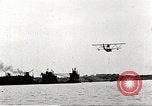
End of WW1, U.S. Battleships serving with British 6th Battle Squadron and some from U.S. Atlantic Fleet, in Firth of Fourth
U.S. Battleships that served as 6th Battle Squadron, with the British Grand Fleet, plus several from the U.S. Atlantic Fleet, gathered at end of World War I, in the Firth of Forth, Scotland. A twin engine bi-wing float plane circles over the Firth. Ships and derricks of shipyard in background. Small sailboat in water. Various American battleships in full dress - flags flying from both cage masts and crews manning the rails, dressed in winter blues. View of battleship USS Florida (BB-30) at anchor. The USS Arkansas (BB-33) anchored. The USS Pennsylvania (BB-38) and USS Arizona (BB-39) in the distance. The USS Nevada (BB-36) and the USS Oklahoma (BB-37). Bow view of the USS New York (BB-34) steaming. Views of the Forth Rail Bridge over the Firth of Forth. Warships in distance, framed by the bridge span. Stern view of a Nevada-class Battleship steaming. The USS Texas(BB-35) at anchor. More views of the Battleships Nevada and Oklahoma Last U.S. Battleship seen is the USS Utah (BB-31) at anchor.
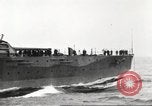
United States warships exercise with British Grand Fleet during World War I
U.S. warships maneuver with elements of the British Grand Fleet, during World War 1. Bow of a battleship seen briefly. A 3"/23 caliber gun on the deck of a subchaser. Battleships practice columnar battle formations. A destroyer in camouflage paint. Subchasers and destroyers underway. U.S. Matthews-built 110 foot wooden subchaser, number SC 175, plunging through heavy seas. Heavy wake behind a subchaser with sailor sitting in stern. View from stern of a subchaser with foamy wake as the boat rides the swells.
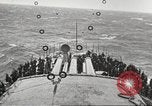
Various scenes of U.S. warships in 1917. British Admiral David Beatty welcomes U.S. Battleship Division Nine to the Grand Fleet.
Scenes of U.S. warships in World War I. Sailors take calisthenics, on deck, aboard Pennsylvania class U.S. battleship underway in Atlantic ocean, as viewed from above her three-gun upper turret. Different time and place: British Admiral David Beatty welcoming officers of the U.S. Ninth Battleship Division upon their arrival to join the Grand Fleet, in 1917, at the Firth of Forth, in Scotland. Admiral Beatty giving a welcome speech to officers and sailors of the Ninth Battleship Division, aboard the USS New York. US destroyer Manley (DD-74) camouflaged in Firth of Forth. Different place and time: Sailors hold on to lines as they watch a U.S. destroyer pass at high speed, and a Battleship following. U.S. warships signal each other using lights and morse code. Battleship passes at high speed.

British sailors aboard HMS Belfast (C35) underway in the English Channel for the D-Day landings on Normandy, France.
Allied convoy underway in the English Channel for the D-Day landings on Normandy, France during World War II. British sailors on the deck of HMS Belfast (C35). The sailors talk to each other on the deck of the cruiser. The convoy includes LCTs (Landing Craft Tanks), an LCI (Landing Craft Infantry), destroyers and landing crafts. Barrage balloons over the convoy.

British sailors unload supplies at a beachhead after the D-Day landings on Colleville-sur-Mer, Normandy.
Allied troops on a beach after the D-Day landings on Colleville-sur-Mer, Normandy during World War II. British sailors unload supplies at Omaha Beachhead. Soldiers climb a hill.
CRITICALPAST.COM: About Us | Contact Us | FAQs - How to Order | License Agreement | My Account | My Lightboxes | Shopping Cart | Advanced Search | Featured Collections | Website Terms & Conditions | Privacy Policy ©2026 CriticalPast LLC.
License Agreement |
Terms & Conditions |
Privacy Policy
©2026 CriticalPast LLC.