


 Francais
 Deutsch
 Italiano
Refine Your Search
British-Gliders stock footage and images
- Showing 2029 to 2034 of 3412 results more
more Hide
Hide
Allied forces and German Army in Battle of the Bulge
German counter attack in Battle of the Bulge, in world War 2. U.S. Army Sherman tank crews load artillery shells and fire from wooded positions. U.S. artillery crews load shells and fire heavy guns under camouflage nets. Scene changes to German forces: German infantry advancing past knocked out U.S. artillery piece and Sherman tank. A Jagdpanzer IV tank destroyer rolls by behind the soldiers and the wreckage of tanks from recent battle. German Panzer V "Panther" tank advances, with several soldiers riding on top, followed by a Jagdpanzer IV tank destroyer with a few German soldiers in and on top of it. Grille Ausf. M self-propelled artillery gun fires. German infantry and trucks with German soldiers enter a village. British RAF Hawker Typhoon aircraft dive and fire rockets at German ground targets. U.S. forces fire artillery and regroup in a forest. U.S. troops move through water and mud in a town. U.S. Army soldiers carry wounded on stretchers. British troops escort German prisoners of war in a town. U.S. Army trucks move through deep water flooding the main street of a small town. An American soldier places his foot on edge of a bin and water pours out of his boot. American soldiers take a chow break to eat.
The City of Paris, France, before and after the Nazi invasion of 1940, and America preparing for World War II
Views of Paris in the late 1930s, prior to World War II. The Arc de Triomphe de l'Étoile (Arch of Triumph). The Tuileries gardens (Jardins des Tuileries) with bed of tulips in full bloom in foreground. The Eiffel Tower (la tour Eiffel). The fountain of River Commerce and Navigation at the Place de la Concord, Paris, with the Madeleine church (L'église de la Madeleine) directly behind, the Hotel de Crillon,barely seen at left, and its twin building, the French Naval Ministry, opposite, on the Rue Royale. People strolling and shopping on the Boulevard Haussmann. Awning of Les Deux Magots café and patrons seated at tables outside, in the Saint-Germain-des-Prés area of Paris. People relaxing in the Tuileries gardens, with Arc de Triomphe du Carrousel and Musée du Louvre in background. An artist at work, seated at a bench in the foreground. The west facade of Notre Dame Cathedral. Parisians looking at posters, reading in parks, visiting bookstores. Sign directing visitors to the Congres des Ecrivains (Congress of Writers) held at Maison de la Mutualité conference center at 24 Rue Saint-Victor, 5th arrondissement of Paris, France.in June, 1935. Several writers seated at a table with others standing around. Closeup of three. Closeup of British writer, Aldous Huxley, wearing eyeglasses. Two writers conversing. Scene shifts to Paris at night. Car traffic on streets of Paris at night. Illuminated sign at Moulin Rouge cinema theatre, topped with illuminated arms of a windmill. Lighted sign of nightclub, Le Rat Mort, in Place Pigalle. Interior of a Paris nightclub with sophisticated clientele. French entertainer musician playing a guitar. An official posting an announcement called "Counseil de Revision," calling for conscription (military draft recruitment) of citizens for military service. Parisians preparing defenses in the city, in front of the Eiffel Tower. Man deep in a trench preparing a shelter. Men carrying sandbags up a ladder to protect a national monument. Copy of the New York Times newspaper annnouncing the German attack on Poland. Copy of New York Daily News announcing fall of Holland. The New York World-Telegram paper announcing capitulation of France. German Panzer II tanks and motorcycle troops entering Paris. German infantry marching through the Arch of Triumph, on the Champs-Élysées. A Frenchman wiping his eyes as he watches the occupying troops. Hermann Goering with other officers riding in an open car along a Paris street. Closeup of Arch of Triumph. Adolf Hitler, accopanied by staff, looking at the Eiffel Tower. Nazi flag flying from the tower. Closeup of Hitler looking around. The U.S. Capitol building in Washington, DC. President Franklin D. Roosevelt, in Academic garb, at the University of Virginia commencement ceremony, in Memorial Gymnasium, on June 10, 1940. (FDR's son Franklin Jr. was among the graduates assembled, from the UVA Law School). Roosevelt expresses American sympathy and support for nations invaded by the Nazis. American street scene. Women preparing gifts intended for France. A poster showing a French soldier, entitled: "Le Paquet Au Front." American draftees in training at an army post in the U.S. Smoke billowing from American industrial facilities. Workers at an American shipyard. View of warships under construction at the yard. A Huge gun barrel being moved on special rail dollies, in a U.S. arms factory. U.S. Navy F4U Corsair Production Line during World War II. M3 Lee medium tanks being manufactured in U.S. factory. Closeup of finished one being transported via transverse crane. M4 Sherman tanks moving on flat rail cars. A speeding steam locomotive pulling freight cars. Martin PBM-5 Mariner in flight over an Atlantic convoy carrying war materiel to the United Kingdom. Sailor wearing headset, standing near depth charges at stern of a ship. British Naval Ensign flying from mast of a ship.
The Quebec and Tehran Conferences in World War II. German defenses in the Western Wall. The air war in Europe.
Allied strategic Conferences in World War 2. Opening scene shows Château Frontenac. Then President Franklin Roosevelt seated with Canada Prime Minister, McKensie King, and British Prime Minister, Winston Churchill. Scene shifts to their respective military staffs conferring at a table. Next scene shows the Russian Embassy in Tehran, Iran, with the Big Three (Joseph Stalin, FDR, and Churchill) seated on the portico, and their top ranking military officers standing behind them. Soviet Marshal Kliment Voroshilov stands behind Stalin. American officers are seen in next scene, including General George Marshall, Admiral Ernest King (lighting a cigarette) and General Henry H. ("Hap") Arnold. U.S. Ambassador to Russia, W. Averell Harriman, stands behind King and Arnold. Closeup of Churchill. Shift to an animated map of Europe. It illustrates the massive fortifications put in place by the Nazis along the coast of occupied Europe. Camera pans across heavy German coastal guns, Pill Boxes, and shore obstacles in place on the beaches. Marshal Erwin Johannes Eugen Rommel leads a group of German officers on an inspection tour of the "Atlantic Wall" defenses. Closeup of Rommel. British Bristol Blenheim bombers en route to attack targets in the German occupied areas. Views of Allied airmen inside cockpit of their bomber aircraft. A flight of five German fighters (appear to be Bf-109s) peeling off to attack an Allied bomber. View inside bomber of American gunner in bomber firing machine gun at attacking German fighter. Head on view of German Focke Wulf FW-190 fighter heading straight toward the camera, and point of view from gun camera as German aircraft zooms up over it. Gunner in bomber firing. An aircraft exploding inflight. View inside Allied bomber, through cracked windshield, of aircraft in a formation of U.S. Martin B-26 Marauder bombers. Next shot is rearward from bomb bay showing bombs away view as bombs are released from a B-26. Scene shifts to aerial view from rear of a U.S. B-17 bomber dropping bombs. View of the bombs striking a railroad marshaling yard. Another view of a B-26 bomber in flight.
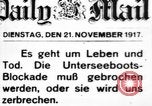
German U-Boat stops the Spanish steamer " Asuarca," at sea in World War I
Slate mimics The British Daily Mail newspaper, Tuesday, November 21, 1917, declaring that England must break the German U-boat blockade or be broken by it. Another slate alludes a statement by British MP Gibson Bowles to the effect that Britain's food supply is being controlled by the German submarine. Crew of a surfaced German submarine is seen on deck taking advantage of good weather to perform maintenance on their deck gun, during World War 1. Officers in Conning tower scan horizon with binoculars. The neutral Spanish Steamer, "Asuarca," is sighted from the conning tower, where the Imperial German Navy war ensign is displayed along with a nautical pennant bearing a white cross on red background, indicating the numeral "4." The crew is also raising a bicolor nautical flag for the letter "H." (A slate states that the U-boat is signalling for the ship to send a boat.) View of the single-stack Spanish steamer. A boat from the Asuarca, sits alongside the U-boat after bringing an officer carrying her papers. The officer is seen leaving the submarine and boarding the ships dinghy, to return to the Asuarca. A Slate indicates she carried no contraband and was therefore allowed to proceed unhindered. (World War i; World War 1; WWI; WW1)

Activities of U-Boat, U-35, on return voyage during World War I
View from the surfaced German U-Boat, UB-35, on a scenic cruise along the British coast in World War 1. The U-Boat crew uses explosives to sink a ship, close to shore (after releasing the ship's crew). The ship was loaded with salt herring for transport to Genoa, Italy. Repeated explosions are seen. In change of scene, five prisoners of war (British ship captains) take a morning walk on the deck of the UB-35 behind a screen of tarpaulin stretched across the deck. A slate referring to the difficulties experienced by Britain from German U-Boats. The U-35 Captain, Lothar von Arnauld de la Periere, is seen sitting in his conning tower. Other officers are keeping watch. He receives a message from a sailor below. He writes a note to Headquarters reporting on ships and tonnage sunk by the U-35, and mentioning 5 English ship's captains taken prisoner, in the month of May, 1917. He signs it: "U-35, Arnauld." Closeup of the note. The U-35 proceeds to rendezvous with the Austro-Hungarian Novara-class scout cruiser, "Helgoland." View of the 4-stacker Helgoland with black smoke issuing from her stacks. View from the U-35 as it passes to port of the Helgoland. Captain von Arnauld and another officer, greet an Austro-Hungarian navy officer who comes aboard bringing greetings and wishes for good luck from his Admiral, to the U-35. View of the Admiral's flagship,the Austro-Hungarian Armored Cruiser, S.M.S. Sankt Georg. (Slate reads three cheers for the returning U-Boat, so presumably the Sankt Georg crew gives cheers.) Camera pans across the cruiser to deck of the U-35, where officers and men of the U-35 salute and raise their hats in three cheers for their Austrian-Hungarian comrades. Flags fly from the U-35, one for each Allied ship sunk. The U-35 with crew on deck moves slowly into port next to another submarine and large ship. U-Boat Captain von Arnauld walks to a fleet message center. The U-35 crew happily receive and read letters from home. The next scene shows the U-35 heading out to sea again,
Ladies and gentlemen gather to hear a speaker at a courtyard in Wales, during World War I
British men and women entering a building in Wales, UK. They assemble before a stage at the back of the building. Participants are well dressed and constitute a dignified gathering. A gentleman addresses them. British flags displayed and a sign stretched across the top of the stage reads, in Welsh: "adgofion mebyd ein gwron,gwron y byd." ( childhood memories of our hero, the hero of the world ). The gathering may be of political nature and the sign may allude to David Lloyd George who spent his childhood in Wales.(He was Secretary of State for War and then Prime Minister of the United Kingdom at the head of a wartime coalition government, beginning in 1916.) Following the meeting, participants come out of the front entrance, and pose momentarily for the cinematographer, before continuing on their way.