


 Francais
 Deutsch
 Italiano
Refine Your Search
British-Gliders stock footage and images
- Showing 2173 to 2178 of 3412 results more
more Hide
Hide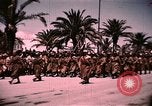
Troops of Allied nations march and B-25 bombers fly in formation during Victory Day parade in Tunis, Tunisia.
Victory Day parade in Tunis, Tunisia during World War II. Troops of Allied nations march during the parade. Robed British and French troops marching in the parade. A crowd gathered on the side of the road. A few United States Army Air Forces B-25 Mitchell bombers in formation flight above the parade ground. An army band moving in the parade. American soldiers march during the parade. Troops marching across a reviewing stand. American, French and British flags hoisted on poles on the reviewing stand. Several fighter aircraft in formation flight. Soldiers holding guns march with the officers leading the parade.
V-E Day at Piccadilly Circus in London, England. A large number of men, women, children and soldiers celebrate.
Piccadilly Circus on V-E Day in London, England during World War II. A large crowd of men, women and servicemen on the streets in London on V-E (Victory in Europe) Day. A double-deck bus moving through the crowd on a street. Men and women carrying children, smiling and walking on the street. People gathered at Trafalgar Square. Sailors holding British flags in front of the crowd. A number of soldiers, girls and children seated on a pyramidal structure in the square. A few soldiers waving British and Norwegian flags from the top of the structure. A large crowd gathered around the structure. View of buses moving through the crowd. Three American soldiers reading a newspaper. Newspaper headlines read 'Germany Surrenders'.
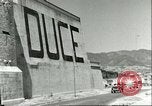
Allied forces advancing through Messina, Sicily, Italy in World War II.
Allied soldiers in a jeep and a British personnel carrier, drive past huge letters, spelling "DUCE," painted on the side of a massive concrete wall in Messina, during World War 2. Change of scene shows American soldier examining an Italian Pavesi military tractor. He is very intested in its unusual wheels. Change of scene shows the soldier climbing into the seat of another Pavesi tractor and checking out its controls. A large building across the street displays a British flag. An American technical sergeant offers an Italian civil policeman a cigarette. A closeup of the policeman as he smokes. The sergeant points to "Heil Rommel" written on a door, and other graffiti in chalk on a wall. He pauses to examine some wrecked Italian vehicles. Closeup of the wreckage.
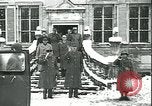
Charles de Gaulle and Winston Churchill together in Paris, France following its liberation in World War II
Opening scene shows French General Charles de Gaulle and British Prime Minister Winston Churchill as they leave a French Headquarters building in Paris, France, after its liberation in World War 2.. It is snowing. An American soldier, bugler, is blowing a salute. Another U.S. soldier holds the door of a staff car open. Among those following Churchill and de Gaulle, is British Field Marshal Sir Alan Francis Brooke, Chief of the Imperial General Staff. And (behind two French civilian officials), is French General Marie-Pierre Kœnig. Next, is seen an honor guard of American soldiers, rendering rifle salutes with right shoulder arms. Alternating Closeup glimpses of Churchill, de Gaulle, and company with those of the honor guard. Very close view of Churchill. Scene shifts to French military drum and bugle corps playing. Closeup of Churchill, de Gaulle, Brooke, and French General de Lattre, all saluting, and a French military color guard dipping colors in salute as others render rifle salutes. More views of French honor guard. Next, a jeep carrying General de Lattre, in front and Churchill and de Gaulle in the rear, passes by with occupants saluting. Glimpse from rear of French military honor guard. The jeep passing between troops in formation and a line of American Sherman tanks with their crews standing in front of their tanks. Views from various angles of the scene.
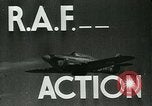
World War I Royal Flying Corps airplanes and flight crews shown during a historical retrospective on the Royal Air Force
Part of a British production, circa 1940, highlighting the work of the Royal Air Force during World War II, and discussing the history of the RAF while showing World War I Royal Flying Corps (RFC) images. The Royal Air Force in the United Kingdom. The flag of the Royal Air Force (RAF) on a mast. RAF personnel from all parts of the commonwealth march in a mass formation during World War II, including mainland Great Britain pilots and Indian RAF pilots and crews. A line of aircraft stationed on an airfield in the UK. History of RAF is discussed by narrator, with images from World War I of Royal Flying Corps (then part of British Army) airmen and their aircraft. Views of several World War I aircraft on an airfield and taking off, including the Sopwith Camel, the Royal Aircraft Factory S.E.5, the Bristol F.2 Fighter. Royal Flying Corps pilots and crews gathered for group photos.
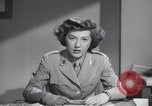
Yugoslav Marshal Josip Broz Tito at his headquarters in Yugoslavia (WW2)
A uniformed member of the U.S. Women's Army Corps (WAC) reads a letter from a soldier named Sergeant Lowry, asking why Army-Navy Screen Magazine doesn't show pictures of Marshal Tito, famous Yugoslav patriot. In response, the next scene shows rugged mountains of Yugoslavia, where Marshal Tito has his headquarters, in World War II. Closeup of Marshal Tito flanked on his left, by British Brigadier General Fitzroy Maclean, Winston Churchill's special envoy to the Yugoslav leader, and on his right, barely seen, U.S. Office of Strategic Services (OSS) Officer, Army Major Linn M. Farish, American Liaison to the Partisans. The three step down to a lower porch at the headquarters building, where Major Farish pumps his arm in the air several times as he speaks to General Maclean. Tito smiles, smokes his pipe, and makes some comment to them. The scene shifts to a British military photographer as he finishes taking a still picture of Tito and his principal staff officers, standing in a group, along with Tito's dog, Tigar.
CRITICALPAST.COM: About Us | Contact Us | FAQs - How to Order | License Agreement | My Account | My Lightboxes | Shopping Cart | Advanced Search | Featured Collections | Website Terms & Conditions | Privacy Policy ©2026 CriticalPast LLC.
License Agreement |
Terms & Conditions |
Privacy Policy
©2026 CriticalPast LLC.