


 Francais
 Deutsch
 Italiano
Refine Your Search
British-Gliders stock footage and images
- Showing 2311 to 2316 of 3412 results more
more Hide
Hide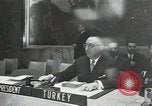
United Nations Security Council, 1955. Israeli envoy Abba Eban, Turkish envoy Salim Sarper, and UK envoy Sir Pierson Dixon
Turkey's ambassador to the UN, Salim Sarper, strikes a gavel, while seated at the delegate's table of the UN Security Council in New York, United States. Israeli delegate, Abba Eban is seen chatting with others. Abba Eban with British UN delegate, Sir Pierson Dixon, to his left. Scene of council room.
German military aircraft of World War I. including bi-planes, tri-planes, seaplanes and highwing monoplanes.
Various World War I planes (mostly German). Fokker D-7s and Fokker DR1. German seaplane. British tri-wing bomber with "RAEWAR Mark II" on its nose section. German Zeppelin Staaken R.VI bomber, with Fokker fighter plane parked under its wing. A German bi-wing bomber in flight.

Gerhard Zucker and others attempting to develop postal rockets in the 1930s.
Slate refers to efforts to overcome problems with compressed powder rockets. A large crowd is gathered to watch a demonstration of a Zucker mail rocket. Gerhard Zucker walks ahead and left of Several uniformed Brown Shirts, AKA Nazi Stormtrooper (Sturmabteilung) as they carry a large rocket down some stairs at a beach. Uniformed Hitler youth (Hitlerjugend) are also seen in the crowd of spectators. A cinematographer sets up his camera on structure near the water. Next, the rocket is seen set upon its inclined launching stand as Zucker makes ready the four rockets on each side of the large mail carrier. Closeup of Zucker doing this as another person deposits mail through a door atop the rocket body. Scene shifts to the Wadden Sea off Cuxhaven,on April 9, 1933, where Zucker follows Nazi Stormtroopers carrying the mail rocket across wet sands. Spectators stand shoulder-to-shoulder atop a hill in the background.Zucker standing alone next to the rocket. He and an assistant ignite the 8 side rockets and the mail rocket takes off. But, instead of heading straight, it noses up and loops over backwards, falling to the sand. Stormtroopers lift up the damaged device. Later, Zucker is seen designing a launch with concentric guide rings. He made several attempts in 1934 and 1935, to convince British Royal Mail officials of the viability of rocket mail. He is seen in the last attempt on the Isle of Wight, in January, 1935, standing by his rocket, surrounded by English spectators. His launch stand with concentric rings is clearly seen. He places mail in the rocket body and drops it down through the rings on the launch stand, ignites it and it appears to take off smoothly.(It actually failed.) Views of Belgian Karl Roberti and his postal rocket. An American rocket carrying a line out to a boat needing rescue offshore.
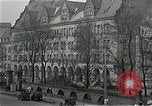
Soldiers and civilians have their passes checked at the Palace of Justice during the Nuremberg trials in Germany.
Exteriors of the Palace of Justice (Fürther Str. 110, 90429 Nürnberg, Germany) in Nuremberg during the Nuremberg trials shortly after World War 2. British guards in front of the entrance. Sign of the Nuremburg Palace of Justice in English and German: 'Loitering is Forbidden'. Soldiers and civilians have their passes checked before entering the courthouse. 'Palace of Justice' pass. Soldiers stand guard on the courthouse steps while others enter inside.
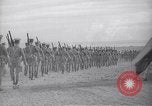
The Royal Sussex Regiment at Fayid Camp, Canal Zone in Egypt, ready to leave for Wady Soft for their maneuvers.
The Royal Sussex Regiment at Fayid Camp, Canal Zone, Egypt. General Weir, commander of British troops in Egypt, arrives. The Regiment ready to leave for Wady Soft in the desert for their maneuvers. Shots on the way. At Wady Soft, soldiers dig trenches. General Weir watches the men dig trenches. Machine guns and gas mask drill.
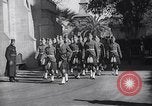
Scottish soldiers, Cairo General Weir and Sir Miles Lampson at St Andrews Church, Egypt.
Scottish soldiers arrive at St Andrews Church (St. Andrew’s United Church of Cairo, 38, 26 July Street Cairo, Egypt) in Cairo, Egypt. Cairo General Weir and Sir Miles Lampson, British Ambassador at Church. Sir Miles Lampson and soldiers come out of Church.
CRITICALPAST.COM: About Us | Contact Us | FAQs - How to Order | License Agreement | My Account | My Lightboxes | Shopping Cart | Advanced Search | Featured Collections | Website Terms & Conditions | Privacy Policy ©2026 CriticalPast LLC.
License Agreement |
Terms & Conditions |
Privacy Policy
©2026 CriticalPast LLC.