


 Francais
 Deutsch
 Italiano
Refine Your Search
British-Gliders stock footage and images
- Showing 2353 to 2358 of 3412 results more
more Hide
Hide
Victorious Australian troops marching back from an engagement at the front in France, during World War I
Large contingent of Australian troops marching along a road, as they return from a victorious engagement against German forces at the front in France, during World War One. The sides of the road are lined with other British troops who cheer for the Aussies.
Captured German dugouts in a field in France, during World War I.
German dugouts and trenches captured by British, in France, during World War One. They are unusually well constructed.
Roads made impassable by huge crater created during retreat by German forces in France during World War One
A huge crater created by German explosive demolition at a key crossroad in a French town during World War I, to impede Allied troops advancing as the Germans withdrew. Several British soldiers explore the crater. View of the town, from a hilltop. Many houses are damaged or destroyed. Several soldiers walking on the street in the town. The road continues straight, beyond the town into the distance.
Stretcher bearers carry gassed man into gas proof dug out in France, during World War I.
British sentry stands near a gas-proof dugout at the end of a deep reinforced trench on the Western Front in World War 1. Two stretcher bearers arrive carrying a soldier gas victim. The sentry opens a door to the dugout, and helps them carry the victim inside. (World War I; World War 1; WWI; WW1)
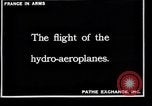
French Navy hydro-aeroplanes (flying boats and float planes) in World War I
During World War 1, a French naval aviator climbs into the hull of a Franco-British Aviation Type H flying boat, marked F.B.A. #8. Another crew member is already aboard and the engine is running. They taxi out in the water and take off in the aircraft. As they taxi for takeoff, a Breguet 14H float plane lands in background. Aerial views from the airborne F.B.A. Type H, showing boats in the water below. Next are seen two voisin 3 float planes taxiing slowly in water. A Viosin 3 float plane taxis rapidly up onto a wooden ramp. (WWI. WW1)
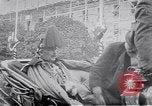
King Edward VII, of Britain, on State Visit in Berlin with his nephew, Kaiser Wilhelm II of Germany.
Film opens showing Kaiser Wilhelm II of Germany, seated in a carriage outside a building covered with scaffolding. He is wearing a fur-collared great coat and a plumed hat. Several flags are decorated poles behind the carriage. His uncle, King Edward VII of the United Kingdom, steps into the carriage. British King Edward VI is wearing an overcoat and top hat. As Edward VI settles into his seat, an attendant cover both men with a carriage robe. As the carriage pulls away, an honor guard in formation at attention is seen in the background. The carriage carrying the Kaiser and the King is seen ahead of another one in which a woman is riding, accompanied by a man in top hat and a military officer in uniform. Local spectators stand at the side of road and on hills overlooking the roadway. A third carriage, drawn by a pair of white horses, carries a woman accompanied by a man in a top hat and a military officer in an elaborate plumed hat. A fourth carriage follows with a military officer and two statesmen in top hats. Film ends as horses pulling another carriage.
CRITICALPAST.COM: About Us | Contact Us | FAQs - How to Order | License Agreement | My Account | My Lightboxes | Shopping Cart | Advanced Search | Featured Collections | Website Terms & Conditions | Privacy Policy ©2026 CriticalPast LLC.
License Agreement |
Terms & Conditions |
Privacy Policy
©2026 CriticalPast LLC.