


 Francais
 Deutsch
 Italiano
Refine Your Search
British-Gliders stock footage and images
- Showing 2485 to 2490 of 3412 results more
more Hide
Hide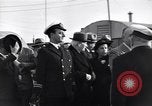
Greek Prime Minister, Themistoklis Sofoulis, boards the Greek Destroyer, RHS Hastings, in the Port of Piraeus.
Themistoklis Sofoulis (Sophoulis) Prime Minister of Greece, arrives at the port of Piraeus. Officials greet and welcome him. A color guard of Greek sailors presents arms in salute as Sofoulis is taken by the arm and escorted by a Greek admiral. He doffs his hat in acknowledgment. With the Admiral at his side, and , surrounded by civilian officials,and several naval officers, he makes his way to the Greek Navy Destroyer, RHS Hastings, tied up at the pier. A junior officer assists him as he ascends a gangway to board the ship. On deck, the ship's captain greets him and introduces several junior officers who salute and shake hands with him. The Greek National flag is seen fluttering in the breeze from the ship's mast. View of ship's bow as forward line is hauled aboard. The Greek State Flag is displayed from the ship. View from the pier as the ship backs away, followed by views of her underway. (This ship is the former British HMS Catterick, Class III Hunt destroyer, which was transferred on loan to Royal Hellenic Navy in 1946,as the Greek RHS Hastings. The number 15 appears on her hull which was formerly assigned to the Greek Destroyer Vasilissa Olga, that was sunk in 1943.)
General Vafiadis, Colonel Ford Trimble, Col C.B. MacKenzie, and Greek troops at Greece-Albania border during Greek Civil War.
Military officials of the US, UK and Greek Army during the Greek Civil War. Greek General Markos Vafiadis, a Greek captain, Colonel Ford Trimble United States Army, British Lt. Col. C.B. Mackenzie observe a map. The officials observe the enemy guerilla positions with binoculars. At the Greece-Albania border soldiers stretched on ground ready for attack. Military officials atop a mountain. Soldiers take their position behind stone walls on a hill. Soldiers check their ammunition and grenades. Soldiers standing at a mortar position during late evening hours.
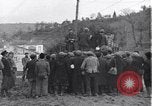
The Allied Military Government (AMG) begins immediate efforts to cleanup and rebuild Liberated areas of Sicily in World War II.
Allied Military Government efforts to rebuild Sicily after capturing it from Axis forces during World War 2. Italian men needing employnent board an open truck for transport to a job site. Workers standing with American soldiers preparing to work. A huge crowd of men pushing and shoving outside an Allied Military Government (AMG) labor hiring headquarters where they were offered decent wages to begin rebuilding after the war's destruction. Italian men, as well as American soldiers, rebuilding roads in the Alpine region of Italy, where German forces had destroyed them as they withdrew. U.S. Army engineers using a bulldozer, to clear and smooth a road. A large dump truck spreading new gravel for a highway bed. A team of workers manning a cable to pull down a damaged portion of a building. A British Army officer and a Colonial soldier in a turban, set explosive charges to destroy a bomb-damaged building. They detonate the charges and bring down the entire large building. Bulldozers at work on huge piles of rubble. A steam shovel being employed to clear large piles of debris. Men at work in Palermo, to clear entire streets buried in rubble. Men clearing rubble near piles of twisted steel building girders. Rubble being moved by horse-drawn carts and dumped into the sea. Italian masons at work building new homes and refurbishing old ones. In views three months after the original Allied landing in Sicily during July,1943, Palermo is seen well on the way to restoration. School children, including girls with brooms, walking to a place needing cleanup. Views of them cleaning steps and windows. Citizens picking up debris from streets and sidewalks. A man using a hose to clean a street and sidewalk in the city.
Tehran Conference and successive preparations for D-Day attack on Nazi regions in France by Allied forces (WW2)
World War II Documentary entitled "D-Day Convoy." Leaders and military Generals of the Allied nations at the Tehran Conference. U.S. President Roosevelt, British Prime Minister Churchill, Soviet General Stalin, General George Marshall of U.S. Army, General Eisenhower. Map showing the targets of raid in France under German occupation. Immense military ammunition, artillery, tanks, weapons and infantry troops amassed in England and readied for military raids. American infantry troops being trained to raid the Peninsula of Normandy. Troops advance between bomb blasts and gun fire during training. Allied air force bombers bombing their targets in France. Formation of Martin B-26 bomber aircraft flying overhead. Point of view shot from inside aircraft, seen through rain spotted plexiglass gun canopy, flying very low over a French village, on the way to bombing target. Aerial view of U.S. Army Air Force B-17 Flying Fortress bomber dropping bombs over enemy target in Europe. View of bombs falling away from aircraft toward targets during a day time bombing raid. Explosions and smoke on the ground as targets are hit. Aerial fights between German and Allied air forces. Gun camera footage scenes as seen from Allied aircraft as they shoot at German airplanes. Several scenes of German aircraft exploding in flight. Airplane blasts in sky. U.S. army troops with ammunition moving toward camps in southern England. At the marshaling area soldiers receiving and trying on gas masks. They also receive inflatable life belts, food rations, cigarettes, candy including Hershey's chocolate, and French money as invasion currency. Briefing of the troops by the commanders.

Signing of the surrender note aboard the USS Missouri after the surrender of Japan to the Allied Forces in World War II.
Signing of the instruments of surrender formalizing the capitulation of Japan to the Allied Forces in World War II. The Battleship USS Missouri in the Tokyo Bay. The U.S. Destroyer, Buchanan, pulls alongside bringing representatives of the Allied Powers to participate. U.S. General of the Army, Douglas MacArthur, Supreme Commander of Allied Forces boards the USS Missouri and is welcomed by Fleet Admiral Nimitz and Admiral Halsey. They proceed to the ship's Veranda deck for the signing ceremony. Japanese delegation led by Foreign Minister Mamoru Shigemitsu, accompanied by General Yoshijiro Umezo arrives in a boat. Speech by MacArthur as Japanese delegation looks on. Japanese representatives sign the surrender instruments. General MacArthur then signs using several pens that he presents to U.S. General Wainwright and British General Percival and others. Admiral Chester Nimitz signs for all U.S. forces, followed by Admiral Halsey. Allied representatives then sign for China, the United Kingdom, Soviet Union, Australia, Canada, France, Netherlands, and New Zealand. MacArthur gives closing comments. Allied aircraft fly overhead after the ceremony.
History of Germany as a group of 300 medieval princely states with feudalistic rulers.
Mix of actor portrayals and actual footage: Church, homes and schools of America. Various United States soldiers. Views of German soldiers. German soldiers marching in a parade ground. Rulers and dictators of Germany: Adolf Hitler (World War II), Kaiser Wilhelm II, Otto Von Bismarck who laid identity of Germany as Nazi, Huns, and Prussians respectively. Historic overview of Germany. Princes and feudalistic rulers of the states. In contrast the US, French and British parliamentary system. King Frederick, the Great of Prussia with his cavalry and in his court. Prussian war against Austria, Russia, Sweden, France. German women wave for victorious troops. Portraits of Scharnhorst and Gneisenau. Dictums of Clausewitz, crushing of the 1848 revolt in Prussia. Germans emigrate to the U.S. Otto Von Bismarck addresses the ministry his policies of blood and iron.
CRITICALPAST.COM: About Us | Contact Us | FAQs - How to Order | License Agreement | My Account | My Lightboxes | Shopping Cart | Advanced Search | Featured Collections | Website Terms & Conditions | Privacy Policy ©2026 CriticalPast LLC.
License Agreement |
Terms & Conditions |
Privacy Policy
©2026 CriticalPast LLC.