


 Francais
 Deutsch
 Italiano
Refine Your Search
British-Gliders stock footage and images
- Showing 259 to 264 of 3412 results more
more Hide
Hide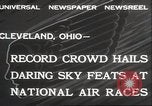
American Air Aces participate in the National Air Race in Cleveland, Ohio.
National Air Race in Cleveland, Ohio. Open Stadium is packed with spectators. Al Wilson dons his flying helmet and flies a Curtiss Pusher replica, performing aerobatics, including an inside loop. Glider pilot Jack O'Meara performs for the crowd, landing in the grass and smiling for the camera. (Note: Flier Al Wilson was killed later during these same Cleveland aviation events, when his 1910 Curtiss plane collided with an autogyro during landing.)
Aviation history; historic early flight scenes; first hand accounts from persons who knew and worked with the Wright brothers.
Views of traffic on a city street around the turn of the 20th century. A mix of horse and buggies and motorcars and bicycles. People waiting for a trolley car. Reenactment of persons using an early telephone and of early filmmakers at work with camera on motion picture film. The Wright brothers home at 7 Hawthorne Street, West Dayton, Ohio. The Wrights' former housekeeper, Carrie Grumbach, recalls December 17, 1903, a telegram arriving about the Wright brothers successful first powered flight. Glimpse of Wright brothers machine shop. Charlie Taylor, who had worked in their shop, speaks of being pleased at their accomplishment. View of the Wrights flying gliders at Kitty Hawk, North Carolina. Charlie Taylor describing how he machined and built the motor for the Wright brothers airplane. Glimpse of that motor or a facsimile. Men positioning the Wright brothers airplane for launching, and French citizens gathered to watch a demonstration of their airplane in France. French aviation pioneer, Henri Farman with two other men in his Voisin-Farman I airplane. They begin takeoff. Closeup of Brazilian aviation pioneer, Alberto Santos-Dumont. Other early aircraft in flight. A Wright Flyer passing over the Fort Myer drill ground in Virginia. An Army balloon in the background. Retired United States Air Force Brigadier General, Frank P. Lahm, walks across the tarmac on an airport and speaks for interviewer (unseen). He speaks about the difficulty the Wright brothers had in convincing the U.S. Army of the value of their airplane. He tells that in December, 1907, Wilbur Wright was finally granted an interview with the Board of Ordnance and Fortifications, which led to a contract, in 1908, with the Signal Corps. Moving imagesof Orville Wright and assistants bringing a Wright Flyer to Fort Myer, Virginia, to conduct flight trials for the Army. Views of the airplane being flown all around the area, watched by spectators. (This footage is a mix of 1909 footage where the aircraft shows two half-rounds of canvas in the front elevator, and 1908 footage, taking off and flying, where the aircraft has a single half-round of canvas in the front elevator.) After landing on the 9th of September, 1908, then, Lieutenant Lahm, accepts Orville Wright's offer to fly with him. Lahm climbs aboard the airplane, sits next to Orville Wright, and they are seen taking off and flying about for six minutes and forty seconds. (Lahm is the first. military officer to ever fly in an airplane.) The next scene shows the wreck of a Wright Flyer, in which Army Lieutenant Thomas Selfridge was killed and Orville Wright injured, on September 17, 1908.
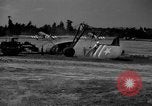
U.S. Army Air Force P-47 Thunderbolt, Martin B-26 Marauder and Lockheed P-38 Lightning taxi and take off in France.
Several United States aircraft taxi on a runway and take off in France during World War II. A tractor crane hooked to a wrecked U.S. Army Air Force Waco CG-4 glider. U.S. Army Air Force P-47 Thunderbolts parked in the background. A U.S. Army Air Force Silver Lockheed P-38 Lightning taxi past the parked aircraft in the background. The aircraft while taxiing raises dust. Invasion markings on the aircraft. A USAAF C-47 taxis forward, takes a turn and takes off. The aircraft in flight over the low field. Insignia of the United States. A U.S. Army Air Force Martin B-26 Marauder taxis on a runway and raises dust. Another C-47 taxis on the runway and takes off. A signal aircraft in the foreground. Parked aircraft and trees in the background.
U.S. Airborne Engineers lay a mesh strip over a field and aircraft parked in the background in France.
United States Airborne Engineers in France during World War II. U.S. Airborne Engineers lay a mesh strip over a field. U.S. Army Air Force P-47 Thunderbolts parked in the background. A mesh landing strip in the foreground. The Airborne Engineers lay more net on the landing strip. The engineers laying net. Parked aircraft in a revetment. A tractor crane and men attach the hook of the crane to the wreckage of the glider. U.S. Army Air Force C-47 Skytrains parked at a field. An explosion on a tree and the tree falls.
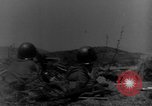
Seventh U.S. Army soldiers prepare for the Allied Invasion of Southern France during Operation Dragoon of World War 2
From a 1952 U.S. Army television program titled The Big Picture. U.S. troops in a fox hole in Korea. A U.S. tank carrying many GIs in Germany.US ski troops in Alaska. Amphibious training on beach in Puerto Rico. United States Army Sergeant James Mansfield introduces the story of United States Seventh Army in the Allied Invasion of Southern France, "Operation Dragoon." Army Colonel William Wilson Quinn seated in office, with army rifle on his desk. He refers to the "Blue Badge" which is the Army infantryman's badge. Then he introduces the story of the Seventh United States Army: On 14 August 1944 Bay of Naples is seen as an open air Marshalling area. Barrage balloons float above the area. Large landing ships sit at dock with their front loading doors open. 3rd,45th and 36th division combined into 7th United States Army. Mechanized war equipment being loaded and checked off the loading chart. 7th army soldiers march through streets. Red Cross workers distribute donuts. Soldiers board ships. Ships leave harbor to join convoy. Ships docked at the West Coast of Corsica. Officers meet for conference aboard ship. Men attend last minute details. Some pray. Animated map depicts the route of the advancement by the troops. Port Cros and Levant : French commandos landed on these islands. U.S. B-25 bombers in flight drop bombs. Fighting ships take their positions. Navigators, gunners and signal men alert. Soldiers prepare for fight. Army Air Forces C-47 aircraft fly in formation. A B-24 bomber over mountains. B-25s in flight.509th Parachute Infantry Battalion being inspected at airport. Paratroopers get into aircraft. Aircraft taxis and takes off. United States Army Air Force C-47 Skytrain and C-54 Skymaster military transport aircraft in flight toward Southern France. Paratroopers descend to ground and advance. Gliders land. Soldiers unload and ready artillery. Aerial view of rugged terrain. Ships underway at sea. Officers look through binoculars aboard ship.
USAAF B-24 Liberator drop supplies and jeeps loaded with soldiers move past cheering crowds in Netherlands during World War II.
U.S. 101st Airborne Division in Holland during World War II, during Operation Market Garden. Soldiers aboard a jeep moving across a field. Other soldiers walking along the field with gliders aground in the background. United States Army Air Forces B-24 Liberator aircraft in flight overhead. Supplies are dropped from the aircraft. Jeeps loaded with U.S. Army soldiers move along a road past cheering civilians. A woman waves a large American flag, greeting the troops. (This is possibly the town of 't Zand.)
CRITICALPAST.COM: About Us | Contact Us | FAQs - How to Order | License Agreement | My Account | My Lightboxes | Shopping Cart | Advanced Search | Featured Collections | Website Terms & Conditions | Privacy Policy ©2026 CriticalPast LLC.
License Agreement |
Terms & Conditions |
Privacy Policy
©2026 CriticalPast LLC.