


 Francais
 Deutsch
 Italiano
Refine Your Search
British-Gliders stock footage and images
- Showing 2845 to 2850 of 3412 results more
more Hide
Hide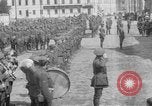
339th Infantry of the American Expeditionary Force North Russia in Archangel, Russia, during Russian Civil War and World War I time.
Troops of the American 339th Infantry Regiment are drawn up in formation on a street in Archangel, Russia, during the Allied Northern Russia intervention, of World War 1, and of Russian Civil War. The Regimental Brass Band is playing while approached by a group of Allied reviewing officers, led by Imperial Russian (White Russian) General Yevgeny-Ludvig Karlovich Miller (also known as EK Miller). The reviewing officers pass in front of the formation, moving away from the camera. Next, British Major General Frederick C. Poole, Commander of the Allied forces, is seen decorating a 339th infantryman. American officers following General Poole, shake hands with the medal recipient, as they pass. (A small Russian boy in the foreground watches all the activities.)
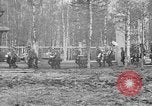
A funeral in 1918 and Memorial Day ceremony in 1919, during Allied North Russia Intervention of World War I
Military band (not playing) leads U.S. soldiers of the 339th Infantry, in loose formation, through wooded area to a cemetery in a field near a church in Archangel (Arkhangelsk) during the Allied North Russia Intervention of World War 1. Several officers (unidentifiable) are standing on a raised stand. Two large crosses are seen behind them. Scene changes completely, to American Memorial Day ceremony at Archangel,in 1919. Allied officers occupy stands decorated with colors of the participating Entente powers. The military band is located nearby. A speaker's stand is set up and ostensibly occupied by Brigadier General Wilds P. Richardson and British Field Marshal Edmund Ironside. (But they cannot be recognized in the distance) A horse and carriage are seen in the far background. Soldiers, sailors, and civilians are in attendance. The ceremony begins with everyone saluting colors held by an honor guard. Then, a squad of American soldiers fires a three-salvo salute with their rifles. (World War I; World War 1; WWI; WW1)
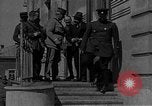
Allied officers meet and review troops, as they pass in review on Eastern Front, in World War I
Events during World War I. French officers greet other officers of Allied Powers on steps of a building. Russian and British officers are seen. Allied officers review troops, as they pass in review, on field. Officers give salute to marching troops.
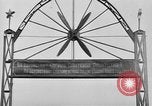
German Operation Barbarossa on the Eastern Front in World War II
Opening scene shows a Russian steel gateway topped by a propeller and two stars. Camera pans down to show that this is the entrance to a Soviet airfield containing a damaged hangar and Soviet military aircraft scattered about. Closeup of a destroyed Soviet airplane. A damaged Soviet Tupolev Tu-2 bomber. Numerous damaged Soviet Polikarpov I-15 bi--wing fighter aircraft. Caissons and Soviet artillery sitting at a railroad siding. Closeup of a damaged artillery piece. Numerous pieces of abandoned soviet artillery, sitting next to heavy guns mounted on rail cars. Soviet tanks missing their turrets. A German soldier examines what looks like a damaged British Mark V tank of World War I vintage. Camera pans over a number of undamaged Soviet tanks parked in a field. Thousands of captured Soviet prisoners of war are seen on a hillside, and then marching under guard. Closeup of one with a large star on his uniform hat. Soviet prisoners being marched about ten-abreast along a road. (Note: about 20 thousand Soviet troops were captured by the Germans in Operation Barbarossa.)
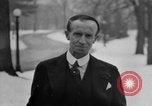
John Buchan, Governor General of Canada, broadcasts New Year's message and speaks about abdication of King Edward VIII.
John Buchan, 1st Baron Tweedsmuir, British Governor General of Canada, broadcasts New Year's message to citizens of Canada. He speaks about the death of King George V, of England, and of his successor, King Edward VIII, who of his own will resigned from his high office. He gives New year wishes and talks about his travels and what he has seen that has made him optimistic about Canada and its future.
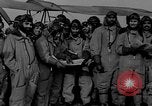
Indian fliers of Civil Disobedience Party suspend their political activities and participate in defense of Britain during WWII
Indian flyers, who are members of Civil Disobedience Party, pose in front of british military airplanes, during World War II. Then, suspending their political cause, because of the war, they climb aboard their airplanes and take off, supporting the defense of Great Britain.
CRITICALPAST.COM: About Us | Contact Us | FAQs - How to Order | License Agreement | My Account | My Lightboxes | Shopping Cart | Advanced Search | Featured Collections | Website Terms & Conditions | Privacy Policy ©2026 CriticalPast LLC.
License Agreement |
Terms & Conditions |
Privacy Policy
©2026 CriticalPast LLC.