


 Francais
 Deutsch
 Italiano
Refine Your Search
British-Gliders stock footage and images
- Showing 3193 to 3198 of 3412 results more
more Hide
Hide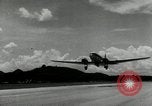
Aircraft drops pamphlets and paratroopers jump from aircraft in Malaysia during the Malayan Emergency.
A film about guerrilla war for independence fought between the Commonwealth armed forces and Malayan Communist Party in Malaysia. An aircraft takes off from an airfield. Aircraft drops pamphlets over a jungle. Men place secret information in a crate. A troop seals the crate. A man addresses people. A British aircraft takes off. Paratroopers in the aircraft. Pilot in cockpit at controls. Paratroopers jump from aircraft and descend in parachutes. The pilot and copilot at controls. Supplies dropped from aircraft. Troops roll supply crates. Troops carry crates and stack crates. Troops talk to locals. Tribal people sit in front of houses. A man makes fence. Men build houses. Troops guard settlements.
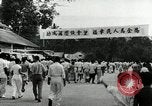
Chin Peng meets Tunku Abdul Rahman and troops destroy settlements in Malaysia during the Malayan Emergency
The film about guerrilla war for independence fought between Commonwealth armed forces and Malayan Communist Party in Malaysia. People walk on street. The Guerrilla leader Chin Peng arrives in car. He meets the Prime Minister of Malaysia Tunku Abdul Rahman. Officials seated. Officials come out after the meeting. Chin Peng disagrees to surrender arms and enters his car. Men at desk. A man pins photograph of a Guerrilla leader on board. Troops walk in a line. Troops fire artillery. A helicopter in flight. British aircraft in flight. Aerial view of the target. Aircraft drop bombs on target. Troops disembark from helicopter. Troops wade through jungle. Troops wade across a stream. Troops bomb Guerrilla settlements during Malayan crisis. Troops burn Guerrilla settlements. Men tied to wooden poles.
Cargo unloaded at St Katharine Docks and packed on backs of elephants for a parade in London, England
100th anniversary celebration of the first cargo of the British tea in London, England. Cargo unloaded at St Katharine Docks. Cargo being packed on backs of elephants for a parade to the auction rooms at Mincing Lane. People and elephants in a parade.
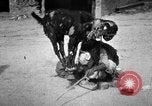
The master plays a drum as a goat and monkeys perform at a market place in India.
A documentary film on poverty stricken Indian people entertaining themselves in India. A goat balances on a stand. Two British children watch monkeys perform. The master plays a drum. Master makes monkeys perform. People watch the animals perform. Goat walks around the master. A monkey sitting on the goat. The master makes the goat to balance on a pot.
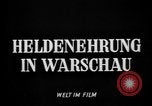
Polish people honor dead heroes of the Resistance in Warsaw, at end of World War II.
Officials assembling to honor fallen Polish Resistance heroes. A speaker stand displaying the Polish Military Eagle Insignia is set up in a square in Warsaw. Demolished and damaged buildings are seen in the background. Cars arrive carrying officials. Polish military and police stand along the square and many people are assembled behind them holding flags of all sorts. Closeup of well-dressed civilian officials presenting an official Government citation for Kyzyzem Grunwaldu (the cross of Grunwald). A Polish general stands with officers of Allied forces, including British and French, and a Polish civilian official. A group of uniformed Allied military men and women standing in front of war-torn ruins. Polish troops parade followed by Polish girls and boys carrying a large banner. View of numerous crosses marking graves of fallen in the ruins. Camera pans over scene of desolation and destruction. Wreaths placed at a memorial site among the ruins. Crude lettering in concrete wall reads something about being part of the wall where Resistance Fighters were killed. Details and date are obscured. Multiple scenes of bombed out and destroyed buildings. A man walking away through rubble.

A brief film visit to the animals at the Tierpark Hagenbeck near Hamburg, Germany
Visitors strolling at the Hagenbeck zoo (Tierpark Hagenbeck) in Stellingen, near Hamburg, Germany. A herd of ponies coming out of a large zoo building, into an open yard. Ostriches mixing in a yard with zebras. Young people enjoying the antics of brown bears and zebras. A man and woman smiling as they watch the animals. A male lion, in his pen, walks toward the camera, as does a rhinoceros (missing a horn) in his pen. A father holds his young daughter up so she can see better. A number of mountain goats are climbing down rocks in their enclosure. A British soldier is amongst the visitors watching the animals. View from behind spectators watching elepants in their large outdoor area. Closeup of elephant's eye. Two elephants in harnesses are seen at work, lifting large iron radiators from rubble at the side of a road in town. They place the radiators on a flat bed trailer. Next, they tow a large steel framework from the rubble. A large group of spectators watches these goings on, and some feed one of the elephants, putting a piece of fruit in its trunk. The keeper directs the elephants to other heavy objects in the rubble, which they pick up and carry with their trunks, placing them on the flat bed trailer. With crowds still watching, the zoo keeper leads leads the elephants as they pull the loaded trailer along the street, while pedestrians watch. (World War II period).
CRITICALPAST.COM: About Us | Contact Us | FAQs - How to Order | License Agreement | My Account | My Lightboxes | Shopping Cart | Advanced Search | Featured Collections | Website Terms & Conditions | Privacy Policy ©2026 CriticalPast LLC.
License Agreement |
Terms & Conditions |
Privacy Policy
©2026 CriticalPast LLC.