


 Francais
 Deutsch
 Italiano
Refine Your Search
British-Gliders stock footage and images
- Showing 409 to 414 of 3412 results more
more Hide
Hide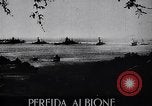
British Navy attacks French Vichy fleet at Mers-el-Kebir, Oran, Algiers, during World War II
Opening scene shows ships of the French fleet in the harbor of Mers-el-Kébir, Oran, Algeria, during World War 2. French tricolors seen flying from the superstructure of the French battleship, Dunkerque. A motorboat arrives, delivering a note from British Admiral Somerville, via HMS Foxhound (destroyer) to Vichy French naval officer Marcel-Bruno Gensoul, with final warning ultimatum against siding with the Axis powers. Sailors on the Dunkerque watch over the railing of their ship. The messengers board the Dunkerque. French and British Navy sailors exchange signal light messages between ships. Onboard the Dunkerque, the message is delivered to French Admiral Marcel-Bruno Gensoul. Closeup of the message. More signal light messages between ships. (The French had rejected the ultimatum.) French sailors are seen running across a concrete pier separating small pleasure boats in the foreground, from the French warships on the other side of the pier, in the background. View of sailors running to battle stations aboard French ships. An explosion occurs in the waters of the harbor. Striking shells create explosions near the French warships. The Battleship Dunkerque with heavy black smoke rising from her funnel getting underway. French sailors on a battleship with heavy white smoke surrounding them as they stand near her 13-inch guns. The French battleship, Bretagne, exploding after being hit by British gunfire. French sailors fighting fires on burning deck of a warship. Another view of the exploding battleship, Bretagne. A British warship firing its 15-inch guns. Unidentified French warship hit in its aft section by gunfire and exploding in heavy smoke. French survivors in life vests and lifeboats throughout the harbor. Wreckage of some destroyed French ships. (Note: The attack was part of Operation Catapult, a British plan to neutralize or destroy French warships in Vichy France, to prevent them from falling into German hands.)
British Eighth and U.S. Army advance in to Tunisia defeating German and Italian Armies in North Africa during World War II.
British Eighth Army advances in to Tunisia defeating German and Italian Armies in North Africa during World War II. General Montgomery briefs British soldiers near sea coast. Tanks and trucks advance into Tunisia on a road with wrecked German machine gun post near road. General Eisenhower and General Montgomery during a meeting. Highland fighter troops on victory march on roads of a town in Tunisia. A British warship in sea and an anti aircraft gun alert on a post on Mediterranean Sea shore. United States Army advances in trucks and fights German resistance in a battle. Graves of German soldiers nearside roads. U.S. and British soldiers meet from two ends on April 7, 1943. Soldiers meet and shake hands with warmth. U.S. and British bombers on a mission to Nazi posts. Aerial views of B-25 bombers and B-26 bomber aircraft en route to targets. German antiaircraft guns fires at Allied bomber aircraft. Posts destroyed by series of bomb explosion. Surrendered Italian and German soldiers in large numbers. Injured Nazi soldier treated by Allied medics. Views of General Eisenhower, Field Marshal Montgomery, and Field Marshal Alexander. A French General is also shown (possibly General Georges Barré).
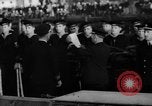
US, British and Polish Naval officers receive American submarines in New London, Connecticut. during World War II.
U.S. Navy transfers submarines to British and Free Polish Governments in New London, Connecticut during World War 2.. Film begins showing an American Navy Lieutenant reading from a document as a Navy Commander stands nearby. They are addressing officers and crew on a U.S. submarine being transferred to the British Navy. A large audience of sailors stand on a pier across the water in the background. A British sailor is silhouetted as he salutes from the deck of the boat. The submarine's officers and crew step up onto the dock, and then sailors return to the submarine and stand in formation along with their captain and other officers, on the deck near the boat's deck gun. A sailor atop the submarine raises the British Navy White Ensign on its mast, as the officers and crew salute. The sailor then fastens the Royal Navy Commissioning Pennant containing the Cross of St. George, above and behind the Ensign atop the submarine. The officers salute again. Scene changes to a submarine transferred to the Polish, where Polish sailors raise a Naval Ensign containing the seal of the Polish Government in Exile. Closeup of Polish Navy Commander standing on the pier with Polish officers and crew behind him on the deck of the newly transferred submarine. Next, the Polish officers and crew are seen in formation on the pier. The Polish officers and crew on their submarine. Glimpse of the British Officers and crew on their submarine. A final scene with Polish captain and his crew on their submarine.

German troops patrol captured Crete, and round up British troops as prisoners of war (WW2)
German campaign in Crete during World War II. German troops patrol the captured city of Crete. German soldiers in military vehicles drive on a road. German soldiers capture surrendered British soldiers with their hands held high. The British prisoners of war are seen being marched on a beach. British soldier prisoners of war wait on beaches and in encampments under Nazi German guard. A German officer reviews documents. German forces hand out food to British prisoners and a German medic bandages the hand of a British soldier. Citizens in Crete gathered outside a hotel where German officers stand on balcony and address the crowd. German troops in the captured city setup gun emplacements to guard the city. Two mostly sunken ships off the coast of Crete.

U.S. President Franklin Roosevelt meets British Prime Minister Winston Churchill aboard USS Augusta in North Atlantic
U.S. President Franklin Roosevelt and British Prime Minister Winston Churchill meet for the Atlantic Conference aboard American Heavy Cruiser, USS Augusta (CA-31), anchored in Placentia Bay, Argentia, Newfoundland, Canada. High ranking American military officers and officials attending include Presidential advisor, Harry Hopkins; U.S. Army Air Corps Chief, General Henry Arnold; U.S. Chief of Naval Operations, Admiral Harold R. Stark; Vice Admiral Ernest J. King, and Commander in Chief, U.S. Atlantic Fleet. President Franklin Roosevelt stands with his son, Franklin D. Roosevelt, Jr., to meet the Prime Minister. FDR also greets other members of the British delegation, including British Minister of Supply, Lord Beaverbrook. British and American sailors mingling together. Prime Minister Churchill and President Roosevelt are seen seated on deck, for a church service, aboard the British Battleship, Prince of Wales. They read documents and conclude agreements known as the Atlantic Charter.
State Funeral of Philip Kerr, Lord Lothian, British Ambassador to the United States, in Washington DC.
The funeral of Philip Kerr, the 11th Marquess of Lothian, and British Ambassador to the United States, from 1939 until his death in 1940. Spectators stand on the sidewalk across from the British Embassy in Washington, DC. British flag flying over the Embassy. Leaving the front gates of the Embassy is a coffin draped with the British flag resting on a caisson, drawn by a team of matched white horses. High-ranking British military officers walk behind followed by civilian mourners. A squad of cavalry on horseback escort the funeral procession. View of the Washington National Cathedral, still under construction, with derrick and scaffolding visible. A crucifer heads about 30 clergy in white robes, leading the funeral cortege up the front steps of the Washington National Cathedral. Military pallbearers in uniform carry the coffin up the steps. U.S. first lady, Mrs. Eleanor Roosevelt arrives and steps from a black limousine. Brief view inside the Cathedral sanctuary. Pallbearers carry the coffin down the steps. Official mourners follow. A large group of mourners stand on upper steps of Cathedral as the immediate funeral party departs.
CRITICALPAST.COM: About Us | Contact Us | FAQs - How to Order | License Agreement | My Account | My Lightboxes | Shopping Cart | Advanced Search | Featured Collections | Website Terms & Conditions | Privacy Policy ©2026 CriticalPast LLC.
License Agreement |
Terms & Conditions |
Privacy Policy
©2026 CriticalPast LLC.