


 Francais
 Deutsch
 Italiano
Refine Your Search
Bruchsal Germany 1945 stock footage and images
- Showing 9625 to 9630 of 10461 results more
more Hide
Hide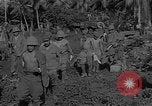
Announcement is made on loudspeakers for convention of Japanese and ruins in Guam.
U.S. soldiers in Guam during the Battle of Guam. U.S. soldiers walk in line. They are sitting on ground. A native walk with a stick. An announcement is made on loudspeakers for convention. Japanese civilians climb hilly terrain up. Captured Japanese under American soldiers. A soldier bandages to wounded. Ruins and debris. Views of damaged buildings and shelter. (World War II period).
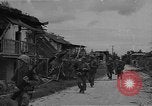
Radioman George Ray Tweed speaks about suffering inflicted by Japanese on Chamorros natives in Guam.
Chamorros in Guam during the Battle of Guam. U.S. soldiers pass along streets of Guam. M-tanks are transported, ships in the background. Interior of office: George Ray Tweed, Chief radiomen on Guam who, with the help of locals hid out for the duration of the Japanese occupation, talks about violence that Japanese inflicted on Chamorro natives. He shows hideouts, from where soldiers fought. He talks to an officer. Chamorro natives pray for dead. Dead bodies with cut heads. Dead soldiers lying on ground showing brutality. Chamorro natives get food, medical care and infant care. (World War II period).
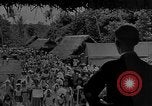
U.S. troops and Chamorro natives work together to rebuild Guam after World War II.
Chamorros in Guam during the Battle of Guam. A man plays whistle. Chamorro natives gather. Plans for Guam people shown. American soldiers load shells into artillery. Bulldozer levels land to construct airfield. An aircraft lands. During the war: naval battle, guns fired, ships underway at sea. A letter from Secretary of Navy James Forrestal depicts the U.S. progress in Guam.
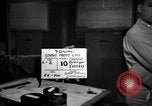
Staff officers plot the progress of operations in Okinawa aboard USS Estes off the shore of Okinawa, Japan.
Staff officers aboard USS Estes off the shore Okinawa, Japan during World War II. Interior of a plotting room aboard USS Estes (AGC-12) as staff officers plot the progress of operations in Okinawa using charts and operation plans. A teletype screen on a bulkhead in the background. The shoreline of Okinawa shows shells bursting and smoke columns near the beach. The message "Suicide boats hidden in inaccessible caves along beaches" appears on the teletype screen. A New York Class battleship from starboard quarter as signal hoist is raised on halyards. An officer reads a letter and turns pages. Pictures of suicide boats in caves are enclosed.
U.S. Navy's Task Force 58 in the Battle of Okinawa during World War II.
Opening title is: "The Fleet That Came To Stay." Opening scene shows a U.S. warship dimly in darkness, during World War 2. Three American sailors in battle gear, lean over the ship's railing and discuss their destination: "Okinawa.". One sailor walks along the deck, past many more looking over the railing. The men discuss being only 320 miles from Japan, itself. Nose view of a Japanese Kawasaki Ki-61 aircraft with engine running. View of it taking off, followed by a succession of views showing numerous similar Japanese aircraft taking off. A U.S. B-29 bomber taking off and views of B-29s in formation aloft. Bombs dropping from the B-29s and seen from the aircraft as they explode on Japanese targets below.
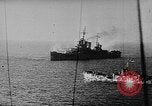
Allied Naval task forces combine efforts in Battle of Okinawa during World War II
Roles of U.S. Navy Task Force 58 and British Task Force 57 during the Battle of Okinawa in World War 2. An LCI (Landing Craft-Infantry) passes in front of the heavy cruiser USS Wichita (CA-45) as it fires its heavy guns. Explosions on Okinawa. Glimpse of Battleship USS Iowa (BB-61) in marine camouflage paint. Naval gun barrels firing and shells exploding on Okinawa. The USS LSM(R)-190, a Landing Ship Medium (Rocket) is seen firing barrages of rockets at Okinawa. Closeup of the rocket pods firing. At time 00:18-00:20 the U.S. heavy cruiser USS Minneapolis,CA-36 is seen firing her main battery. Numerous views of shells bursting on the ground. More views of rocket firing landing ships, with more closeups of the rocket pods firing. Change of scene to the south, where the battleship HMS King George V, flagship of Task Force 57, and battleship HMS Howe, are seen bombarding Japanese air installations on Formosa. British Navy Marlett fighter planes (equivalent to U.S. F4Fs) in formation flight. Anti-aircraft gunfire from British aircraft carriers and other warships. Closeup of British multiple Pom Pom gun batteries firing.
CRITICALPAST.COM: About Us | Contact Us | FAQs - How to Order | License Agreement | My Account | My Lightboxes | Shopping Cart | Advanced Search | Featured Collections | Website Terms & Conditions | Privacy Policy ©2026 CriticalPast LLC.
License Agreement |
Terms & Conditions |
Privacy Policy
©2026 CriticalPast LLC.