


 Francais
 Deutsch
 Italiano
Refine Your Search
Bruchsal Germany 1945 stock footage and images
- Showing 1813 to 1818 of 10461 results more
more Hide
Hide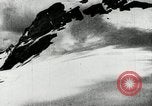
Travel by air, rail, and bus in Germany, circa 1936
Air and rail travel in Germany before World War II. View of snow-covered mountains and clouds. Flying above them is a German Lufthansa Junkers Ju 52 trimotor passenger airplane. It is named "Hans Wende" and displays registration "D-ADER" on its fuselage, and a swastika on its tail. Closeup of the forward part of the aircraft. View of passengers inside the cabin, enjoying the views out their windows. Body of water below. A passenger lights a cigar, and smokes. Another swings a typewriter down from the back of seat in front of her and prepares to type something. Views out plane's window behind left wing showing flaps slightly extended and as plane banks in right turn. Quick pan across copilot's position and back, showing corrugated metal on right wing. The city of Berlin is seen below. Passengers preparing to land. Aerial views of pre-war city of Berlin, from behind right wing, as aircraft descends to land. "Berlin" spelled out in large letters on ground at the airport, visible from the air. Aerial view of various buildings and landmarks, including the Berliner Dom (largest church in the city) seen below. The Lustgarten, two bridges leading to the Unter Den Linden boulevard below, with cars moving on it. The Zeughaus (Unter den Linden 2 10117 Berlin) and other buildings are seen along Unter Den Linden. As the aircraft passes over the Brandenburg Gate and forested park, below, the scene shifts to a zoom-in on the gate and transitions to a ground view of it with cars driving through the gate. Closeup of the “Quadriga” statue atop the gate, depicting the goddess of victory driving a chariot pulled by four horses. Camera moves through the gate and shows policemen, in white uniforms, directing traffic, including double-decker buses. Brief glimpse of the Victory Column (Siegessäule, Großer Stern 1, 10557 Berlin, Germany) on the Königsplatz across from the Reichstag. Pedestrians walking and trams passing along the street. Sightseeing bus carrying passengers along the road. View of the passengers inside the moving bus and the guide explaining the sights and landmarks of Berlin. They pass the Neue Wache war memorial. Scene shifts to a railroad train traveling in the city and rising up to an elevated track that passes through a building. View as the train approaches and passes through an elevated station. Brief view of the Wuppertal Schwebebahn (suspended railway). View of a German high-speed passenger train seen as it passes a bridge. Passengers relaxing inside the train. Some are eating and drinking. Several views of trains moving at high speed. Train signals in action along the railways.
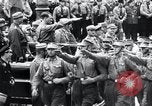
German Fuhrer Adolf Hitler reviews Stormtroopers and addresses a gathering in Germany.
Nazi German Fuhrer Adolf Hitler reviews Brownshirts in Berlin, Germany. SA (Sturmabteilung) troopers parade and give the Nazi salute. Hermann Goering and other Nazi officials stand on walk in front of Hitler. The Stormtroopers march as civilians give Nazi salute. German soldiers march with Nazi flags. Brief view from above on Kaiser-Wilhelm Gedachniskirche Memorial Church (Breitscheidplatz, 10789 Berlin, Germany). Hitler addresses a gathering, speaking in an animated and emphatic fashion. Hitler brushes back his hair that has fallen forward onto his forehead. Reich officials and Nazi officers present for his speech. The crowd gives the Nazi salute. Nazi flag on stage, the crowd chants Heil Hitler while saluting their Fuhrer.
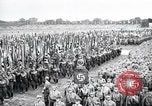
German Stormtroopers march with Nazi flags as Adolf Hitler reviews them in Germany.
Adolf Hitler reviews Brownshirts in Germany. SA Stormtroopers (Sturmabteilung) march with Nazi Party Swastika flags. The military band plays. Hitler reviews the parade. Ernst Rohm, SA Chief of Staff, stands beside him. Heinrich Himmler standing nearby. Other Nazi officers in the background. German soldiers march with the Nazi 'Germany Awake' flags. SA personnel stand in formation. Swastika banners hung at the venue.
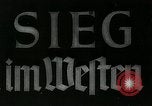
Condensed history of Germany from World War I through the rise of Hitler and the 3rd Reich.
A condensed history of Germany from the first World War through the rise of Hitler and the 3rd Reich, prior to World War II. From the Nazi German perspective, 'Sieg Im Westen' depicts German activities during and after World War 1. German troops take an oath of allegiance to Adolf Hitler. The Alpine landscapes, the Rhine and the Cologne Cathedral. An animation of the German frontiers in Bismarck's time. Interior and exterior scenes of the Ruhr industrial area. View of the Hamburg Harbor. Two German soldiers in Prewar uniforms on honor duty as sentries. A German prewar naval vessel or navy ship. An animation of the extent of World War I fighting beyond German borders and ending with the presentation of situation on November 9th , 1918. Scenes of World War I fighting, with many explosions and dirt flying upward on battlefields in World War I, and view of German soldiers in trench carefully looking out towards "no man's land". An animation of World War I fighting. Paul Von Hindenburg, a German General and his deputy, General Erich Friedrich Wilhelm Ludendorff, at a headquarters. Signatures in the Versailles Treaty. An animation depicts the creation of the Polish Corridor. Demilitarization and disarmament activities of German factory areas. World War I German fighter planes are dismantled and wrecked. Labor strike riots and communist rebellion in Berlin with fights in front of the Brandenburg Gate. French occupation of Ruhr area. German postwar hyperinflation. German workers getting books stamped at a payroll office. Hyperinflation demonstrated with various German monetary notes growing in face value, superimposed on a spinning roulette wheel. Types of German inflation money during post-war collapse of economy in Germany. Adolf Hitler addressing a crowd. Storm troopers in regimental parade formations.
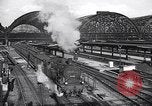
Repair of wrecked railroads, power plants, factories and coal mines at Ruhr Valley in Germany after World War II.
Wrecked railroads, Coal mines, power plants and factories being rebuilt and rehabilitated in Germany after World War 2. Railroad trains moving on tracks in Germany soon after World War 2. German civilian workers repair rails and tracks destroyed by Allied bombers. German workers in a tire factory build railway and automobile tires, in Munich. Trucks manufactured at a truck factory drive out of the factory. People lined to see some of the items produced for export. British occupied Ruhr Valley. Wrecked Krupp factories in Ruhr Valley. A German steel smelting plant in operation, workers pour molten steel. Coal cars leave Ruhr Valley. Animated charts show production and export of coal during 1937 and 1946. German miners enter and leave mines. Miners eat and take half of their food out to German children.
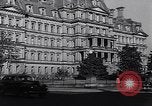
British, Soviet and U.S. officials meet and discuss industrial, agricultural and civil rebuilding of Germany after World War II.
Industrial, agricultural and civil rebuilding of Germany after World War II. State Department building in Washington DC. Secretory of States, James F. Byrnes dictates to secretary. General Luicius D Clay speaks to the members of British Occupational government. Ernest Bevin, Vyacheslav Molotov and James F. Byrnes pose for a group photograph. German farmers in an agricultural field. Men and woman plow farm by horse cart. Worker watches a factory kiln with molten metal. Cavaliers of American Military Police on horse back patrol on the streets in Germany with a destroyed cathedral in the background. They cross a bridge with sign Herkules Bridge. German workers make farm equipment and a German family with young children eats a meal.
CRITICALPAST.COM: About Us | Contact Us | FAQs - How to Order | License Agreement | My Account | My Lightboxes | Shopping Cart | Advanced Search | Featured Collections | Website Terms & Conditions | Privacy Policy ©2026 CriticalPast LLC.
License Agreement |
Terms & Conditions |
Privacy Policy
©2026 CriticalPast LLC.