


 Francais
 Deutsch
 Italiano
Refine Your Search
Bruchsal Germany 1945 stock footage and images
- Showing 253 to 258 of 10461 results more
more Hide
Hide
Americans in New York City celebrate the surrender of Japan in World War II, at Times Square.
Film opens showing aerial view of a United States B-29 Superfortress bomber aircraft in flight, then scenes of numerous U.S. Army Air Forces warplanes and bombing (partially obscured by on screen newsreel text). Next, crowds are seen jamming Times Square in Manhattan, New York City, celebrating victory over Japan in World War 2. (Known as V-J Day or Victory over Japan day, marking the end of World War 2, on 14 August, 1945.) A facsimile of the Statue of Liberty has been set up in the square. Moving lights on Times Building motograph news zipper or ticker announce Japanese surrender. Jubilant celebrations and smiling Americans wave American flags. Closeup of the Statue of Liberty facsimile. A woman dances the Lindy Hop with a U.S. Navy sailor, as others (including many servicemen in uniform) watch.
Interview of Capt. William S. Parsons, U.S. Navy, crew member on Enola Gay, after the Hiroshima atomic bombing mission
Setting: North Field, Tinian Island in Mariana Islands, South Pacific, almost a week after the atomic bomb was dropped on Hiroshima Japan, August 8, 1945, during World War II. Public Relations Officer, Major John F. Moynahan (not seen) is interviewing members of the Crew of the B-29, Enola Gay, from which the bomb was dropped. Here he interviews Captain William Sterling "Deke" Parsons of the U.S. Navy who was weaponeer aboard the Enola Gay, during the mission. and who now serves as Scientific Head of the Atomic Bomb Project in the Pacific Theater. Captain Parsons describes the events of the mission from their early morning departure through the actual bombing. He notes that the actual bombing went smoother than earlier practice missions.
United States warships and the Marine Corps raid and gain control over the Japanese island of Okinawa, during World War II.
The Pacific Theater of World War II during the Year 1945. Attack on Japanese island of Okinawa by the United States Military. United States Navy ships from the sea, launch a number of missiles towards the islands. The missiles traverse an aerial route and destroy the target Japanese positions. United States Marine Corps raid the island moving in amphibious landing tractors towards the island. Battle between Japanese soldiers and U.S. Marines. American flag hoisted on Okinawa after four months of furious battle. Officials and Military Commanders and soldiers salute the flag.
Several Italian Fascist officials and soldiers apprehended by Partisans in Ivrea Italy, as World War II ends in Europe.
Armed Italian Partisans escort several Italian Fascist officials, who walk with their hands raised along a street in Ivrea, Northern Italy, during final days of World War 2, in Europe. Local citizens walk along beside and behind them, including some on bicycles. Another scene shows Italian Partisans escorting several soldiers, of the Italian National Republican Army, with their hands on their heads. This group is also followed by a large number of local citizens. Scene shifts to an American jeep carrying an officer and two U.S. soldiers. It is followed by an automobile, seen, later parked with another near a sidewalk, where several Italian Republican Army officers are conversing cordially with American soldiers of the U.S. 92nd Infantry Division.(By May 5, 1945, all Nazi German forces in Italy, had capitulated.) Italian women and children seen in a small open bus.
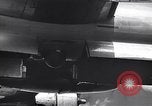
Bombing of Hiroshima, Japan, during World War II. B-29 in flight, bomb doors open, explosion on ground and devastation scenes
Bomb bay of United States Army Air Force B-29 aircraft opens. Interior view of aircraft shows bombardier in nose as he looks through bomb sight. Actual atomic bomb detonation over Nagasaki Japan as seen from B-29 aircraft on August 9, 1945. View of mushroom cloud rising rapidly from an atomic blast (a different blast; not Nagasaki or Hiroshima). Ground views of devastated city of Hiroshima following atomic bombing in World War 2.
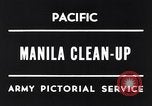
U.S. Army battles against fortified Japanese forces during World War II, in Manila, Philippines
Wartime news film entitled: "Manila Cleanup." View of the Pasig River, dividing North and South Manila. American tanks and tank destroyers on North bank, firing at Japanese positions on the South side of the river. Exploding shells on South side. U.S. troops fire 155mm howitzers at low elevation, blasting the walls of Intramuros and adjacent buildings. The 540th Field Artillery fire 240mm guns point blank against the ancient walls. Troops firing machine guns at the Colegio de San Juan de Letran and Manila Post Office buildings. Troops of the 3rd Battalion, 129th Infantry, 337th Division, crossing the river in small assault boats, under covering fire. Landing on the South Bank, troops fan out around and about the walled city. Japanese forces resist from fortified pill boxes and machine gun nests near the public buildings. U.S. troops breach a section of the wall and elements of the 37th Division enter Intramuros on February 23, 1945. U.S. soldiers sheltered behind wall as others employ flame throwers. U.S. Soldiers prepares a TNT charge to blow up walls and seal underground passageways. A destroyed Japanese pill box at base of wall with many dead Japanese soldiers are seen. U.S. artillerymen firing 155mm howitzers directly at Japanese troops holed up in the Legislative, agricultural and finance buildings. Troops of B Company, 148th Infantry Regiment, advance from the Manila City Hall, towards the Legislative building. They direct flame throwers at Japanese fortifications under the wall. Soldier with flame thrower passes through group of riflemen and fires into hole in wall. U.S. soldiers fighting room to room in the walled city. On February 24th U.S. troops defeat the last Japanese resistors of Manila in World War II.
CRITICALPAST.COM: About Us | Contact Us | FAQs - How to Order | License Agreement | My Account | My Lightboxes | Shopping Cart | Advanced Search | Featured Collections | Website Terms & Conditions | Privacy Policy ©2026 CriticalPast LLC.
License Agreement |
Terms & Conditions |
Privacy Policy
©2026 CriticalPast LLC.