


 Francais
 Deutsch
 Italiano
Refine Your Search
Bruchsal Germany 1945 stock footage and images
- Showing 307 to 312 of 10461 results more
more Hide
Hide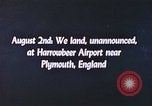
President Truman and his party at RAF Station Harrowbeer near Plymouth, England during World War II.
United States President Harry S. Truman, and his party, make unplanned stop at RAF Station Harrowbeer during return from the last 4-Power meeting of World War 2, held at Berlin in July, 1945. (Their planned destination, RAF Station St Mawgan, was fogged in. So the President instructed his pilot, Lieutenant Colonel Henry T. Myers, to land at Harrowbeer, when they saw it was clear.) Truman descends steps from the Presidential Airplane (Douglas VC-54C named the "Sacred Cow," used by Presidents Roosevelt, and Truman). Two other C-54 aircraft have also arrived (unseen). One carried Secretary of State, James F. Byrnes, who poses with the President and three members of the British WAAF (Women's Auxiliary Air Force) identified as: Section Officer Eira Buckland Jones, Corporal Clarice Turner, and Leading Aircraft Woman Audley Bartlett. Views from inside car taking members of Presidential party to Plymouth Harbor. Groups of local people wave as the car passes through the English countryside. Larger numbers of spectators line the streets of the city of Plymouth. View of Plymouth Harbor from launch taking members of President's party out to the USS Augusta, anchored in Plymouth Sound (not seen).
Montage of World War II scenes, encompassing the allied Pacific campaigns and Big Three wartime meetings.
Allied campaigns against Imperial Japan during World War II. Animated map depicts Allied victories in various Pacific islands like Guadalcanal, Palau, and the Mariana Islands. A map of the Philippines. United States troops invade the Philippines. Naval guns fire at a shore and flak bursts are seen. Dramatic shot of a Japanese Zero aircraft approaching United States Navy ships that are firing guns. The Japanese aircraft is hit at close range to the ship, a wing ruptures, it is consumed in fire and crashes with explosion in the sea beside the ship. Many landing craft with U.S. Army forces landing at beach on Leyte. Soldiers land and advance inland. United States Army General Douglas MacArthur and President Sergio Osmeña of the Philippines wade ashore. Filipino women and children on the island are assisted by U.S. forces and provided with food and protection. Following are meetings of wartime Allied leaders, shown briefly in the ending of the film: Prime Minister Winston Churchill meeting President Franklin D. Roosevelt on the battleship, USS Augusta, at Newfoundland, during the Atlantic Conference, 1941. Roosevelt stands at the railing, assisted by his son, Army Captain Elliot Roosevelt. Roosevelt and Churchill meeting with Generalissimo Chiang Kai-Shek, at the Cairo conference, in 1943. Joseph Stalin, Roosevelt, and Churchill pose outside the Livadia Palace (Baturyna St, 44-а, Livadiya, 98655) during the Yalta conference in 1945. Soviet Foreign Minister Molotov, American Ambassador Harriman, British Foreign Minister, Anthony Eden, and Churchill's daughter, Sarah, in uniform, are among those standing behind the seated Big Three. Delegates from 51 Nations gathered for the first meeting of the UN General Assembly, in Westminster Central Hall, London, England, in 1946.
Franklin Delano Roosevelt retrospective - FDR with Winston Churchill, Chiang Kai-shek and Joseph Stalin at different events in different continents.
Life of the President of the United States Franklin Delano Roosevelt in the United States. U.S. President Franklin D Roosevelt is greeted by British Prime Minister Winston Churchill aboard HMS Prince of Wales during the Atlantic Conference for signing of the Atlantic Charter off Newfoundland in 1941. The ship approaches the harbor. Soldiers present arms aboard a ship. Prime Minister Churchill and President Franklin D Roosevelt talk. President Franklin Roosevelt addresses U.S. Congress with declaration of war after the Pearl Harbor attack by Japan in World War 2. The President signs a document. President Roosevelt reviews troops in Casablanca. The troops march. Franklin Roosevelt salutes troops. Vehicles driven in the foreground. Cairo: Franklin D Roosevelt and Winston Churchill with the Chairman of the Nationalist Government of China Chiang Kai-shek. Tehran : Franklin D Roosevelt, Winston Churchill and General Secretary of the Communist Party of the Soviet Union Joseph Stalin pose. United States: The exteriors of the White House. People enter White House. President Franklin Roosevelt with Vice President Harry S. Truman at the 1945 inaugural ceremony. Yalta : President Franklin D Roosevelt, Winston Churchill and Joseph Stalin pose. Franklin D Roosevelt addresses a conference. (World War II period).
Some U.S. Army soldiers focusing on leisure after World War 2, and some attend Army extension classes in the United States.
A post-war U.S. Army film (after World War 2) in 1945-1946 contrasts dice and pool playing soldiers with the soldiers who take Army extension classes to prepare for jobs in civilian life following demobilization and discharge from the Army. Group of U.S. Army soldiers in a room as they play pool at a billiards table. Soldiers in a barracks room seated on a bed and on the floor throwing dice in a game of craps. The soldiers play cards and smoke. Contrast is shown with U.S. Army students seated in a class. An officer takes lessons. A soldier takes notes. A young teacher or professor explains a concept with the help of a blackboard. View of the Hôtel Miramar in Biarritz, France (built in 1927 and demolished in 1978). Aerial view of a building with interconnected corridors. Street level view of the University of Calcutta Senate Hall in Calcutta (Kolkata), India (hall designed by Walter Granville; one time home to the Asutosh Museum of Indian Art; demolished in 1960). People walking in front of the Senate Hall as a car and a pulled rickshaw go by. In next scene, a sign reads 'Fox-Hole Campus'. An officer holds a mechanical model and explains a concept to students. A soldier works with equipment and an African American soldier stitches clothes at a sewing machine. A sign "Learn today; Earn tomorrow" as soldiers learn skills to help them in the civilian sector after separation from the armed forces. A solder works on a model. Pamphlets on a desk with the names of different subjects written on them that U.S. Army students can study to learn skills and jobs, including Automobile Repair Shop, Retail Bakery, Service Station, Grocery Store, Metal Working Shop, Shoe Repair Business, Small Sawmill Business, Beauty Shop.
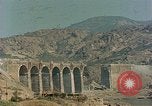
Aftermath of World War II. A wrecked bridge and abandoned United States Army gliders in France.
Reminders of World War 2, in France, 1945. A high bridge of about eight masonry arches with two bombed out, in mountainous region of France. Camera pans right, showing a number of substantial homes scattered across the valley, with tall mountains behind. Scene shifts to a different, flatter landscape, where about a dozen U.S. Waco CG-4A gliders are seen abandoned in a field, in various states of disrepair. Writing in chalk on the side of one glider reads, "Whispering Yoddles, Fort Worth Texas, Little One Alice". There are no D-day stripes on these gliders, indicating they were probably used subsequent to the Normandy invasion, in other operations such as "Bluebird & Dove" in the South of France, in August, 1944.
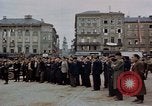
German forces depart Linz, Austria, at the end of World War II
Opening scene shows local citizens as they stand in the main square (Hauptplatz) of Linz, Austria, watching surrendered German troops depart at the end of world War 2. The troops climb over barriers at the base of the Trinity Column (Dreifaltigkeitssäule) and march in loose formation out of the city. A group of American troops watch from atop an M10 tank destroyer. View through a building archway as the German soldiers march past. The long column continues along a road looking down on the Danube River. Another view shows two U.S. soldiers with slinged rifles strolling at the head of the column. The departing German soldiers are all disarmed and carry their personal kit and gear. A group of German officers pass the camera, and one takes particular notice of the filming. A Sherman tank passes going in the opposite direction. A civilian man, carrying a brief case walks past the departing troops. (Note: Today, the Trinity Column looks different than in this film. In 1943 all removable statues and parts were taken from the column and safely stored in central cellars on Kapuzinerstrasse. They were recovered in 1945 and restored to the column, along with other changes, that were completed in December, 1947.)
CRITICALPAST.COM: About Us | Contact Us | FAQs - How to Order | License Agreement | My Account | My Lightboxes | Shopping Cart | Advanced Search | Featured Collections | Website Terms & Conditions | Privacy Policy ©2026 CriticalPast LLC.
License Agreement |
Terms & Conditions |
Privacy Policy
©2026 CriticalPast LLC.