


 Francais
 Deutsch
 Italiano
Refine Your Search
Bruchsal Germany 1945 stock footage and images
- Showing 325 to 330 of 10461 results more
more Hide
Hide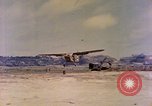
Wounded U.S. Marine being loaded aboard Stinson L-5B aircraft in Okinawa, Japan during World War II.
Air evacuation of wounded United States Marines on Okinawa in June, 1945. U.S. Army Air Forces Stinson L-5B Sentinel ambulance aircraft of the 163rd Liaison Squadron landing in front of camera as signalman waves flags. Identifiable aircraft serial numbers are: 44-17001, 44-17308, 44-17005. An ambulance pulls up on the field in front of a Red Cross tent and men carry a woundedsoldier on a stretcher towards L-5B aircraft. Another Marine on litter being loaded aboard an aircraft. More L-5B's taxi into position and take off. Identifiable tail numbers 44-17320, 44-16938. One aircraft, only identifiable with the number '80' on the tail is a Marine Corps OY-1 (L-5B).
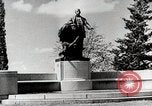
Achievements of African Americans in art, literature, music science, and medicine in the United States, in the late 1930s and 1940s.
A film about achievements of various African American men and women citizens in the United States. A statue of Booker T. Washington, founder of Tuskegee University in Alabama. View of African American scientist and inventor George Washington Carver, as an elderly man, working with another scientist in a laboratory. African American judge of New York city court. African American explorer Matthew Henson is seen looking at a globe (he was with Admiral Peary planting the American flag at the North Pole in 1909), and an unnamed African American surgeon at work in an operating room in New York. Next scene shows famous "father of the blues" musician and composer W.C. Handy (William Christoper Handy) smiling. Next is seen the financier and publisher of the Amsterdam News, Dr. C.B. Powell (Clilan Powell) greeting three uniformed African American women during a World War 2 war bond drive, and handing them a check (close up is shown) for 25,000 dollars, dated January 4, 1942, for the war bond drive. It is from the account of the Victory Mutual Life Insurance Company which Dr. Powell also owned. The check is signed by C.B Powell and Philip M.H. Savory (Dr. Savory was co-owner of the New York Amsterdam News). The next scene shows Elise Johnson McDougald, better known as Gertrude Elise Ayer, who was the first black full-time public school principal after the consolidation of New York City schools in 1898. She was also a noted woman writer during the Harlem Renaissance. She is seated in her office at her desk, likely in P.S. 119 in Harlem, since this is approximately year 1945 and she was at P.S 119 at that time. Her name plaque is visible on the front center of the desk. Principal Ayer smiles as a woman delivers a document to her. Next is seen the African American historian, author, and professor, Lawrence D. Reddick, serving in his role as the curator of the Schomburg Collection of African American Literature. In an art studio is seen the famous "Harlem Renaissance" African American sculptor and painter Charles Alston, at work on a sculpture. Next scene shows the famous African American contralto singer, Marian Anderson, receiving a bouquet of flowers and smiling after a performance. This transitions to a view of African American orchestra conductor Dean Dixon leading an orchestra in a performance of Beethoven's 9th Symphony. Several views of different sections of the orchestra performing under Dixon's direction. Clip closes with brief shots of campuses of several historically black colleges and universities in the United States like Howard University, Hampton, Tuskegee, Fisk, Prairie View. A football game underway in one of the colleges, and view on the field as quarterback throws a pass.
African American WACS of the 6888th Central Postal Directory Battalion march in formation after arrival in Birmingham England.
African American women soldiers of the 6888th Central Postal Directory Battalion, nicknamed “Six Triple Eight", Women's Army Corps (WACS), march in formation on February 15, 1945, during World War 2. Location is Birmingham, England, United Kingdom, at the time of the unit's arrival in Birmingham. A military band of male soldiers precedes the group of marching WACS. The long column of African American WACS, marching 4 deep, is led by commanding officer Major Charity Adams. Close up views of the women marching. WACS in front of the unit carry the American flag in the procession.
African-American WACS pass in review before Major Charity Adams and General John C H Lee during World War II.
During World War 2, African American women soldiers of the Women's Army Corps (WACS) stand in formation at a parade ground in Birmingham, England, United Kingdom, during a formal military review on February 15, 1945. The women are from the 6888th Central Postal Directory Battalion, nicknamed “Six Triple Eight, which had just arrived in Birmingham. The WACS' commanding officer, Major Charity Adams, stands beside General John C.H. Lee. The African-American female soldiers of the WACS march in a column, eight deep, passing by General John CH Lee and Major Charity Adams, who salute the soldiers. Other male officers stand on the review stand behind officers Lee and Adams. Note: Major Charity Adams (Charity Edna Adams; later Charity Adams Earley) was the first African-American woman officer in the WACS, and, at the end of the war, then Lieutenant Colonel Adams was the highest ranking African-American woman in the United States military.
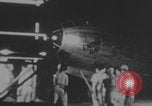
Enola Gay mission to drop “Little Boy” atomic bomb over Hiroshima, Japan (World War 2)
Enola Gay atomic bomb mission over Hiroshima, Japan during World War 2. The Enola Gay, a Boeing B-29 Superfortress bomber, prepares to leave for the Hiroshima mission. Army Armed Forces maintenance men and Enola Gay crew prepare the Enola Gay in Tinian, Northern Mariana Islands, checking their watches as the glance at the horizon. Maintenance men check bomb bay doors before closing. Pilot Colonel Paul Tibbets looks out of cockpit window of Enola Gay. Nose art of Enola Gay is seen. Close up of controls with hand show "starter" and "engine primer." Enola Gay engine starts and one of it propellers turns. The Enola Gay takes off from North Field, in the Northern Mariana Islands. Point of view through B-29 cockpit window as plane speeds down runway. Motion picture cameraman films the take off. The Enola Gay seen overhead as it leaves for Japan. Aerial View of Iwo Jima Island in Japan. The Enola Gay begins slow climb to bombing altitude over Iwo Jima. Crew member, possibly Tibbets, uses a pair of binoculars. Aerial view of Hiroshima. Enola Gay crew check instruments last time before dropping. The Enola Gay begins its bomb run. Crew bombardier turning a dial on a bomb site. View of Enola Gay with bomb bay doors open. Moving gauge pointer as bomb is dropped and seen exiting bomb bay. The Enola Gay banks away from Hiroshima at high speed. Aerial view in color of mushroom cloud forming over Hiroshima after the atomic bomb detonates in the city. (This actually shows the Nagasaki bomb blast from August 9, 1945, not the Hiroshima blast, despite the statements of the narrator in this edited film). Gigantic mushroom cloud from atomic bombing.
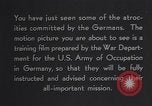
Training film for U.S. troops with the Army of occupation in Germany after world War II
Opens with bell tolling Victory against Germany in World War II. Next, a slate reads: "Victory Leads to Peace," and a farmer is seen with cattle pulling a plow. But narrator says "the problem now is future peace," and a map of Germany is shown overlaid with "Your Job in Germany." A cartoon of a soldier is superimposed on the map, along with one of a World War 1 American soldier and a figure of possible future soldier with similar mission. Camera focuses on parts of German aircraft in a jumbled heap. Closeups of weary defeated German soldiers at end ot World War II. Glimpse of Adolf Hitler speaking and haranguing an audience from a podium in an animated and forceful way. Swastika flags displayed from houses in a quaint German town. Joseph Goebbels, Nazi Reich Minister of Propaganda, at a microphone. Glimpse of a German concentration camp. But as they appear, each of the Nazi elements promptly disappears, showing the scenes without such Nazi symbols and persons. Skeleton remains of bombed buildings. Flower displays. Bucolic German rural countryside and quaint old villages in peaceful settings. Camera focuses on a book titled "German History." Chapter I, titled "Blood and Iron," shows Image of Otto von Bismarck. German troops march in a parade. Narrator states that "under Bismarck, the German empire was built." (He formed the German Empire in 1871, unifying Germany with himself as Imperial Chancellor, while retaining control of Prussia at the same time.) The film shows mounted German lancers as it alludes to Bismarck's campaigns against Denmark in 1867; Austria in 1866; and France, in 1870. Germany's leaders celebrating its status, in 1871, as the mightiest power in Europe. Troops marching and girls dancing nearby. Farmers plowing field with a horse and cow. Classic peaceful rural alpine scenes with local people in agricultural pursuits. A group of local German musicians playing folk music as village people dance outdoors. Back to the book, Kaiser Wilhelm II is shown on Chapter 2, entitled: "Deutschland über Alles." Gathering of German soldiers in Pickelhaube (spiked helmets). A German Big Bertha howitzer firing. German troops marching against Serbia; Russia; and France (with view of war damaged French cathedral). German invasion of Belgium in 1940 (with view of clock tower resting in rubble). German troops seen in Italy, walking past battle-damaged buildings. German Zeppelin dropping bombs on British targets and view of bombed out London neighborhood. Next scene shows a capsized ship with survivors running across its hull. Film slate labels the scene as United States, as if it is a U.S. ship attacked by Germany. (Actually, it is the Austro-Hungarian Battleship, SMS Szent Istvan, torpedoed, by Italian torpedo boats, during World War I.) Next, American soldiers in trench are seen going "over the top" and into "no man's land" on the western front of World War 1. Glimpse through a window of Kaiser Wilhelm II, after defeat of Germany, in 1918. View of Germans in a Beer Garden. Picturesque view of German town. A German orchestra performing. American soldiers marching out of Germany, with flags waving. Back to the history book,as chapter III is revealed, entitled "Today Germany, tomorrow, the world," and featuring Adolf Hitler. German troops invading Austria (where a civilian lies dead on the ground). German troops entering Czechoslovakia (where local people in tears render the Nazi salute). They march into Poland (where a girl weeps over someone, not seen, on the ground). They march into France (where a wounded, bandaged child cries in a bed). Next, is a scene from England, where a British child victim of bombing lies dead in the remains of a shelter. German troops invading Norway, Holland, Denmark, Belgium, Luxembourg and Russia (where a woman tries to rouse a dead woman). They invade Yugoslavia (where women sit near coffins of children) and Greece (where a woman rescues a naked child). A U.S. merchant ship explodes after being torpedoed by a German submarine (unseen). Scenes of destruction with people plucking dead victims from rubble of buildings. American troops invading Normandy, France on D-day, June 6, 1944. Several American soldiers fall to German gunfire on the beach. Wounded American soldiers being transported in jeeps on the battlefield and being placed on landing craft for evacuation. Americans walking past huge piles of destroyed aircraft parts. A landing craft filled with wounded American soldiers. American wounded and dead on a battlefield. Sailors abandoning a burning American ship by jumping into the sea. A sailor picked up in a life boat. A wounded American soldier being dragged from the beachhead at Normandy. Various wounds being treated by U.S. Medical Corps personnel. More scenes of American wounded being moved on stretchers. Scene shifts abruptly to German people folk dancing. Film concludes with question marks about the future.
CRITICALPAST.COM: About Us | Contact Us | FAQs - How to Order | License Agreement | My Account | My Lightboxes | Shopping Cart | Advanced Search | Featured Collections | Website Terms & Conditions | Privacy Policy ©2026 CriticalPast LLC.
License Agreement |
Terms & Conditions |
Privacy Policy
©2026 CriticalPast LLC.