


 Francais
 Deutsch
 Italiano
Refine Your Search
Bruchsal Germany 1945 stock footage and images
- Showing 343 to 348 of 10461 results more
more Hide
Hide
Concentration camp in Landsberg Germany showing guard towers, barracks buildings and a barbed wire fence in Germany.
Landsberg concentration camp in Germany during World War II. Guard towers in the camp area. A board in German reads ' Regards! Storage area ! Standing still and taking pictures are prohibited. Violations will be punished'. Barrack buildings and a barbed wire fence around the camp.
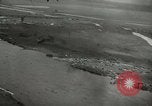
Damaged bridge at Tangermunde, Germany, seen following the surrender of Germany in World War II
View from aircraft flying over the Elbe River, at Tangermunde, after Germany surremdered in World War 2. It flies over the bridge there, which has been severely damaged, with its span touching the water at one point. The aircraft continues flying over nearby rail yards.
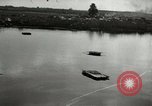
German soldiers and civilians cross damaged bridge at Tangermunde, Germany, after surrender of Germany in World War II
View of the Elbe River, at Tangermunde, after Germany surrendered in World War 2. Objects floating in the water. Closeup shows twisted steel of severely damaged bridge over the river. Some German soldiers are seen crossing the bridge. View of bridge from American-occupied bank of the Elbe. The bridge span is seen to have dropped to touch the water on the other side of the river. Two young women in their underwear, rush along a path in a park on one bank of the river. A German soldier with face bandaged accompanies a young woman along the path. a German soldier smoking a cigarette, stands near a park bench. One of the young women, previously seen, stands, now wrapped in a tarp covering, next to an American tank. The twisted bridge is immediately behind her. She walks past the camera. Scene shifts to people crossing the bridge. A woman carrying a baby in arms hurries past several German soldiers seated on the ground. Next, many women and children are seen with their belongings, trudging past the seated German soldiers. Two women walk past the camera, one wearing a German Army uniform. Scene shifts to opposite side of the Elbe River, where the dropped bridge span touches the water. German soldiers are making their way across on planks placed there temporarily. A German soldier and a woman help an injured soldier on the river bank. German soldiers are gathered beneath the bridge span. Two help a third who is in the water. Two German soldiers, one a Red Cross medic, carry the man, as numerous German civilians surrounding them, look on. Closeup of German soldiers carrying arms, including panzerfaust (hand-held anti-tank weapon), crossing the bridge. They pass an American soldier on the American-occupied side of the Elbe, where they must deposit their arms with others already stacked in piles.

The outgoing President Harry S Truman and the President-elect Dwight D Eisenhower.
President Harry S Truman holds his last official cabinet meeting in Washington DC. The President with his cabinet team seated around a table. He is presented with a chair at the head of the table. Plate on chair reads 'The President April 1945.' New York: President-elect Dwight D Eisenhower with his future official family poses for pictures. The future President with his cabinet seated and standing.
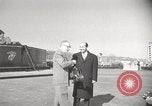
President Eisenhower and Vice President Nixon at the dedication ceremony of the Iwo Jima Memorial in Virginia, United States.
Dedication ceremony of the U.S. Marine Corps War Memorial (The Iwo Jima Memorial) in Arlington, Virginia, United States. Sculptor Felix de Weldon and photographer Joe Rosenthal shake hands with the statue of flag raising in the background. Chaplain says a prayer at a ceremony. Spectators seated with their hats off. President's car comes own the drive way followed by others. U.S. President Dwight D. Eisenhower walks with Navy personnel. Vice President Richard Nixon talks to a Marine who raised the flag at Iwo Jima. Nixon poses with the three survivors of the original flag raising at Iwo Jima. Statue of the flag raising at Iwo Jima. A sign at the base of the statue reads 'Felix de Weldon 1945-1954'.
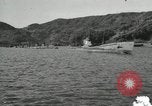
Operation "Road's End" and preparations for destruction of the Japanese submarine fleet moored in Sasebo Bay, Japan
Views from U.S. boat moving among Japanese submarines in Sasebo Bay, Japan, during Operation Road's End, involving the scuttling of the Japanese submarine fleet. Seen are submarines: I-47; I-162; I-156l;n-203;I-158;I-103;107;I-58. An American launch pulls up to I-58 (the sub that sank the USs Indianapolis on July 31, 1945, in the Philippine Sea).Vice-Admiral Robert M. Griffin, Commander of U.S. Naval Forces, Japan, climbs aboard the sub, followed by other members of his party. Admiral Griffin walks the deck of the submarine, followed by a Rear Admiral, who points out some features of the boat to Admiral Griffith. View of the group standing on the deck of the I-58.
CRITICALPAST.COM: About Us | Contact Us | FAQs - How to Order | License Agreement | My Account | My Lightboxes | Shopping Cart | Advanced Search | Featured Collections | Website Terms & Conditions | Privacy Policy ©2026 CriticalPast LLC.
License Agreement |
Terms & Conditions |
Privacy Policy
©2026 CriticalPast LLC.